. 2010 May;120(5):1551-60.
doi: 10.1172/JCI41431. Epub 2010 Apr 1.

Antiangiogenic cancer therapy combined with oncolytic virotherapy leads to regression of established tumors in mice

Affiliations

Antiangiogenic cancer therapy combined with oncolytic virotherapy leads to regression of established tumors in mice

Timothy Kottke et al. J Clin Invest. 2010 May.

Abstract

Clinical trials of oncolytic virotherapy have shown low toxicity and encouraging signs of efficacy. However, it remains critically important to develop methods for systemic viral delivery if such therapies are to be clinically implemented to treat established tumors. In this respect, much effort is being focused on combining oncolytic viruses with standard treatment modalities such as inhibitors of VEGF165 (an alternatively spliced isoform of VEGF-A) signaling, which are widely used to treat several different cancers. Here, we have demonstrated that combining VEGF165 inhibitors with systemic delivery of oncolytic viruses leads to substantial regression and cure of established tumors in immunocompetent mice. We have shown that manipulating VEGF165-mediated signaling by administering VEGF165 to mice harboring mouse melanoma cells that do not express VEGF165 and by administering a VEGF inhibitor and then withdrawing treatment to allow VEGF levels to rebound in mice harboring mouse melanoma cells expressing VEGF165 allows tumor-associated endothelial cells transiently to support viral replication. This approach led to direct tumor cell lysis and triggered innate immune-mediated attack on the tumor vasculature. It also resulted in long-term antitumor effects, even against tumors in which viral replication is poorly supported. Since this combinatorial approach targets the tumor endothelium, we believe these data have direct, wide-ranging, and immediate clinical applicability across a broad range of tumor types.


Figures
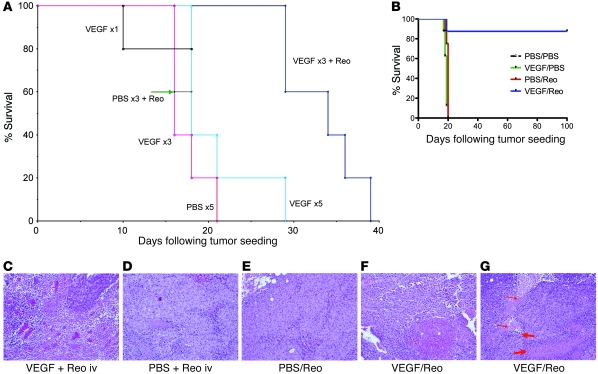
Figure 1
Figure 1. VEGF165 conditions tumors for systemic Reo therapy.
(A) Mice bearing B16 tumors established subcutaneously 7 days previously in C57BL/6 mice (5/group) were treated with a single injection per day for 1, 3, or 5 consecutive days of VEGF165 (1 μg/injection) (VEGF ×1, ×3, or ×5); 5 daily injections of PBS (PBS ×5); 3 daily injections of PBS followed 24 hours later by a single i.v. injection of Reo (5 × 10⁸ TCID50) (PBS ×3 + Reo); or 3 daily injections of VEGF165 followed 24 hours later by a single i.v. injection of Reo (VEGF × 3+Reo). Survival (tumor reaching 1.0 cm in diameter) was followed over time. (B) C57BL/6 mice bearing B16 tumors established 7 days previously in C57BL/6 mice (7–8/group) were treated (days 1–3) with a single injection per day for 3 consecutive days of VEGF165 or PBS, followed 24 hours later (days 4, 5) by a single i.v. injection per day for 2 consecutive days of Reo or PBS. This regimen was then repeated (days 8–12 and 15–19) twice in surviving mice. Survival (tumor reaching 1.0 cm in diameter) was followed over time. (C and D) Subcutaneous B16 tumors were examined histologically after being excised 24 hours following a single i.v. injection of Reo administered 24 hours after a single injection per day for 3 consecutive days of either (C) VEGF165 or (D) PBS. (EG) Subcutaneous B16 tumors were examined histologically after being excised 72 hours following 2 daily i.v. injections of Reo administered 24 hours after a single injection per day for 3 consecutive days of either (E) PBS or (F and G) VEGF165. Intratumoral hemorrhage/necrosis is shown in F. Perivascular immune infiltrates (thick red arrow) and indistinct tortuous blood vessels (thin red arrow) are shown in G. Original magnification, ×20.
Figure 2
Figure 2. VEGF165 sensitization to Reo therapy involves host cells.
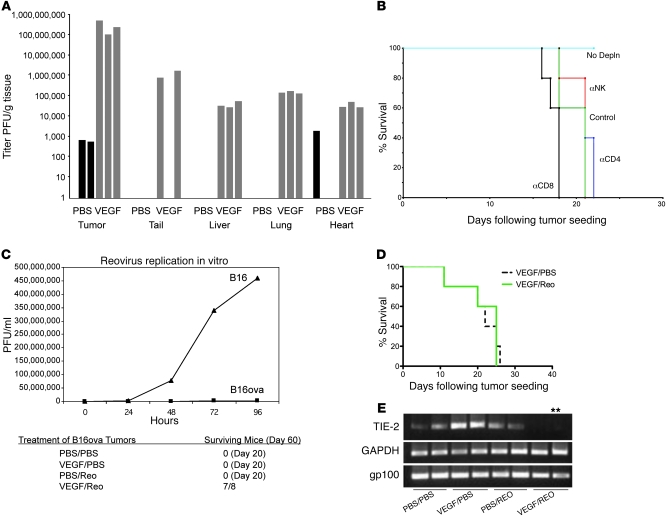
(A) Viral titers from organs of mice bearing 10-day tumors treated with a single injection per day for 3 consecutive days of VEGF165 or PBS, followed 24 hours later by a single i.v. injection per day for 2 consecutive days of Reo. (B) Mice bearing 5-day established B16 tumors (5/group) were left intact (2 i.p. injection of IgG, days 6, 7 [No Depln]) or were depleted of CD8 (α-CD8), CD4 (α-CD4), or NK cells (α-NK). Mice were then treated (days 8–10) with VEGF165 or PBS, followed by Reo or PBS (control) (days 11, 12) as in A. (C) Top panel: viral titers recovered from B16ova or B16 cells infected in vitro with Reo (MOI 0.1). Bottom panel: mice bearing 7-day established B16ova tumors were treated with VEGF165 or PBS (days 1–3), followed by Reo or PBS (days 4, 5) as in A. This regimen was repeated (days 8–12 and 15–19) twice. Mice surviving by day 60 are shown. (D) MyD88-deficient mice bearing 7-day established B16 tumors (7–8/group) were treated with VEGF165 or PBS (days 1–3) followed by Reo or PBS (days 4, 5) as in A. This regimen was repeated (days 8–12 and 15–19) twice. (E) RT-PCR with primers for endothelial TIE2, tumor-specific gp100, or GAPDH using RNA from B16 tumors 48 hours following 2 i.v. injections of PBS or Reo 24 hours following 3 consecutive daily injections of either VEGF165 or PBS. **Positive for TIE2 upon nested PCR.
Figure 3
Figure 3. VEGF165 burst conditions endothelial cells for Reo replication.
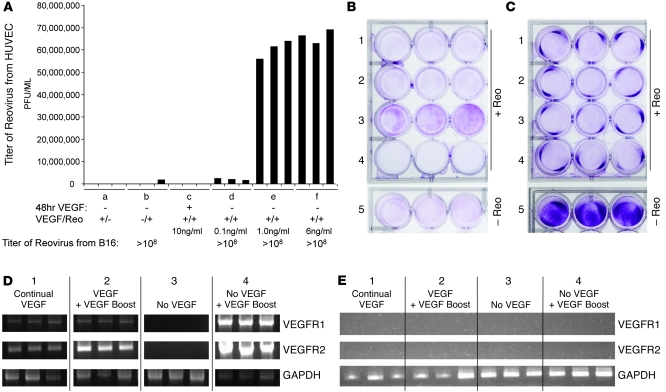
(A) HUVEC or B16 tumor cells were cultured in triplicate wells in vitro for 48 hours in the absence of VEGF165 (see groups a, b, and d–f) or continually with VEGF165 present in the medium (group c) at 10 ng/ml. Cultures were then exposed to mock infection (group a) or to Reo (MOI of 0.1) (groups b–f) in the presence of added VEGF165 at 10 ng/ml (groups a and c) or at 0.1 ng/ml (group d), 1.0 ng/ml (group e), or 6 ng/ml (group f). 72 hours later, viral titers were determined by plaque assay. (B and C) HUVEC (B) or B16 tumor cells (C) were cultured in triplicate wells in vitro for 48 hours continually with VEGF165 present in the medium at 6 ng/ml (rows 1, 2, and 5) or in the absence of VEGF165 (rows 3 and 4). Cultures were then exposed to mock infection (row 5) or to Reo (MOI of 0.1) (rows 1–4) in the presence of no VEGF165 (row 3), VEGF165 at 12 ng/ml (row 2), or VEGF165 at 6 ng/ml (rows 1 and 4). 72 hours later, surviving cells were visualized by crystal violet staining. (D and E) RT-PCR analysis for expression of VEGFR1 and VEGFR2 genes in HUVEC (D) or B16 tumor cells (E) treated as described in treatments 1–4 in B and C above.
Figure 4
Figure 4. Transwell model of tumors separated from virus by an endothelial cell layer.
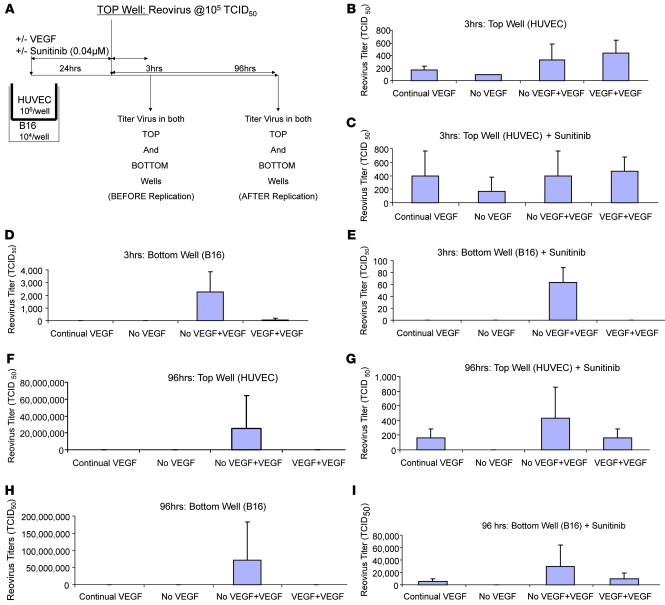
(A) In vitro Transwell model to assess the effects on availability of Reo to B16 tumor cells separated from the virus source by a monolayer of HUVEC. (BE) Transwells were set up in triplicate as shown in A. Triplicate Transwells were cultured for 48 hours continually with VEGF165 present in the medium at 6 ng/ml or in the absence of VEGF165. All cultures were then exposed to Reo (MOI of 0.1) either in the presence of VEGF165 at 6 ng/ml, VEGF165 at 12 ng/ml, or no VEGF165. One set of Transwells was also incubated with sunitinib as an inhibitor (C and E). 3 hours after addition of VEGF165/Reo to the top chamber, cells and supernatants from the top chambers (HUVEC; B and C) or bottom chambers (B16; D and E) were harvested and titered for Reo by plaque assay. (FI) The experiment of AE was repeated except that viral titers were assayed 96 hours following addition of Reo/VEGF165/sunitinib to the Transwells.
Figure 5
Figure 5. Sunitinib inhibition of VEGF-induced Reo replication.
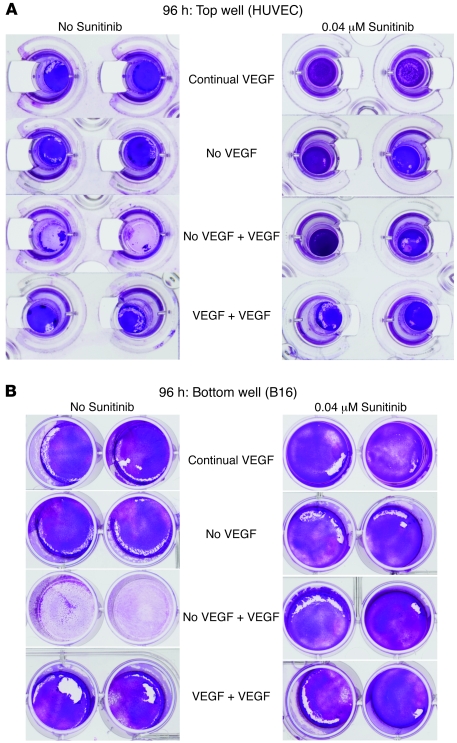
(A and B) At the end of the 96-hour time point (Figure 4, F–I), cytotoxicity to both the HUVEC (upper chamber, A) and B16 tumor cells (lower chamber, B) were visualized by crystal violet staining.
Figure 6
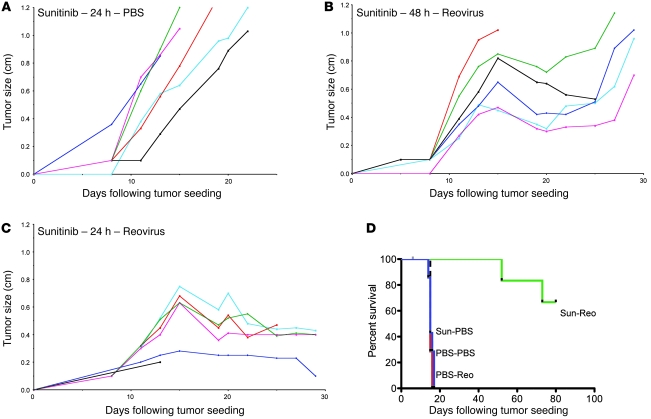
Figure 6. Sunitinib inhibition of VEGF165-producing tumors synergizes with systemic Reo.
(AC) C57BL/6 mice bearing subcutaneous B16-VEGF tumors established 7 days previously were treated (days 1–2) with a single injection per day for 2 consecutive days of sunitinib followed by a single i.v. injection per day for 2 consecutive days of either (A) PBS 24 hours following the last sunitinib injection (days 3, 4); (B) Reo 48 hours following the last sunitinib injection (days 4, 5); or (C) Reo 24 hours following the last sunitinib injection (days 3, 4). (D) C57BL/6 mice bearing B16-VEGF tumors established 7 days previously in C57BL/6 mice (7–8/group) were treated (days 1–3) with a single injection per day for 3 consecutive days of sunitinib or PBS followed 24 hours later (days 4, 5) by a single i.v. injection per day for 2 consecutive days of Reo or PBS. This regimen was then repeated (days 8–12 and 15–19) twice in surviving mice. Survival was followed over time.
Figure 7
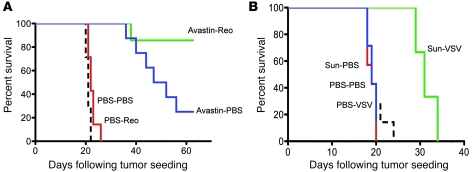
Figure 7. Treatment of VEGF165-producing tumors with VEGF inhibitor and systemic oncolytic virus.
(A) C57BL/6 mice bearing B16-VEGF tumors established 7 days previously in C57BL/6 mice (7–8/group) were treated (days 1–3) with a single injection per day for 3 consecutive days of Avastin or PBS followed 6 and 30 hours later by i.v. injections of Reo or PBS. This regimen was then repeated twice in surviving mice. Survival was followed over time. (B) C57BL/6 mice bearing B16-VEGF tumors established 7 days previously in C57BL/6 mice (7–8/group) were treated (days 1–3) with a single injection per day for 3 consecutive days of sunitinib or PBS followed 24 hours later (days 4, 5) by a single i.v. injection for 2 consecutive days of VSV (5 × 10⁸ PFU) or PBS. This regimen was then repeated (days 8–12 and 15–19) twice in surviving mice. Survival was followed over time.

References

    1. Fisher K. Striking out at disseminated metastases: the systemic delivery of oncolytic viruses. Curr Opin Mol Ther. 2006;8(4):301–313. - PubMed

    1. Harrington K, Vile R. Virus smuggling, tax evasion and tumor assassination. Nat Med. 2006;12(5):507–509. doi: 10.1038/nm0506-507. - DOI - PubMed
    1. Qiao J, et al. Cyclophosphamide facilitates anti tumor efficacy against subcutaneous tumors following intravenous delivery of Reovirus. Clin Cancer Res. 2008;14(1):259–269. doi: 10.1158/1078-0432.CCR-07-1510. - DOI - PMC - PubMed
    1. Fulci G, et al. Cyclophosphamide enhances glioma virotherapy by inhibiting innate immune responses. Proc Natl Acad Sci U S A. 2006;103(34):12873–12878. doi: 10.1073/pnas.0605496103. - DOI - PMC - PubMed
    1. Harrington K, et al. Cells as vehicles for cancer gene therapy: the missing link between targeted vectors and systemic delivery? Hum Gene Ther. 2002;13(11):1263–1280. doi: 10.1089/104303402760128504. - DOI - PubMed

Publication types

Substances