. 2010 Jun;54(6):2283-90.
doi: 10.1128/AAC.01786-09. Epub 2010 Apr 5.

Altered growth, pigmentation, and antimicrobial susceptibility properties of Staphylococcus aureus due to loss of the major cold shock gene cspB

Affiliations

Altered growth, pigmentation, and antimicrobial susceptibility properties of Staphylococcus aureus due to loss of the major cold shock gene cspB

Brea D Duval et al. Antimicrob Agents Chemother. 2010 Jun.

Abstract

An insertional mutation made in the major cold shock gene cspB in Staphylococcus aureus strain COL, a methicillin-resistant clinical isolate, yielded a mutant that displayed a reduced capacity to respond to cold shock and many phenotypic characteristics of S. aureus small-colony variants: a growth defect at 37 degrees C, a reduction in pigmentation, and altered levels of susceptibility to many antimicrobials. In particular, a cspB null mutant displayed increased resistance to aminoglycosides, trimethoprim-sulfamethoxazole, and paraquat and increased susceptibility to daptomycin, teicoplanin, and methicillin. With the exception of the increased susceptibility to methicillin, which was due to a complete loss of the type I staphylococcal cassette chromosome mec element, these properties were restored to wild-type levels by complementation when cspB was expressed in trans. Taken together, our results link a stress response protein (CspB) of S. aureus to important phenotypic properties that include resistance to certain antimicrobials.


Figures
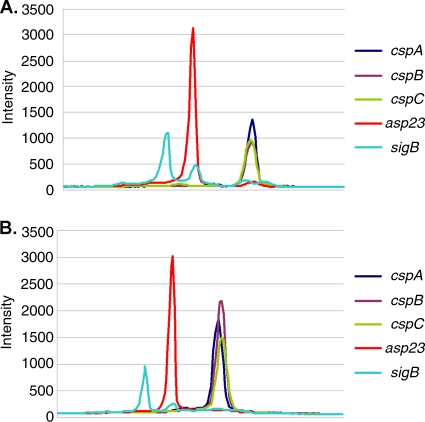
FIG. 1.
FIG. 1.
Densitometry analysis of selected S. aureus transcripts before and after cold stress. RNA was prepared as previously described, and a Bio-Rad ChemiDoc Xl was used to measure the density of electrophoresed cDNA. Intensity is reported in proprietary units as a function of location on the gel. The peak intensity is reported for each transcript at 37°C (A) and after cold shock for 1 h at 15°C (B).
FIG. 2.
FIG. 2.
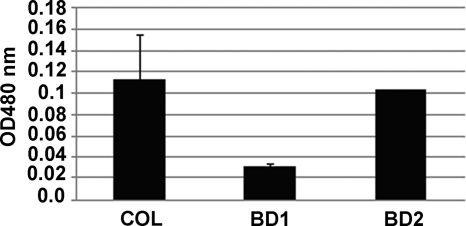
Pigment production by strains COL, BD1, and BD2. Levels of pigment in the test strains were quantified using a methanol extraction protocol adapted from Morikawa et al. (29), and the result for each strain is the average of three different samples done in triplicate. The differences in pigment production between COL and BD1 and between BD1 and BD2 were significant (P value = 0.001).
FIG. 3.
FIG. 3.
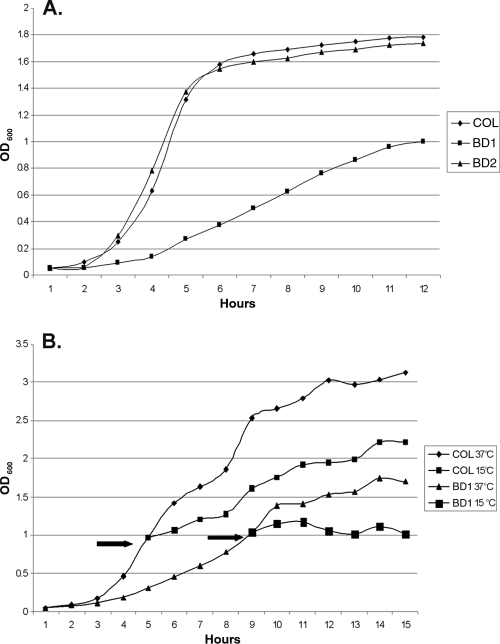
Growth differences observed between staphylococcal strains. (A) Growth experiments were carried out in TSB at 37°C. Growth was monitored each hour by reading the OD600 of cultures started at an identical OD of 0.05. (B) For cold shock experiments, the strains were initially both grown at 37°C until their respective mid-log phases. The cultures were then split (see arrow) into equal volumes and either grown at 37°C or shifted to 15°C. The growth of each culture was monitored hourly by measuring the OD600.
FIG. 4.
FIG. 4.
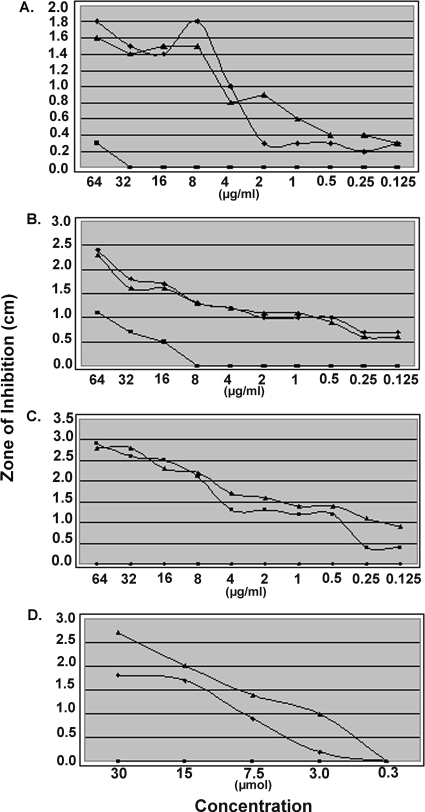
Disk diffusion analysis of selected antimicrobials. Disk diffusion assays were performed as previously described (9). Concentrations of amikacin (A), tobramycin (B), and methicillin (C) are given in μg/ml, while the concentration of paraquat (D) is given in μM. The zone of inhibition is defined as the diameter of the zone of clearance surrounding the impregnated filter disk as measured in centimeters. Zones of inhibition were measured after plates were incubated overnight at 37°C.
FIG. 5.
FIG. 5.
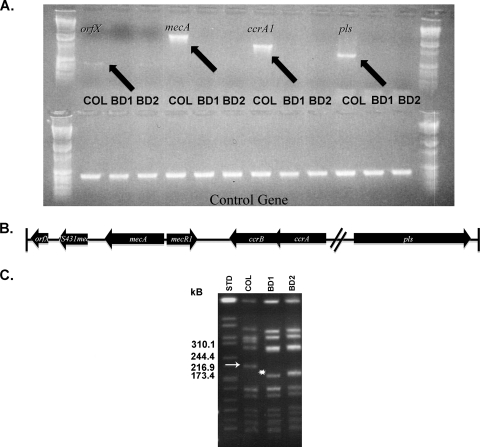
Loss of type I SCCmec genes in strains BD1 and BD2. Selected genes associated with the type I SCCmec were amplified using PCR. As a control, 16S rRNA was amplified in each reaction (A). The primers are listed in Table 2, and each strain used as a template is indicated above. (B) The genetic organization of selected genes on the type I SCCmec. The diagram illustrates the approximate size and orientation of select genes on the cassette and is not drawn to scale. (C) The PFGE SmaI restriction patterns of strains COL, BD1, and BD2 were compared from left to right, and the lane order is the SmaI fragments of the Salmonella serotype Branderup strain H9812 genome (STD), COL, BD1, and BD2. The sizes of SmaI fragments near the 200-kb fragment from COL are indicated. Southern blot analysis was used to confirm the deletion of the type I SCCmec. A DIG-labeled mecA PCR product was used to probe for the fragment containing the SCCmec in the staphylococcal genomes, and this probe hybridized only with the 200-kb SmaI fragment (arrow) from strain COL (data not shown; arrow). The asterisk next to the nearly 170-kb band shows the unique SmaI fragment in strains BD1 and BD2 that likely resulted from loss of the type I SCCmec.

References

    1. Anderson, K. L., C. Roberts, T. Disz, V. Vonstein, K. Hwang, R. Overbeek, P. D. Olson, S. J. Projan, and P. M. Dunman. 2006. Characterization of the Staphylococcus aureus heat shock, cold shock, stringent, and SOS responses and their effects on log-phase mRNA turnover. J. Bacteriol. 188:6739-6756. - PMC - PubMed
    1. Augustin, J., and F. Gotz. 1990. Transformation of Staphylococcus epidermidis and other staphylococcal species with plasmid DNA by electroporation. FEMS Microbiol. Lett. 54:203-207. - PubMed
    1. Autor, A. P. 1974. Reduction of paraquat toxicity by superoxide dismutase. Life Sci. 14:1309-1319. - PubMed
    1. Bae, W., B. Xia, M. Inouye, and K. Severinov. 2000. Escherichia coli CspA-family RNA chaperones are transcription antiterminators. Proc. Natl. Acad. Sci. U. S. A. 97:7784-7789. - PMC - PubMed
    1. Brückner, R. 1997. Gene replacement in Staphylococcus carnosus and Staphylococcus xylosus. FEMS Microbiol. Lett. 151:1-8. - PubMed

Publication types

MeSH terms