


The genes coding for the conversion of carbazole to catechol are flanked by IS6100 elements in Sphingomonas sp. strain XLDN2-5
- PMID: 20368802
- PMCID: PMC2848856
- DOI: 10.1371/journal.pone.0010018
The genes coding for the conversion of carbazole to catechol are flanked by IS6100 elements in Sphingomonas sp. strain XLDN2-5
Abstract
Background: Carbazole is a recalcitrant compound with a dioxin-like structure and possesses mutagenic and toxic activities. Bacteria respond to a xenobiotic by recruiting exogenous genes to establish a pathway to degrade the xenobiotic, which is necessary for their adaptation and survival. Usually, this process is mediated by mobile genetic elements such as plasmids, transposons, and insertion sequences.
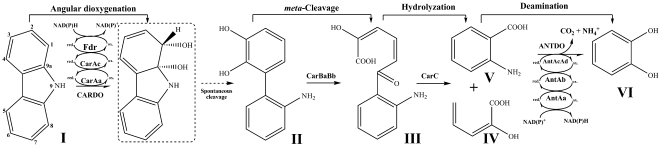
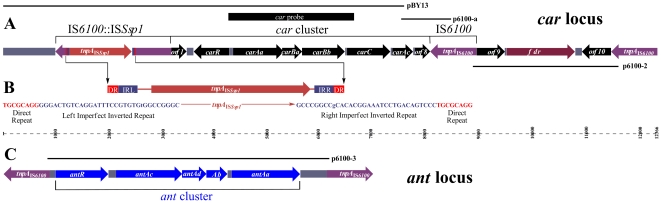
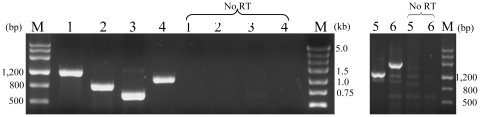
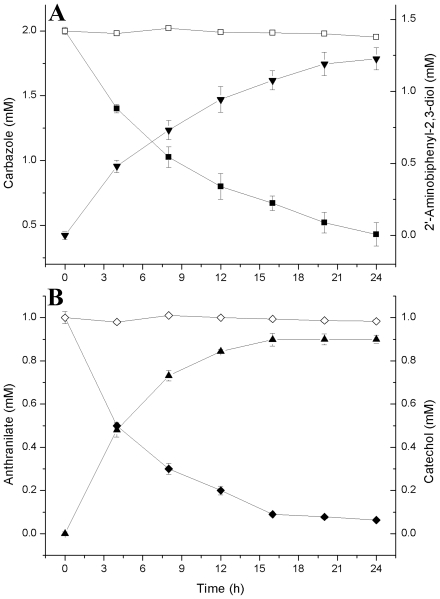
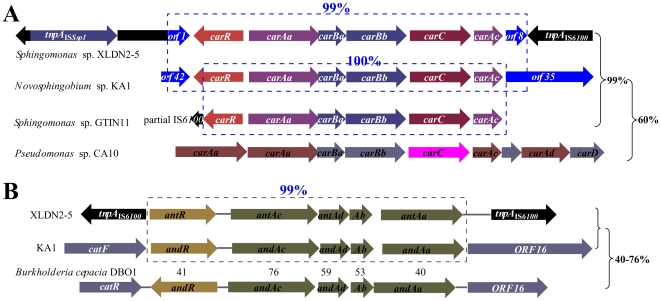
Findings: The genes encoding the enzymes responsible for the degradation of carbazole to catechol via anthranilate were cloned, sequenced, and characterized from a carbazole-degrading Sphingomonas sp. strain XLDN2-5. The car gene cluster (carRAaBaBbCAc) and fdr gene were accompanied on both sides by two copies of IS6100 elements, and organized as IS6100::ISSsp1-ORF1-carRAaBaBbCAc-ORF8-IS6100-fdr-IS6100. Carbazole was converted by carbazole 1,9a-dioxygenase (CARDO, CarAaAcFdr), meta-cleavage enzyme (CarBaBb), and hydrolase (CarC) to anthranilate and 2-hydroxypenta-2,4-dienoate. The fdr gene encoded a novel ferredoxin reductase whose absence resulted in lower transformation activity of carbazole by CarAa and CarAc. The ant gene cluster (antRAcAdAbAa) which was involved in the conversion of anthranilate to catechol was also sandwiched between two IS6100 elements as IS6100-antRAcAdAbAa-IS6100. Anthranilate 1,2-dioxygenase (ANTDO) was composed of a reductase (AntAa), a ferredoxin (AntAb), and a two-subunit terminal oxygenase (AntAcAd). Reverse transcription-PCR results suggested that carAaBaBbCAc gene cluster, fdr, and antRAcAdAbAa gene cluster were induced when strain XLDN2-5 was exposed to carbazole. Expression of both CARDO and ANTDO in Escherichia coli required the presence of the natural reductases for full enzymatic activity.
Conclusions/significance: We predict that IS6100 might play an important role in the establishment of carbazole-degrading pathway, which endows the host to adapt to novel compounds in the environment. The organization of the car and ant genes in strain XLDN2-5 was unique, which showed strong evolutionary trail of gene recruitment mediated by IS6100 and presented a remarkable example of rearrangements and pathway establishments.
Conflict of interest statement
Figures
References
-
- Jha AM, Bharti MK. Mutagenic profiles of carbazole in the male germ cells of Swiss albino mice. Mutat Res. 2002;500:97–101. - PubMed
-
- Kilbane JJ, 2nd, Daram A, Abbasian J, Kayser KJ. Isolation and characterization of Sphingomonas sp. GTIN11 capable of carbazole metabolism in petroleum. Biochem Biophys Res Commun. 2002;297:242–248. - PubMed
-
- Kirimura K, Nakagawa H, Tsuji K, Matsuda K, Kurane R, et al. Selective and continuous degradation of carbazole contained in petroleum oil by resting cells of Sphingomonas sp. CDH-7. Biosci Biotechnol Biochem. 1999;63:1563–1568. - PubMed
-
- Li L, Li Q, Li F, Shi Q, Yu B, et al. Degradation of carbazole and its derivatives by a Pseudomonas sp. Appl Microbiol Biotechnol. 2006;73:941–948. - PubMed
Publication types
MeSH terms
Substances
LinkOut - more resources
Full Text Sources
Other Literature Sources
Molecular Biology Databases
