


A new method for predicting the subcellular localization of eukaryotic proteins with both single and multiple sites: Euk-mPLoc 2.0
- PMID: 20368981
- PMCID: PMC2848569
- DOI: 10.1371/journal.pone.0009931
A new method for predicting the subcellular localization of eukaryotic proteins with both single and multiple sites: Euk-mPLoc 2.0
Abstract
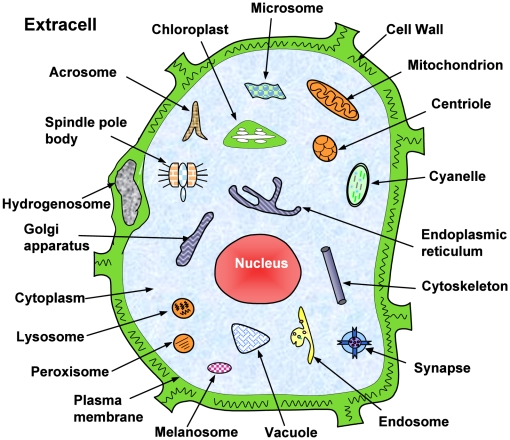
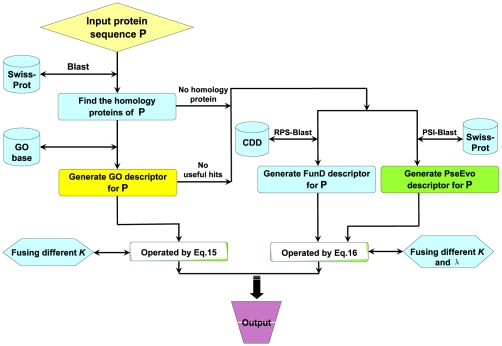
Information of subcellular locations of proteins is important for in-depth studies of cell biology. It is very useful for proteomics, system biology and drug development as well. However, most existing methods for predicting protein subcellular location can only cover 5 to 12 location sites. Also, they are limited to deal with single-location proteins and hence failed to work for multiplex proteins, which can simultaneously exist at, or move between, two or more location sites. Actually, multiplex proteins of this kind usually posses some important biological functions worthy of our special notice. A new predictor called "Euk-mPLoc 2.0" is developed by hybridizing the gene ontology information, functional domain information, and sequential evolutionary information through three different modes of pseudo amino acid composition. It can be used to identify eukaryotic proteins among the following 22 locations: (1) acrosome, (2) cell wall, (3) centriole, (4) chloroplast, (5) cyanelle, (6) cytoplasm, (7) cytoskeleton, (8) endoplasmic reticulum, (9) endosome, (10) extracell, (11) Golgi apparatus, (12) hydrogenosome, (13) lysosome, (14) melanosome, (15) microsome (16) mitochondria, (17) nucleus, (18) peroxisome, (19) plasma membrane, (20) plastid, (21) spindle pole body, and (22) vacuole. Compared with the existing methods for predicting eukaryotic protein subcellular localization, the new predictor is much more powerful and flexible, particularly in dealing with proteins with multiple locations and proteins without available accession numbers. For a newly-constructed stringent benchmark dataset which contains both single- and multiple-location proteins and in which none of proteins has pairwise sequence identity to any other in a same location, the overall jackknife success rate achieved by Euk-mPLoc 2.0 is more than 24% higher than those by any of the existing predictors. As a user-friendly web-server, Euk-mPLoc 2.0 is freely accessible at http://www.csbio.sjtu.edu.cn/bioinf/euk-multi-2/. For a query protein sequence of 400 amino acids, it will take about 15 seconds for the web-server to yield the predicted result; the longer the sequence is, the more time it may usually need. It is anticipated that the novel approach and the powerful predictor as presented in this paper will have a significant impact to Molecular Cell Biology, System Biology, Proteomics, Bioinformatics, and Drug Development.
Conflict of interest statement
Figures

References
-
- Nakashima H, Nishikawa K. Discrimination of intracellular and extracellular proteins using amino acid composition and residue-pair frequencies. J Mol Biol. 1994;238:54–61. - PubMed
-
- Cedano J, Aloy P, P'erez-Pons JA, Querol E. Relation between amino acid composition and cellular location of proteins. J Mol Biol. 1997;266:594–600. - PubMed
-
- Chou KC, Elrod DW. Protein subcellular location prediction. Protein Engineering. 1999;12:107–118. - PubMed
-
- Emanuelsson O, Nielsen H, Brunak S, von Heijne G. Predicting subcellular localization of proteins based on their N-terminal amino acid sequence. Journal of Molecular Biology. 2000;300:1005–1016. - PubMed
-
- Zhou GP, Doctor K. Subcellular location prediction of apoptosis proteins. PROTEINS: Structure, Function, and Genetics. 2003;50:44–48. - PubMed
Publication types
MeSH terms
Substances
LinkOut - more resources
Full Text Sources
Research Materials
