


The HDL hypothesis: does high-density lipoprotein protect from atherosclerosis?
- PMID: 20371550
- PMCID: PMC2903818
- DOI: 10.1194/jlr.R001610
The HDL hypothesis: does high-density lipoprotein protect from atherosclerosis?
Abstract
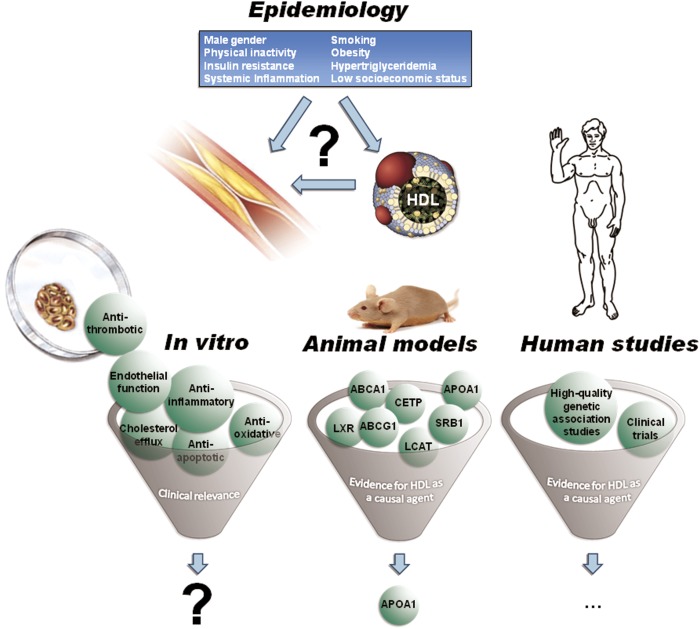
There is unequivocal evidence of an inverse association between plasma high-density lipoprotein (HDL) cholesterol concentrations and the risk of cardiovascular disease, a finding that has led to the hypothesis that HDL protects from atherosclerosis. This review details the experimental evidence for this "HDL hypothesis". In vitro studies suggest that HDL has a wide range of anti-atherogenic properties but validation of these functions in humans is absent to date. A significant number of animal studies and clinical trials support an atheroprotective role for HDL; however, most of these findings were obtained in the context of marked changes in other plasma lipids. Finally, genetic studies in humans have not provided convincing evidence that HDL genes modulate cardiovascular risk. Thus, despite a wealth of information on this intriguing lipoprotein, future research remains essential to prove the HDL hypothesis correct.
Figures
References
-
- Barr D. P., Russ E., Eder H. 1951. Protein-lipid relationships in human plasma. II. In atherosclerosis and related conditions. Am. J. Med. 11: 480–493. - PubMed
-
- Gordon T., Castelli W. P., Hjortland M. C., Kannel W. B., Dawber T. R. 1977. High density lipoprotein as a protective factor against coronary heart disease: The Framingham study. Am. J. Med. 62: 707–714. - PubMed
-
- Gordon D. J., Probstfield J. L., Garrison R. J., Neaton J. D., Castelli W. P., Knoke J. D., Jacobs D. R., Jr., Bangdiwala S., Tyroler H. A. 1989. High-density lipoprotein cholesterol and cardiovascular disease. Four prospective American studies. Circulation. 79: 8–15. - PubMed
-
- Cholesterol Treatment Trialists’ (CTT) Collaborators. 2005. Efficacy and safety of cholesterol-lowering treatment: prospective meta-analysis of data from 90 056 participants in 14 randomised trials of statins. Lancet. 366: 1267–1278. - PubMed
Publication types
MeSH terms
Substances
LinkOut - more resources
Full Text Sources
Medical
Molecular Biology Databases
