


Determinants of survival in patients with brain metastases from cutaneous melanoma
- PMID: 20372154
- PMCID: PMC2856002
- DOI: 10.1038/sj.bjc.6605622
Determinants of survival in patients with brain metastases from cutaneous melanoma
Abstract
Background: This retrospective study aimed to identify prognostic factors in patients with brain metastases from cutaneous melanoma.
Methods: In all, 265 patients under regular screening according to valid national surveillance guidelines were included in the study. Kaplan-Meier analyses were performed to estimate and to compare overall survival. Cox modeling was used to identify independent determinants of the overall survival, which were used in explorative classification and regression tree analysis to define meaningful prognostic groups.
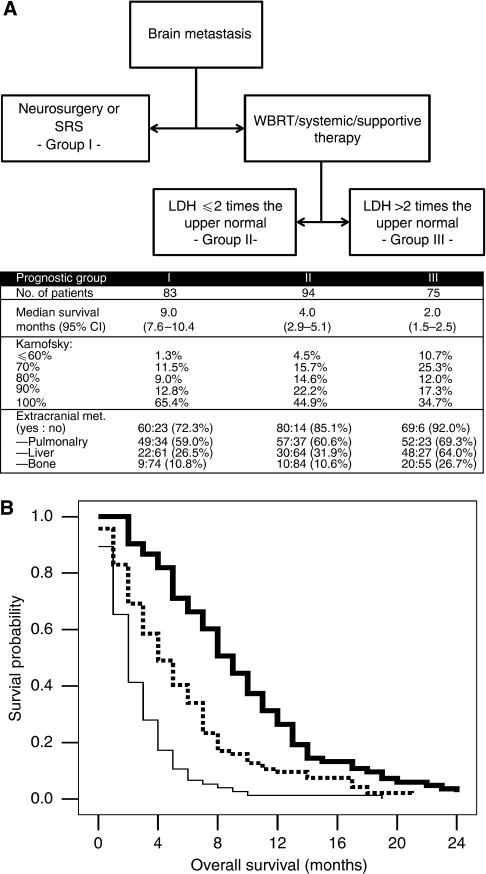
Results: In total, 55.5% of our patients presented with two or less brain metastases, 82.6% had concurrent extracranial metastasis and 64% were asymptomatic and diagnosed during surveillance scans. In all, 36.7% were candidates for local treatment (neurosurgery or stereotactic radiosurgery (SRS)). The median overall survival of the entire collective was 5.0 months (95% confidence interval: 4.3-5.7). Favourable independent prognostic factors were: normal pre-treatment level of serum lactate dehydrogenase (P<0.001), administered therapy (neurosurgery or SRS vs other, P=0.002), number of brain metastases (single vs multiple, P=0.032) and presence of bone metastasis (false vs true, P=0.044). Three prognostic groups with significantly different overall survival were identified. Candidates for local treatment (group I) had the longer median survival (9 months). Remaining patients could be further classified in two groups on the basis of serum lactate dehydrogenase.
Conclusion: Applied treatment and serum lactate dehydrogenase levels were independent predictors of survival of patients with brain metastases from cutaneous melanoma. Patients receiving local therapy have overall survival comparable with general stage IV melanoma patients.
Figures
References
-
- Agarwala SS, Keilholz U, Gilles E, Bedikian AY, Wu J, Kay R, Stein CA, Itri LM, Suciu S, Eggermont AM (2009) LDH correlation with survival in advanced melanoma from two large, randomised trials (Oblimersen GM301 and EORTC 18951). Eur J Cancer 45: 1807–1814 - PubMed
-
- Aoyama H, Shirato H, Tago M, Nakagawa K, Toyoda T, Hatano K, Kenjyo M, Oya N, Hirota S, Shioura H, Kunieda E, Inomata T, Hayakawa K, Katoh N, Kobashi G (2006) Stereotactic radiosurgery plus whole-brain radiation therapy vs stereotactic radiosurgery alone for treatment of brain metastases: a randomized controlled trial. JAMA 295: 2483–2491 - PubMed
-
- Balch CM, Buzaid AC, Soong SJ, Atkins MB, Cascinelli N, Coit DG, Fleming ID, Gershenwald JE, Houghton Jr A, Kirkwood JM, McMasters KM, Mihm MF, Morton DL, Reintgen DS, Ross MI, Sober A, Thompson JA, Thompson JF (2001) Final version of the American Joint Committee on Cancer staging system for cutaneous melanoma. J Clin Oncol 19: 3635–3648 - PubMed
-
- Brand CU, Ellwanger U, Stroebel W, Meier F, Schlagenhauff B, Rassner G, Garbe C (1997) Prolonged survival of 2 years or longer for patients with disseminated melanoma. An analysis of related prognostic factors. Cancer 79: 2345–2353 - PubMed
-
- Buchsbaum JC, Suh JH, Lee SY, Chidel MA, Greskovich JF, Barnett GH (2002) Survival by radiation therapy oncology group recursive partitioning analysis class and treatment modality in patients with brain metastases from malignant melanoma: a retrospective study. Cancer 94: 2265–2272 - PubMed
MeSH terms
Substances
LinkOut - more resources
Full Text Sources
Medical
