


Low levels of realized seed and pollen gene flow and strong spatial genetic structure in a small, isolated and fragmented population of the tropical tree Copaifera langsdorffii Desf
- PMID: 20372183
- PMCID: PMC3183851
- DOI: 10.1038/hdy.2010.33
Low levels of realized seed and pollen gene flow and strong spatial genetic structure in a small, isolated and fragmented population of the tropical tree Copaifera langsdorffii Desf
Abstract
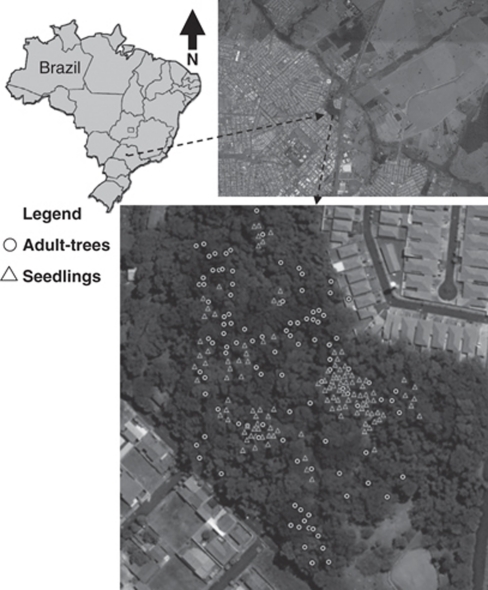
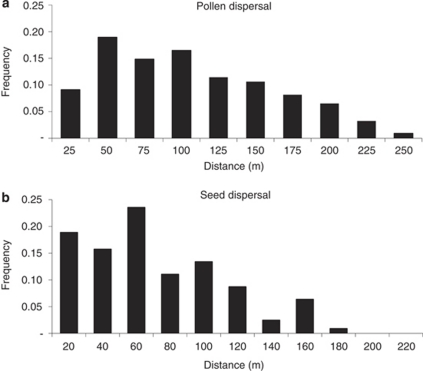
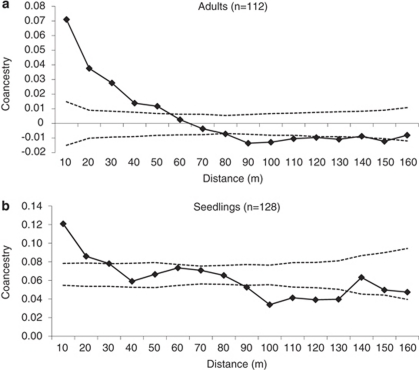
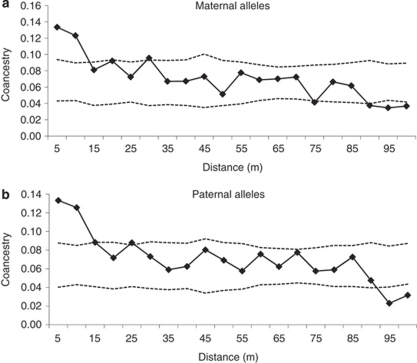
Over the past century, the Brazilian Atlantic forest has been reduced to small, isolated fragments of forest. Reproductive isolation theories predict a loss of genetic diversity and increases in inbreeding and spatial genetic structure (SGS) in such populations. We analysed eight microsatellite loci to investigate the pollen and seed dispersal patterns, genetic diversity, inbreeding and SGS of the tropical tree Copaifera langsdorffii in a small (4.8 ha), isolated population. All 112 adult trees and 128 seedlings found in the stand were sampled, mapped and genotyped. Seedlings had significantly lower levels of genetic diversity (A=16.5±0.45, mean±95% s.e.; H(e)=0.838±0.006) than did adult trees (A=23.2±0.81; H(e)=0.893±0.030). Parentage analysis did not indicate any seed immigration (m(seeds)=0) and the pollen immigration rate was very low (m(pollen)=0.047). The average distance of realized pollen dispersal within the stand was 94 m, with 81% of the pollen travelling <150 m. A significant negative correlation was found between the frequency and distance of pollen dispersal (r=-0.79, P<0.01), indicating that short-distance pollinations were more frequent. A significant SGS for both adults (∼50 m) and seedlings (∼20 m) was also found, indicating that most of the seeds were dispersed over short distances. The results suggested that the spatial isolation of populations by habitat fragmentation can restrict seed and pollen gene flow, increase SGS and affect the genetic diversity of future generations.
Figures
References
-
- Aguilar R, Quesada M, Ashworth L, Herrerias-Diego Y, Loco J. Genetic consequences of habitat fragmentation in plant populations: susceptible signals in plant traits and methodological approaches. Mol Ecol. 2008;17:5177–5188. - PubMed
-
- Aldrich PR, Hamrick JL. Reproductive dominance of pasture trees in a fragmented tropical forest mosaic. Science. 1998;281:103–105. - PubMed
-
- Asuka Y, Tomaru N, Munehara Y, Tani N, Tsumaru Y, Yamamoto S. Half-sib family structure of Fagus crenata samplings in an old-growth beech-dwarf bamboo forest. Mol Ecol. 2005;14:2565–2575. - PubMed
-
- Bacles CFE, Ennos RA. Paternity analysis of pollen-mediated gene flow for Fraxinus excelsior L in a chronically fragmented landscape. Heredity. 2008;101:368–380. - PubMed
-
- Bacles CFE, Lowe A, Ennos R. Effective seed dispersal across a fragmented landscape. Science. 2006;311:628. - PubMed
Publication types
MeSH terms
LinkOut - more resources
Full Text Sources
Miscellaneous
