. 2010 Jun 4;285(23):17574-83.
doi: 10.1074/jbc.M109.095117. Epub 2010 Apr 7.

Euryarchaeal beta-CASP proteins with homology to bacterial RNase J Have 5'- to 3'-exoribonuclease activity

Affiliations

Euryarchaeal beta-CASP proteins with homology to bacterial RNase J Have 5'- to 3'-exoribonuclease activity

Béatrice Clouet-d'Orval et al. J Biol Chem. .

Abstract

In the Archaea only a handful of ribonucleases involved in RNA processing and degradation have been characterized. One potential group of archaeal ribonucleases are homologues of the bacterial RNase J family, which have a beta-CASP metallo-beta-lactamase fold. Here we show that beta-CASP proteins encoded in the genomes of the hyperthermophilic Euryarchaeota Pyrococcus abyssi and Thermococcus kodakaraensis are processive exoribonucleases with a 5' end dependence and a 5' to 3' directionality. We named these enzymes Pab-RNase J and Tk-RNase J, respectively. RNAs with 5'-monophosphate or 5'-hydroxyl ends are preferred substrates of Pab-RNase J, whereas circularized RNA is resistant to Pab-RNase J activity. Degradation of a 3' end-labeled synthetic RNA in which an internal nucleoside is substituted by three ethylene glycol units generates intermediates demonstrating 5' to 3' directionality. The substitution of conserved residues in Pab-RNase J predicted to be involved in the coordination of metal ions demonstrates their importance for ribonuclease activity, although the detailed geometry of the catalytic site is likely to differ from bacterial RNase J. This is the first identification of a 5'-exoribonuclease encoded in the genomes of the Archaea. Phylogenetic analysis shows that euryarchaeal RNase J has been inherited vertically, suggesting an ancient origin predating the separation of the Bacteria and the Archaea.


Figures

FIGURE 1.
FIGURE 1.
Sequence alignment of RNase J1 of B. subtilis (YkqC) with RNase J homologues from P. abyssi (PAB1751) and T. kodakaraensis (TK1469). This alignment was extracted from a large multiple sequence alignment of ∼25 bacterial and 25 euryarchaeal protein sequences (supplemental Fig. S1). The graph at the bottom of the alignment indicates the extent of sequence conservation at each position. Conserved sequence motifs characteristic of the β-CASP proteins are indicated in red (metallo-β-lactamase motifs) and blue (β-CASP motifs). The archaeal loops (green) indicate the position of two insertions that are conserved in the euryarchaeal homologues. The conserved bacterial C-terminal domain (black) is absent in the euryarchaeal homologues.
FIGURE 2.
FIGURE 2.
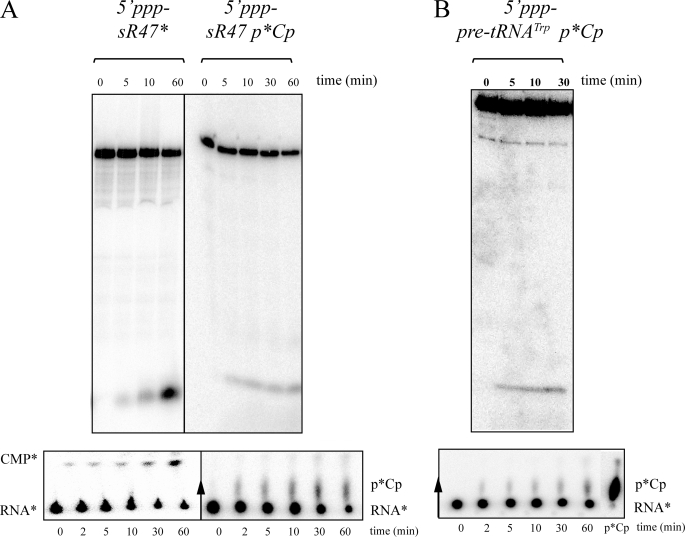
Degradation of 5′-triphosphate RNA substrates by Pab-RNase J. A, degradation of uniformly labeled (5′ppp-sR47*) or 3′ end-labeled (5′ppp-sR47p*Cp) 64-nt sR47 RNA is shown. B, degradation of 3′ end-labeled (5′ppp-pre-tRNATrp p*Cp) 149-nt pre-tRNATrp RNA is shown. Uniformly labeled or 3′ end-labeled RNA (100 fmol) was incubated at 65 °C with 10 nm Pab-RNase J (200 fmol). The asterisk indicates the position of the labeled phosphate in each substrate. The products of the reaction were analyzed by denaturing 8% PAGE (upper panel) and by thin layer chromatography (lower panel). CMP* and GMP* were identified by comparison with the migration positions of nonradioactive CMP and GMP determined by UV shadowing on TLC plates (not shown). Radiolabeled 5′-[32P]pCp was included as a marker (B, lower panel).
FIGURE 3.
FIGURE 3.
Degradation of 5′-monophosphate and 5′-hydroxyl RNA substrates by Pab-RNase J. A, degradation of the 5′ and 3′ end-labeled 64-nt sR47 RNA variants is shown. The nucleotide ladder was generated by alkaline hydrolysis of the 5′ end-labeled sR47 RNA. B, degradation of the 5′ and 3′ end-labeled 149 nt pre-tRNATrp RNA variants is shown. Lane M, markers, 5′ end-labeled digest of Φx174 DNA with HinfI. 5′ or 3′ end-labeled RNAs (100 fmol) were incubated at 65 °C with 10 nm Pab-RNase J (200 fmol). The products of the reaction were analyzed by denaturing 10% PAGE (upper panel) and by thin layer chromatography (lower panel). 5′p* indicates 5′ end-labeled RNA; 5′p-3′p*Cp indicates 5′-monophosphorylated RNA labeled at its 3′ end with pCp; 5′OH-3′p*Cp indicates 5′-hydroxyl RNA labeled at its 3′ end with pCp. Radiolabeled CMP* and GMP* were identified by comparison with the migration positions of nonradioactive CMP and GMP on TLC plates as determined by UV shadowing (A). Radiolabeled 5′-[32P]pCp was loaded on the gel and spotted on TLC plates as a marker (B).
FIGURE 4.
FIGURE 4.
Kinetics of degradation of the substrate variants. The symbols correspond to the following variants of the sR47 substrate: ▴, 5′p*-sR47; ○, 5′ppp-sR47p*Cp; ◇, 5′OH-sR47p*Cp; □, 5′p-sR47p*Cp. 100 fmol of sR47 RNA was incubated at 65 °C with 200 fmol of Pab-RNase J. The fraction of substrate remaining was calculated from quantification of TLC results. The experiment was performed at least in triplicate. The error bars represent S.D.
FIGURE 5.
FIGURE 5.
Degradation of circularized RNAs. Circular RNA was prepared as described under “Experimental Procedures.” 250 fmol of linear (L) or circular (C) 5′ end-labeled 21-nt synthetic RNA (5′p*21-RNA) or sR47 RNA (5′p*sR47) was incubated at 65 °C with 50 nm Pab-RNase J (500 fmol). The products of the reaction were analyzed on denaturing 20% PAGE. The nucleotide ladder was generated by alkaline hydrolysis of linear 5′ end-labeled sR47.
FIGURE 6.
FIGURE 6.
Degradation of the synthetic 21-RNA and 21#-RNA oligonucleotides. The sequence of the synthetic 21-RNA corresponds to the first 21 nucleotides of sR47 (5′-GAUGAAGAUGAUGAGCUCGGC-3′). The synthetic 21#-RNA is interrupted by a nine-atom spacer (9S) formed by three ethylene glycol units replacing the ninth nucleotide from the 5′ end. The RNAs were either 5′ end-labeled (5′p*) or 3′ end-labeled (3′p*Cp). Excess RNA substrate (20 pmol) was incubated at 65 °C with 50 nm Pab-RNase J (1 pmol). The products of the reaction were analyzed by denaturing 20% PAGE. The nucleotide ladder was generated by alkaline hydrolysis of 3′ end-labeled 21#-RNA. The arrow indicates an intermediate in degradation of the 3′ end-labeled 21#-RNA whose size corresponds to the position of the modified linkage.
FIGURE 7.
FIGURE 7.
Phylogenetic trees of the Euryarchaeota and euryarchaeal RNase J. The tree of the Euryarchaeota was constructed from a concatenated sequence of 70 ubiquitous proteins (see “Experimental Procedures”). The euryarchaeal RNase J tree was constructed from sequences that were available at the time of the analysis (supplemental Fig. S1). The trees are arbitrarily rooted. Bootstrap values are indicated at the branch points.

References

    1. Evguenieva-Hackenberg E., Klug G. (2009) Prog. Mol. Biol. Transl. Sci. 85, 275–317 - PubMed
    1. Frank D. N., Pace N. R. (1998) Annu. Rev. Biochem. 67, 153–180 - PubMed
    1. Schiffer S., Rösch S., Marchfelder A. (2002) EMBO J. 21, 2769–2777 - PMC - PubMed
    1. Redko Y., Li de Lasierra-Gallay I., Condon C. (2007) Nat. Rev. Microbiol. 5, 278–286 - PubMed
    1. Li H., Trotta C. R., Abelson J. (1998) Science 280, 279–284 - PubMed

Publication types

LinkOut - more resources