


Urine for the diagnosis of tuberculosis: current approaches, clinical applicability, and new developments
- PMID: 20375787
- PMCID: PMC5454484
- DOI: 10.1097/MCP.0b013e328337f23a
Urine for the diagnosis of tuberculosis: current approaches, clinical applicability, and new developments
Abstract
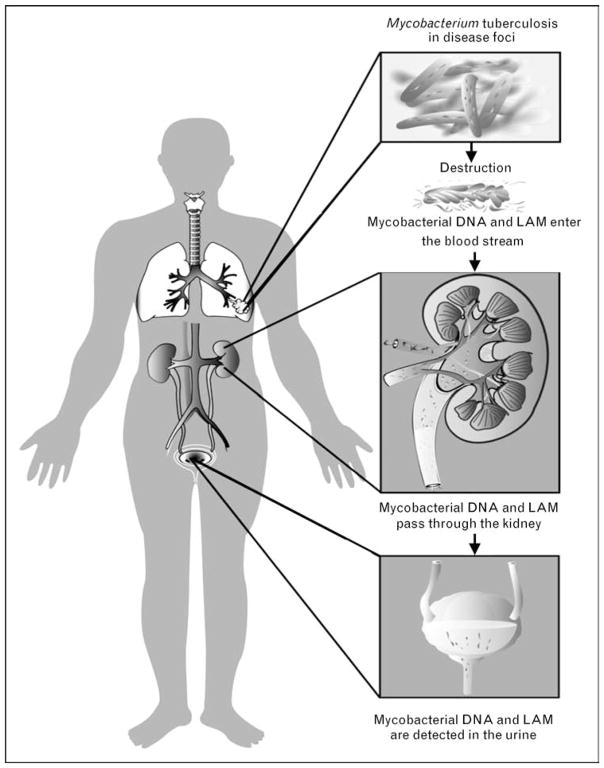
Purpose of review: Urine is increasingly being investigated as a convenient clinical sample for the identification of mycobacterial products for the diagnosis of tuberculosis. The available literature on mycobacterial lipoarabinomannan (LAM) and urine mycobacterial DNA is reviewed.
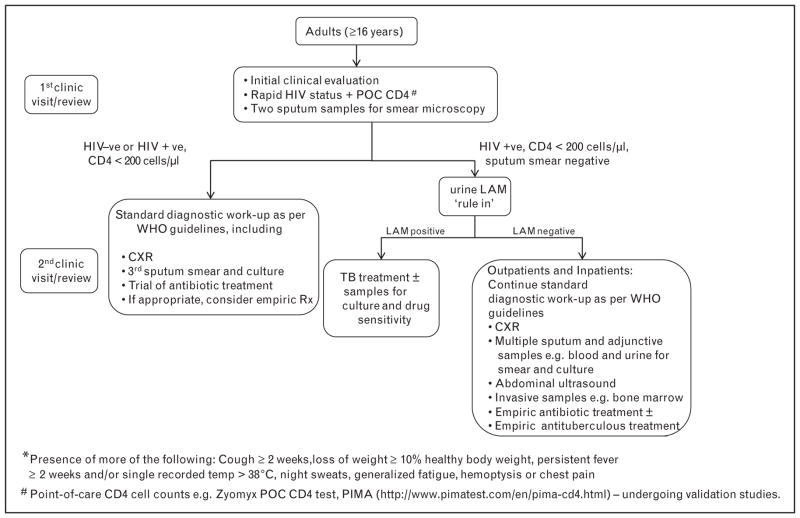
Recent findings: The available data, despite being extracted from heterogeneous clinical populations and different clinical subgroups, indicate that urine LAM has little diagnostic utility in unselected tuberculosis suspects; however, test characteristics improve in HIV-infected patients, particularly those with advanced immunosuppression (CD4 cell count <200 cells/microl). Methodologies for urine PCR for detection of mycobacterial DNA vary across studies and focus is on standardizing assays with respect to specimen collection, assay design, and processing methodology.
Summary: Both the urine LAM and PCR for mycobacterial DNA are being evaluated in different geographical settings. Urine LAM currently offers little utility for the diagnosis of tuberculosis in unselected populations. However, urine LAM appears promising as a diagnostic tool in HIV-infected patients with CD4 cell counts less than 200 cells/microl in different clinical settings. Further developmental studies are required to enhance the performance of the assays, and their usefulness over sputum microscopy in HIV-infected patients with advanced immunosuppression requires definition in large cohort studies.
Figures
References
-
- WHO. Global tuberculosis control: surveillance, planning, financing: WHO report 2009. World Health Organisation; Geneva: 2009.
-
- Harries AD, Hargreaves NJ, Kemp J, et al. Deaths from tuberculosis in sub-Saharan African countries with a high prevalence of HIV-1. Lancet. 2001;357:1519–1523. - PubMed
-
- Garcia GF, Moura AS, Ferreira CS, Rocha MO. Clinical and radiographic features of HIV-related pulmonary tuberculosis according to the level of immunosuppression. Rev Soc Bras Med Trop. 2007;40:622–626. - PubMed
-
- Davies PD, Pai M. The diagnosis and misdiagnosis of tuberculosis. Int J Tuberc Lung Dis. 2008;12:1226–1234. - PubMed
-
- Dheda K, Smit RZ, Badri M, Pai M. T-cell interferon-gamma release assays for the rapid immunodiagnosis of tuberculosis: clinical utility in high-burden vs. low-burden settings. Curr Opin Pulm Med. 2009;15:188–200. - PubMed
Publication types
MeSH terms
Substances
Grants and funding
LinkOut - more resources
Full Text Sources
Other Literature Sources
Medical
Research Materials
