


Estrogen receptor 1 gene (ESR1) is associated with restrictive anorexia nervosa
- PMID: 20375995
- PMCID: PMC3055492
- DOI: 10.1038/npp.2010.49
Estrogen receptor 1 gene (ESR1) is associated with restrictive anorexia nervosa
Abstract
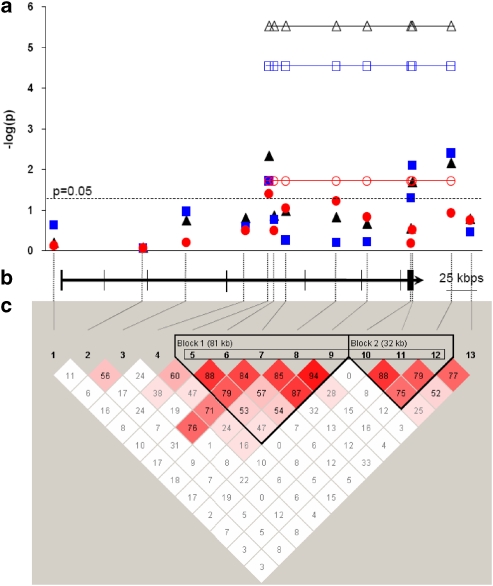
Anorexia nervosa (AN) is a highly heritable young-onset psychiatric illness the etiology of which remains unknown. Estrogen alpha and beta receptors, encoded by ESR1 and ESR2 genes, are involved in food intake regulation and eating behavior, and may have a potential role in AN. We performed a family-based association study of 17 single-nucleotide polymorphisms (SNPs) encompassing ESR1 and ESR2 genes in a cohort of 321 French AN families. We attempted to replicate this finding in a cohort of 41 restrictive AN (RAN) families and in a population-based study of 693 young women. Using the transmission disequilibrium test, a significant over-transmission was detected between AN and ESR1 rs726281 and rs2295193. These SNPs and another among ESR1 were more specifically associated with the RAN subtype (rs726281, p=0.005, odds ratio (OR)=2.1, 95% confidence interval (95% CI)=1.2-3.6; rs3798577, p=0.021, OR=1.6, 95% CI=1.1-2.3; and rs2295193, p=0.007, OR=1.7, 95% CI=1.2-2.5). A large eight-SNPs haplotype of ESR1 gene was also associated with AN (p<0.0001, OR=3.1, 95% CI=1.8-5.1). Association of ESR1 SNPs and RAN was driven by paternal over-transmissions (p<0.0001, OR=3.7, 95% CI=1.9-7.3). Furthermore, we confirmed the preferential paternal over-transmission of the ESR1 rs726281 on the independent German sample of 41 RAN trios (p=0.025, OR=3, 95% CI=1.1-8.3). Finally, rs3798577 was associated with eating disorders in a population-based sample of 693 women (p<0.01). Our findings are strongly in favor of an association between ESR1 polymorphisms and AN. In particular, ESR1 gene confers a high risk of vulnerability to the restrictive subtype of AN, and suggests that the estrogen pathway has to be further analyzed in AN.
Figures
References
-
- American Psychiatric Association 1994Diagnostic and Statistical Manual of Mental Disorders4th edn., Text Revision (DSMIV-TR).American Psychiatric Press: Washington, DC
-
- Bao AM, Hestiantoro A, Van Someren EJ, Swaab DF, Zhou JN. Colocalization of corticotropin-releasing hormone and oestrogen receptor-alpha in the paraventricular nucleus of the hypothalamus in mood disorders. Brain. 2005;128:1301–1313. - PubMed
-
- Barrett JC, Fry B, Maller J, Daly MJ. Haploview: analysis and visualization of LD and haplotype maps. Bioinformatics. 2005;21:263–265. - PubMed
-
- Brambilla F, Monteleone P, Bortolotti F, Dalle Grave R, Todisco P, Faravo A, et al. Persistent amenorrhoea in weight-recovered anorexics: psychological and biological aspects. Psychiatry Res. 2003;118:249–257. - PubMed
Publication types
MeSH terms
Substances
LinkOut - more resources
Full Text Sources
Miscellaneous
