


Determining which automatic digital blood pressure device performs adequately: a systematic review
- PMID: 20376077
- PMCID: PMC2897978
- DOI: 10.1038/jhh.2010.37
Determining which automatic digital blood pressure device performs adequately: a systematic review
Abstract
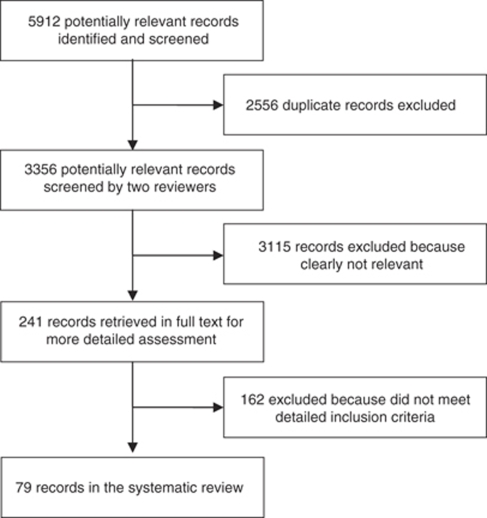
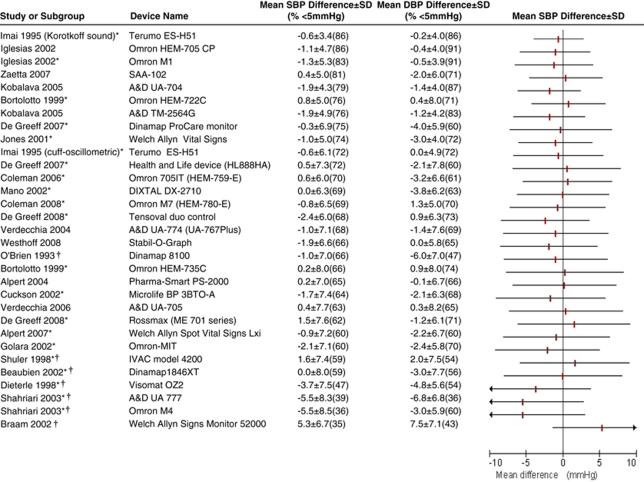
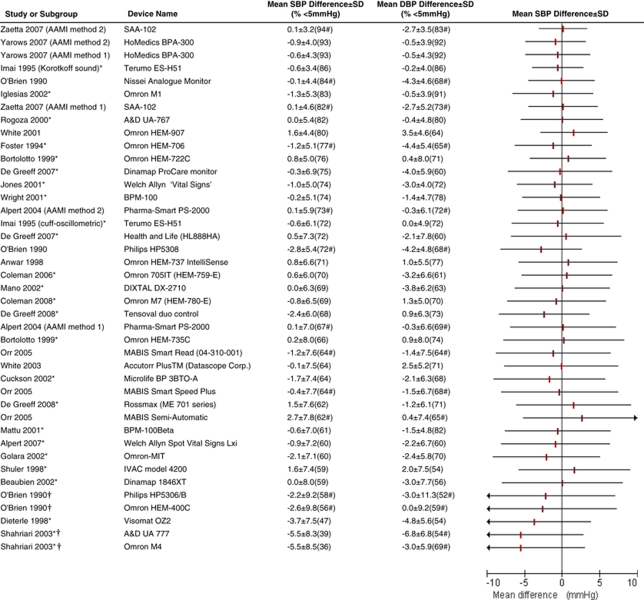
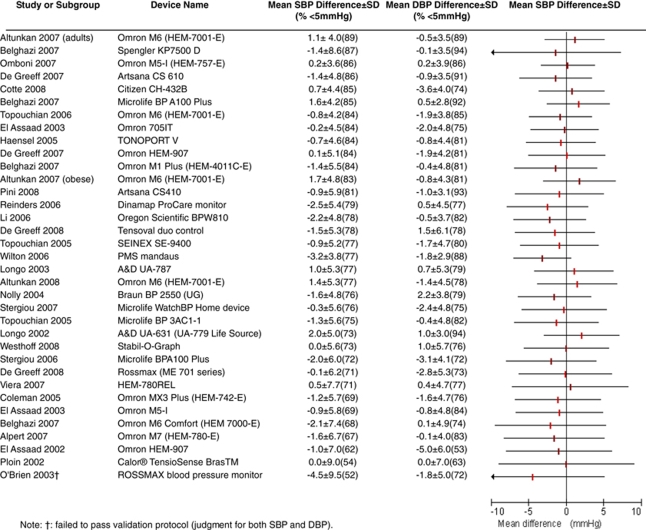
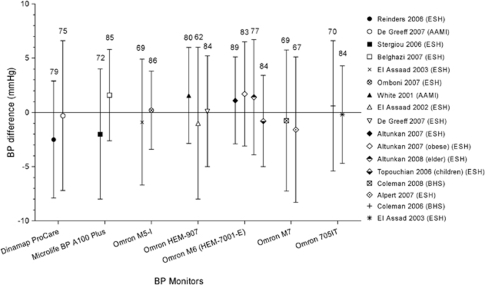
The aim of this study is to systematically examine the proportion of accurate readings attained by automatic digital blood pressure (BP) devices in published validation studies. We included studies of automatic digital BP devices using recognized protocols. We summarized the data as mean and s.d. of differences between measured and observed BP, and proportion of measurements within 5 mm Hg. We included 79 articles (10,783 participants) reporting 113 studies from 22 different countries. Overall, 25/31 (81%), 37/41 (90%) and 34/35 (97%) devices passed the relevant protocols [BHS, AAMI and ESH international protocol (ESH-IP), respectively]. For devices that passed the BHS protocol, the proportion of measured values within 5 mm Hg of the observed value ranged from 60 to 86% (AAMI protocol 47-94% and ESH-IP 54-89%). The results for the same device varied significantly when a different protocol was used (Omron HEM-907 80% of readings were within 5 mm Hg using the AAMI protocol compared with 62% with the ESH-IP). Even devices with a mean difference of zero show high variation: a device with 74% of BP measurements within 5 mm Hg would require six further BP measurements to reduce variation to 95% of readings within 5 mm Hg. Current protocols for validating BP monitors give no guarantee of accuracy in clinical practice. Devices may pass even the most rigorous protocol with as few as 60% of readings within 5 mm Hg of the observed value. Multiple readings are essential to provide clinicians and patients with accurate information on which to base diagnostic and treatment decisions.
Figures
References
-
- O'Brien E, Asmar R, Beilin L, Imai Y, Mallion JM, Mancia G, et al. European Society of Hypertension recommendations for conventional, ambulatory and home blood pressure measurement. J Hypertens. 2003;21 (5:821–848. - PubMed
-
- Wolf-Maier K, Cooper RS, Banegas JR, Giampaoli S, Hense HW, Joffres M, et al. Hypertension prevalence and blood pressure levels in 6 European countries, Canada, and the United States. JAMA. 2003;289 (18:2363–2369. - PubMed
-
- Chobanian AV, Bakris GL, Black HR, Cushman WC, Green LA, Izzo JL, Jr, et al. The Seventh Report of the Joint National Committee on Prevention, Detection, Evaluation, and Treatment of High Blood Pressure: the JNC 7 report. JAMA. 2003;289 (19:2560–2572. - PubMed
-
- ALLHAT Officers and Coordinators for the ALLHAT Collaborative Research Group The Antihypertensive and Lipid-Lowering Treatment to Prevent Heart Attack Trial. Major outcomes in high-risk hypertensive patients randomized to angiotensin-converting enzyme inhibitor or calcium channel blocker vs diuretic: the antihypertensive and lipid-lowering treatment to prevent heart attack trial (ALLHAT) JAMA. 2002;288 (23:2981–2997. - PubMed
-
- Julius S, Jamerson K, Gudbrandsson T, Schork N. White coat hypertension: a follow-up. Clin Exp Hypertens A. 1992;14 (1–2:45–53. - PubMed
Publication types
MeSH terms
Grants and funding
LinkOut - more resources
Full Text Sources
Medical
