


High GUD incidence in the early 20 century created a particularly permissive time window for the origin and initial spread of epidemic HIV strains
- PMID: 20376191
- PMCID: PMC2848574
- DOI: 10.1371/journal.pone.0009936
High GUD incidence in the early 20 century created a particularly permissive time window for the origin and initial spread of epidemic HIV strains
Abstract
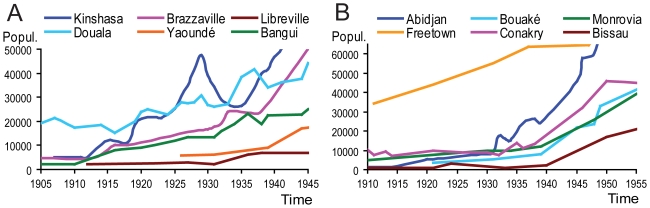
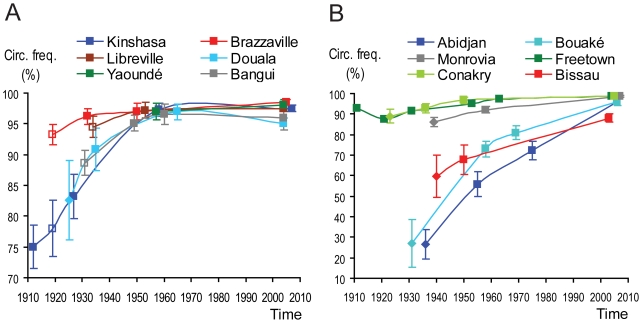
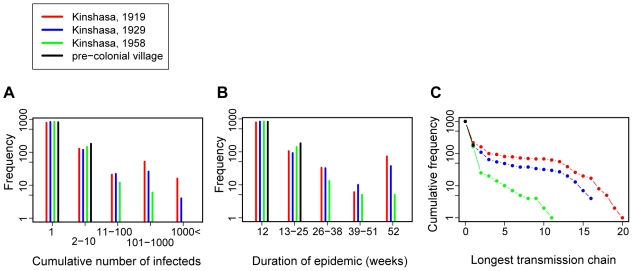
The processes that permitted a few SIV strains to emerge epidemically as HIV groups remain elusive. Paradigmatic theories propose factors that may have facilitated adaptation to the human host (e.g., unsafe injections), none of which provide a coherent explanation for the timing, geographical origin, and scarcity of epidemic HIV strains. Our updated molecular clock analyses established relatively narrow time intervals (roughly 1880-1940) for major SIV transfers to humans. Factors that could favor HIV emergence in this time frame may have been genital ulcer disease (GUD), resulting in high HIV-1 transmissibility (4-43%), largely exceeding parenteral transmissibility; lack of male circumcision increasing male HIV infection risk; and gender-skewed city growth increasing sexual promiscuity. We surveyed colonial medical literature reporting incidences of GUD for the relevant regions, concentrating on cities, suffering less reporting biases than rural areas. Coinciding in time with the origin of the major HIV groups, colonial cities showed intense GUD outbreaks with incidences 1.5-2.5 orders of magnitude higher than in mid 20(th) century. We surveyed ethnographic literature, and concluded that male circumcision frequencies were lower in early 20(th) century than nowadays, with low rates correlating spatially with the emergence of HIV groups. We developed computer simulations to model the early spread of HIV-1 group M in Kinshasa before, during and after the estimated origin of the virus, using parameters derived from the colonial literature. These confirmed that the early 20(th) century was particularly permissive for the emergence of HIV by heterosexual transmission. The strongest potential facilitating factor was high GUD levels. Remarkably, the direct effects of city population size and circumcision frequency seemed relatively small. Our results suggest that intense GUD in promiscuous urban communities was the main factor driving HIV emergence. Low circumcision rates may have played a role, probably by their indirect effects on GUD.
Conflict of interest statement
Figures



Similar articles
-
Circumcision status and incident herpes simplex virus type 2 infection, genital ulcer disease, and HIV infection.AIDS. 2012 Jun 1;26(9):1141-9. doi: 10.1097/QAD.0b013e328352d116. AIDS. 2012. PMID: 22382150 Free PMC article. Clinical Trial.
-
Soap and water prophylaxis for limiting genital ulcer disease and HIV-1 infection in men in sub-Saharan Africa.Genitourin Med. 1993 Aug;69(4):297-300. doi: 10.1136/sti.69.4.297. Genitourin Med. 1993. PMID: 7721293 Free PMC article. Review.
-
Serial human passage of simian immunodeficiency virus by unsterile injections and the emergence of epidemic human immunodeficiency virus in Africa.Philos Trans R Soc Lond B Biol Sci. 2001 Jun 29;356(1410):911-20. doi: 10.1098/rstb.2001.0867. Philos Trans R Soc Lond B Biol Sci. 2001. PMID: 11405938 Free PMC article.
-
HIV-1 DNA shedding in genital ulcers and its associated risk factors in Pune, India.J Acquir Immune Defic Syndr Hum Retrovirol. 1998 Jul 1;18(3):277-81. doi: 10.1097/00042560-199807010-00012. J Acquir Immune Defic Syndr Hum Retrovirol. 1998. PMID: 9665506
-
The causal role for genital ulcer disease as a risk factor for transmission of human immunodeficiency virus. An application of the Bradford Hill criteria.Sex Transm Dis. 1996 Sep-Oct;23(5):429-40. doi: 10.1097/00007435-199609000-00015. Sex Transm Dis. 1996. PMID: 8885077 Review.
Cited by
-
Enhanced heterosexual transmission hypothesis for the origin of pandemic HIV-1.Viruses. 2012 Oct 3;4(10):1950-83. doi: 10.3390/v4101950. Viruses. 2012. PMID: 23202448 Free PMC article.
-
Newly Discovered Archival Data Show Coincidence of a Peak of Sexually Transmitted Diseases with the Early Epicenter of Pandemic HIV-1.Viruses. 2021 Aug 27;13(9):1701. doi: 10.3390/v13091701. Viruses. 2021. PMID: 34578283 Free PMC article.
-
Male Circumcision and the Epidemic Emergence of HIV-2 in West Africa.PLoS One. 2016 Dec 7;11(12):e0166805. doi: 10.1371/journal.pone.0166805. eCollection 2016. PLoS One. 2016. PMID: 27926927 Free PMC article.
-
Beyond the Cut Hunter: A Historical Epidemiology of HIV Beginnings in Central Africa.Ecohealth. 2016 Dec;13(4):661-671. doi: 10.1007/s10393-016-1189-6. Epub 2016 Oct 7. Ecohealth. 2016. PMID: 27718030
-
The Era of Human-Induced Diseases.Ecohealth. 2018 Mar;15(1):8-11. doi: 10.1007/s10393-017-1299-9. Epub 2017 Nov 21. Ecohealth. 2018. PMID: 29164471 Free PMC article. No abstract available.
References
-
- Van Heuverswyn F, Li Y, Neel C, Bailes E, Keele BF, et al. SIV infection in wild gorillas. Nature. 2006;444:164. - PubMed
-
- Hahn BH, Shaw GM, De Cock KM, Sharp PM. AIDS as a zoonosis: scientific and public health implications. Science. 2000;287:607–614. - PubMed
-
- Chitnis A, Rawls D, Moore J. Origin of HIV-1 in colonial French Equatorial Africa? AIDS Res Hum Retroviruses. 2000;16:5–8. - PubMed
Publication types
MeSH terms
LinkOut - more resources
Full Text Sources
Medical
