. 2010 Jul;87(3):1045-55.
doi: 10.1007/s00253-010-2522-6. Epub 2010 Apr 8.

Engineering Corynebacterium glutamicum for isobutanol production

Affiliations

Engineering Corynebacterium glutamicum for isobutanol production

Kevin Michael Smith et al. Appl Microbiol Biotechnol. 2010 Jul.

Abstract

The production of isobutanol in microorganisms has recently been achieved by harnessing the highly active 2-keto acid pathways. Since these 2-keto acids are precursors of amino acids, we aimed to construct an isobutanol production platform in Corynebacterium glutamicum, a well-known amino-acid-producing microorganism. Analysis of this host's sensitivity to isobutanol toxicity revealed that C. glutamicum shows an increased tolerance to isobutanol relative to Escherichia coli. Overexpression of alsS of Bacillus subtilis, ilvC and ilvD of C. glutamicum, kivd of Lactococcus lactis, and a native alcohol dehydrogenase, adhA, led to the production of 2.6 g/L isobutanol and 0.4 g/L 3-methyl-1-butanol in 48 h. In addition, other higher chain alcohols such as 1-propanol, 2-methyl-1-butanol, 1-butanol, and 2-phenylethanol were also detected as byproducts. Using longer-term batch cultures, isobutanol titers reached 4.0 g/L after 96 h with wild-type C. glutamicum as a host. Upon the inactivation of several genes to direct more carbon through the isobutanol pathway, we increased production by approximately 25% to 4.9 g/L isobutanol in a pycldh background. These results show promise in engineering C. glutamicum for higher chain alcohol production using the 2-keto acid pathways.


Figures
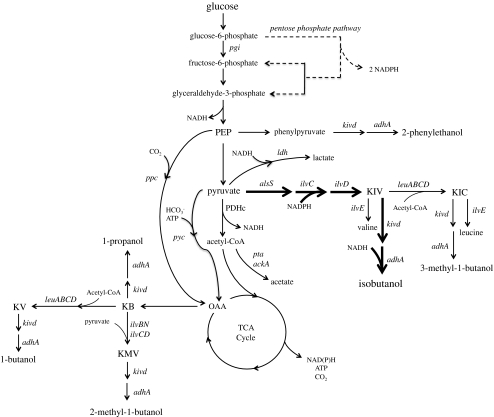
Fig. 1
Fig. 1
2-Keto acid based higher alcohol production pathways from glucose in C. glutamicum. KIV 2-ketoisovalerate, KIC 2-ketoisocaproate, KV 2-ketovalerate, KB 2-ketobutyrate, KMV 2-keto-3-methyl-valerate, PEP phosphoenolpyruvate, OAA oxaloacetate
Fig. 2
Fig. 2
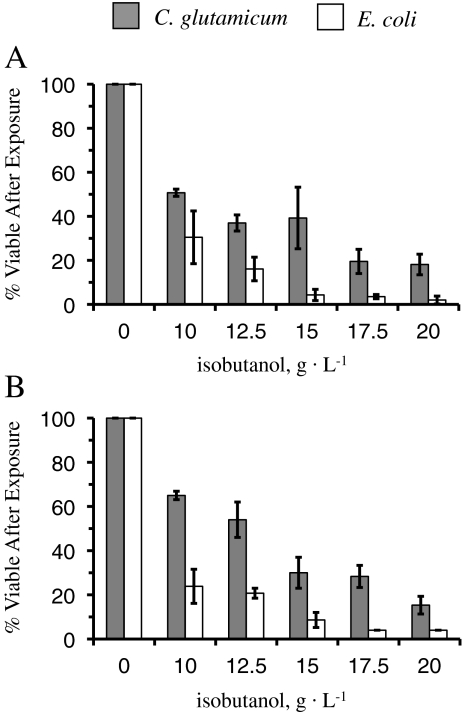
Comparison of isobutanol tolerance of C. glutamicum and E. coli by exposure to isobutanol and calculation of% viable cells remaining. a E. coli and C. glutamicum cultured in LBG medium at 30°C, b E. coli and C. glutamicum cultured in LBG medium at 37°C and CGIII medium at 30°C, respectively. Data shown are the result of three independent experiments
Fig. 3
Fig. 3
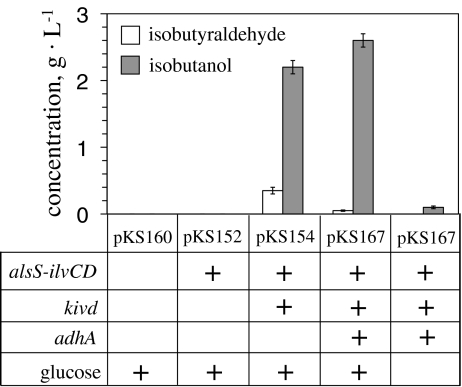
Effects of the systematic overexpression of the synthetic isobutanol pathway on isobutanol production in C. glutamicum. Plus symbols denote overexpression of the indicated gene(s) or the addition of 40 g/L glucose to the media. Data obtained are the result of three independent fermentations
Fig. 4
Fig. 4
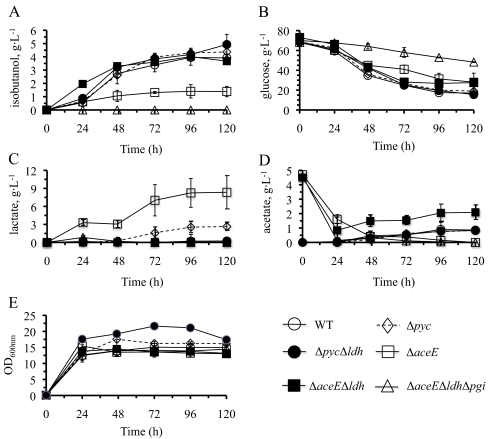
Long-term isobutanol production in C. glutamicum harboring pKS167 (Peftu::alsS-ilvCD-kivd-adhA). a Isobutanol production, b glucose consumption, c lactate production, d acetate production, and e cell growth. WT (open circles), ∆pyc (open diamonds), ∆pycldh (closed circles), ∆aceE (open squares), ∆aceEldh (closed squares), and ∆aceEldhpgi (open triangles). Data obtained are the result of three independent fermentations

References

    1. Arndt A, Eikmanns BJ. The alcohol dehydrogenase gene adhA in Corynebacterium glutamicum is subject to carbon catabolite repression. J Bacteriol. 2007;189:7408–7416. doi: 10.1128/JB.00791-07. - DOI - PMC - PubMed
    1. Atsumi S, Liao JC. Directed evolution of Methanococcus jannaschii citramalate synthase for biosynthesis of 1-propanol and 1-butanol by Escherichia coli. Appl Environ Microbiol. 2008;74:7802–7808. doi: 10.1128/AEM.02046-08. - DOI - PMC - PubMed
    1. Atsumi S, Cann AF, Connor MR, Shen CR, Smith KM, Brynildsen MP, Chou KJ, Hanai T, Liao JC. Metabolic engineering of Escherichia coli for 1-butanol production. Metab Eng. 2008;10:305–311. doi: 10.1016/j.ymben.2007.08.003. - DOI - PubMed
    1. Atsumi S, Hanai T, Liao JC. Non-fermentative pathways for synthesis of branched-chain higher alcohols as biofuels. Nature. 2008;451:86–89. doi: 10.1038/nature06450. - DOI - PubMed
    1. Atsumi S, Li Z, Liao JC. Acetolactate synthase from Bacillus subtilis serves as a 2-ketoisovalerate decarboxylase for isobutanol biosynthesis in Escherichia coli. Appl Environ Microbiol. 2009;75:6306–6311. doi: 10.1128/AEM.01160-09. - DOI - PMC - PubMed

MeSH terms