


doi: 10.1089/aid.2009.0236.
Short communication: Prioritizing communities for HIV prevention in sub-Saharan Africa
Affiliations
- PMID: 20377420
- PMCID: PMC2864052
- DOI: 10.1089/aid.2009.0236
Item in Clipboard
Short communication: Prioritizing communities for HIV prevention in sub-Saharan Africa
AIDS Res Hum Retroviruses.
2010 Apr.
Abstract
HIV prevalence is the most commonly used measure to prioritize communities for HIV prevention. We show that data on two HIV infection stages (early vs. nonearly and late vs. nonlate) allow estimation of two better measures of prevention need: HIV incidence (for prevention of HIV acquisition) and expected probability of HIV transmission in unprotected sex acts between HIV-infected community members and susceptible individuals (for prevention of HIV transmission). The three ranking schemes--by prevalence, incidence, and transmission probability--lead to significantly different community rank orders. Disease stage information should be collected in HIV surveys.
Figures
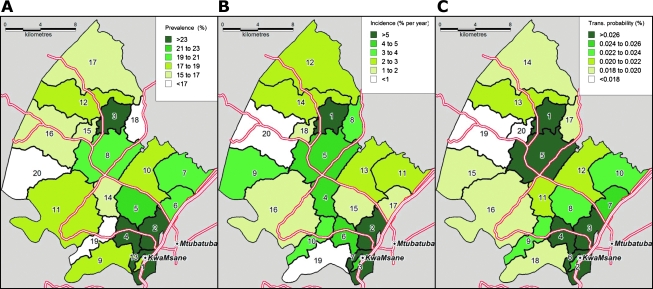
Community ranking according to HIV prevalence, incidence, and transmission probability. Each homogeneously colored area is a traditional Zulu community, Isigodi. The numbers in the areas represent the community rank according to HIV prevalence (A), incidence (B), and transmission probabilities (C).
References
-
- UNAIDS, World Bank: The Global Economic Crisis and HIV Prevention and Treatment Programmes: Vulnerabilities, Impact. UNAIDS; Geneva: 2009.
-
- Bärnighausen T. Bloom DE. Humair S. Human resources for treating HIV/AIDS: Needs, capacities, and gaps. AIDS Patient Care STDS. 2007;21:799–812. - PubMed
-
- Johnson-Masotti AP. Pinkerton SD. Holtgrave DR. Prioritization methods for HIV community planning. J Public Health Manag Pract. 2000;6:72–85. - PubMed
-
- UNAIDS: A Framework for Monitoring and Evaluating HIV Prevention Programmes for Most-at-Risk Populations. UNAIDS; Geneva: 2007.
MeSH terms
Grants and funding
LinkOut - more resources
Full Text Sources
Medical
