Spectrum of HNF1B mutations in a large cohort of patients who harbor renal diseases
- PMID: 20378641
- PMCID: PMC2879303
- DOI: 10.2215/CJN.06810909
Spectrum of HNF1B mutations in a large cohort of patients who harbor renal diseases
Abstract
Background and objectives: Hepatocyte nuclear factor 1beta (HNF1beta) is a transcription factor that is critical for the development of kidney and pancreas. In humans, mutations in HNF1B lead to congenital anomalies of the kidney and urinary tract, pancreas atrophy, and maturity-onset diabetes of the young type 5 and genital malformations.
Design, setting, participants, & measurements: We report HNF1B screening in a cohort of 377 unrelated cases with various kidney phenotypes (hyperechogenic kidneys with size not more than +3 SD, multicystic kidney disease, renal agenesis, renal hypoplasia, cystic dysplasia, or hyperuricemic tubulointerstitial nephropathy not associated with UMOD mutation).
Results: We found a heterozygous mutation in 75 (19.9%) index cases, consisting of a deletion of the whole gene in 42, deletion of one exon in one, and small mutations in 32. Eighteen mutations were novel. De novo mutations accounted for 66% of deletions and 40% of small mutations. In patients who carried HNF1B mutation and for whom we were able to study prenatal ultrasonography (56 probands), isolated hyperechogenic kidneys with normal or slightly enhanced size were the more frequent (34 of 56) phenotype before birth. Various other prenatal renal phenotypes were associated with HNF1B mutations, at a lesser frequency. Diabetes developed in four probands. Hyperuricemia and hypomagnesemia, although not systematically investigated, were frequently associated.
Conclusions: This large series showed that the severity of the renal disease associated with HNF1B mutations was extremely variable (from prenatal renal failure to normal renal function in adulthood) and was not correlated with the genotype.
Figures
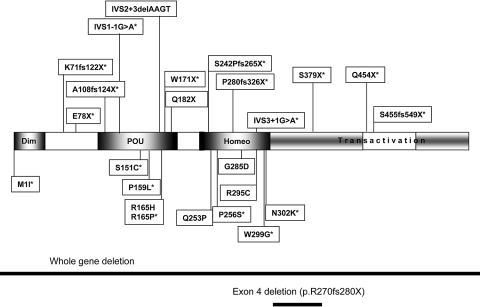

 , missense mutations; ■, truncating mutations) according to the renal phenotype in patients and affected relatives. 1, prenatal hyperechogenic kidneys; 2, hyperechogenic kidney diagnosed after birth; 3, MCD; 4, unilateral renal agenesis; 5, cystic disease; 6, renal hypoplasia; 7, tubulointerstitial nephritis; 8, pyeloureteral junction; 9, pelvic kidney; 10, lack of renal anomaly.
References
-
- Horikawa Y, Iwasaki N, Hara M, Furuta H, Hinokio Y, Cockburn BN, Lindner T, Yamagata K, Ogata M, Tomonaga O, Kuroki H, Kasahara T, Iwamoto Y, Bell GI: Mutation in hepatocyte nuclear factor-1 beta gene (HNF1B) associated with MODY. Nat Genet 17: 384–385, 1997 - PubMed
-
- Zaffanello M, Brugnara M, Franchini M, Fanos V: HNF1B gene mutation leads to nephro-urological defects of unequal severity: an open question. Med Sci Monit 14: RA78–RA86, 2008 - PubMed
-
- Decramer S, Parant O, Beaufils S, Clauin S, Guillou C, Kessler S, Aziza J, Bandin F, Schanstra JP, Bellanné-Chantelot C: Anomalies of the HNF1B gene are the main cause of fetal bilateral hyperechogenic kidneys. J Am Soc Nephrol 18: 923–933, 2007 - PubMed
-
- Haumaitre C, Fabre M, Cormier S, Baumann C, Delezoide AL, Cereghini S: Severe pancreas hypoplasia and multicystic renal dysplasia in two human foetuses carrying novel HNF1beta/MODY5 mutations. Hum Mol Genet 15: 2363–2375, 2006 - PubMed
MeSH terms
Substances
LinkOut - more resources
Full Text Sources
Medical
Miscellaneous