. 2010 May;61(9):2383-93.
doi: 10.1093/jxb/erq072. Epub 2010 Apr 8.

Importance of the alphaC-helix in the cyclic nucleotide binding domain for the stable channel regulation and function of cyclic nucleotide gated ion channels in Arabidopsis

Affiliations

Importance of the alphaC-helix in the cyclic nucleotide binding domain for the stable channel regulation and function of cyclic nucleotide gated ion channels in Arabidopsis

Kimberley Chin et al. J Exp Bot. 2010 May.

Abstract

The involvement of cyclic nucleotide gated ion channels (CNGCs) in the signal transduction of animal light and odorant perception is well documented. Although plant CNGCs have recently been revealed to mediate multiple stress responses and developmental pathways, studies that aim to elucidate their structural and regulatory properties are still very much in their infancy. The structure-function relationship of plant CNGCs was investigated here by using the chimeric Arabidopsis AtCNGC11/12 gene that induces multiple defence responses in the Arabidopsis mutant constitutive expresser of PR genes 22 (cpr22) for the identification of functionally essential residues. A genetic screen for mutants that suppress cpr22-conferred phenotypes identified over 20 novel mutant alleles in AtCNGC11/12. One of these mutants, suppressor S58 possesses a single amino acid substitution, arginine 557 to cysteine, in the alphaC-helix of the cyclic nucleotide-binding domain (CNBD). The suppressor S58 lost all cpr22 related phenotypes, such as spontaneous cell death formation under ambient temperature conditions. However, these phenotypes were recovered at 16 degrees C suggesting that the stability of channel function is affected by temperature. In silico modelling and site-directed mutagenesis analyses suggest that arginine 557 in the alphaC-helix of the CNBD is important for channel regulation, but not for basic function. Furthermore, another suppressor mutant, S136 that lacks the entire alphaC-helix due to a premature stop codon, lost channel function completely. Our data presented here indicate that the alphaC-helix is functionally important in plant CNGCs.


Figures
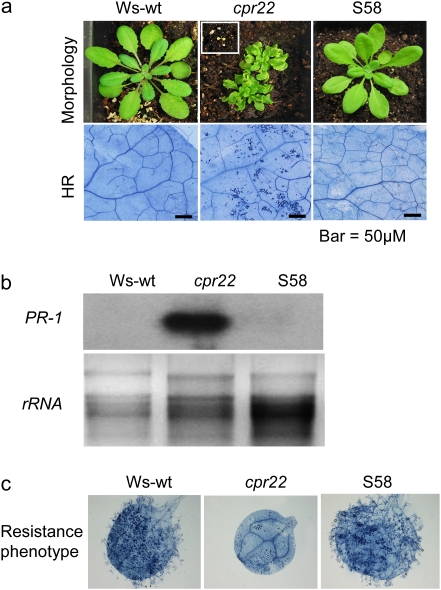
Fig. 1.
Fig. 1.
Characterization of the suppressor mutant S58. (a) Morphological phenotypes and spontaneous HR cell death formation of wilde type (Ws-wt), cpr22, and suppressor 58 (S58). A cpr22 homozygous plant is shown in the white square. Approximately 4-week-old plants were used. (b) Northern blot analysis for PR-1 gene expression in Ws-wt, cpr22, and S58. The samples were taken from approximately 4-week-old plants. Ethidium bromide staining of ribosomal RNA (rRNA; lower panel) served as a loading control. (c) Growth of Hyaloperonospora arabidopsidis, isolate Emwa1 in Ws-wt, cpr22, and S58. Plants were infected by spraying a conidiospore suspension of 106 ml−1 on 7-d-old plants. The Trypan blue analysis 8 d after infection was done to visualize pathogen growth.
Fig. 2.
Fig. 2.
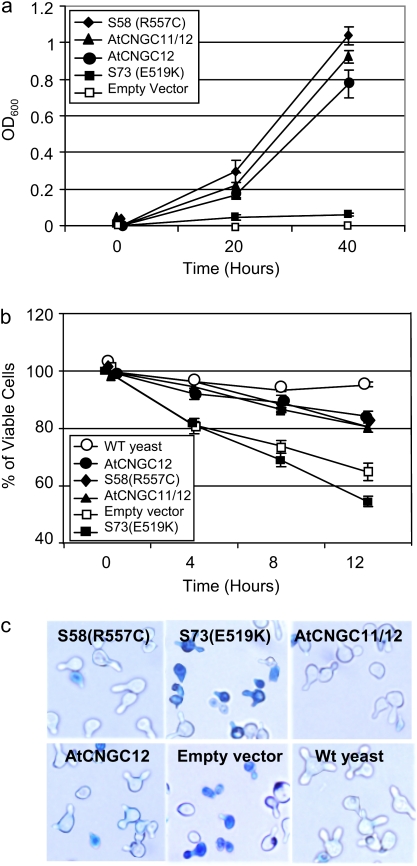
Yeast complementation analyses. (a) AtCNGC11/12, AtCNGC12, and S58 (AtCNGC11/12:R557C) complemented the K+-uptake deficient mutant CY162, whereas S73 and the empty vector did not. Data are the average of three biological repeats ±SE. Student's t test shows significant differences between the empty vector/S73 and AtCNGC11/12, AtCNGC12, or S58 at 20 h and 40 h (P <0.05). Experiments have been performed more than three times with similar results. (b) AtCNGC11/12, AtCNGC12, and S58 (AtCNGC11/12:R557C) complemented the Ca2+-uptake deficient mutant K927, whereas S73 and empty vector did not. Data are the average of three biological repeats ±SE. Student's t test shows significant differences between the empty vector and AtCNGC11/12, AtCNGC12, or S58 at 4, 8, and 12 h (P <0.05).The experiment has been repeated more than three times with comparable results. (c) Yeast viability analysis by Trypan blue staining. AtCNGC11/12, AtCNGC12, and S58 (AtCNGC11/12:R557C) rescued the cell death phenotype of the Ca2+-uptake deficient mutant K927, whereas S73 and empty vector did not. (This figure is available in colour at JXB online.)
Fig. 3.
Fig. 3.
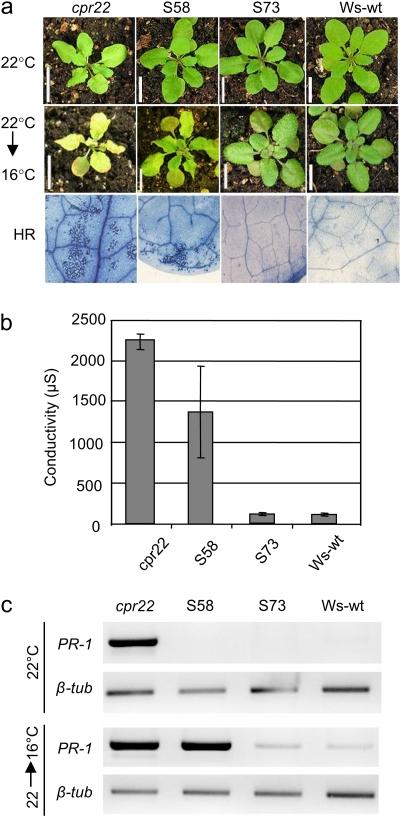
Temperature sensitivity of cpr22-related phenotypes in cpr22, S58, S73, and Ws-wt plants after a shift from 22 °C to 16 °C. (a) S58 displayed cpr22-morphology after temperature shift. cpr22 showed enhancement of HR cell death and S58 induced HR cell death and cpr22-related phenotypes after the temperature shift. No cell death induction was observed in another intragenic suppressor, S73 and Ws-wt under both conditions. Photographs were taken 7 d after the shift. (b) Quantitative analysis of cell death by electrolyte leakage in cpr22, S58, S73, and Ws-wt. Samples were taken 7 d after the shift. (c) RT-PCR analysis of PR-1 gene expression in cpr22, S58, S73, and Ws-wt. Temperature shift induced PR-1 gene expression in S58, whereas no significant change was observed in S73 and Ws-wt. β-tubulin served as a loading control. Samples were taken 7 d after the shift.
Fig. 4.
Fig. 4.
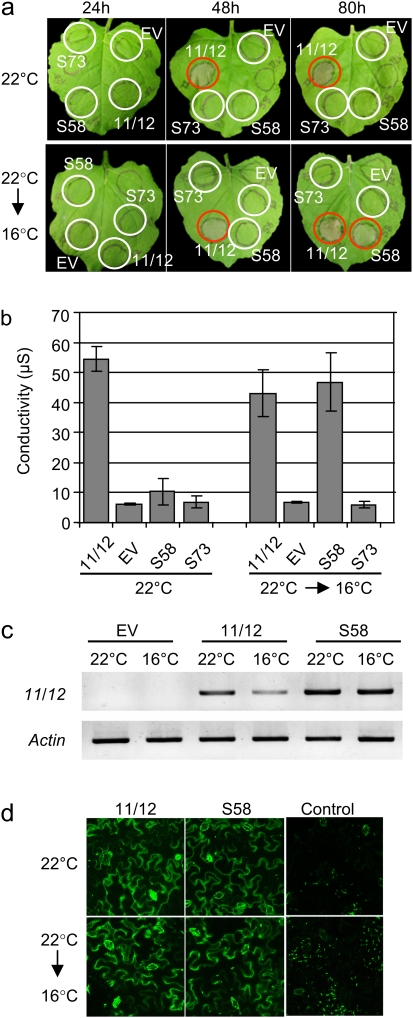
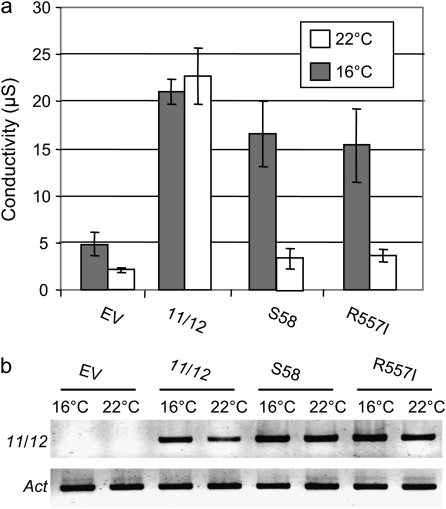
Temperature sensitivity of cell death induction by transient expression of AtCNGC11/12, empty vector, S58 (AtCNGC11/12:R557C), and S73 (AtCNGC11/12:E519K) in Nicotiana benthamiana. (a) Induction of cell death in N. benthamiana 24, 48, and 80 h after Agrobacterium infiltration, either shifted from 22 °C to 16 °C at 12 h after Agrobacterium infiltration (lower panels) or not shifted (upper panels). Cell death induction was observed in the leaf area expressing S58, but not empty vector (EV) or S73 after the temperature shift. Cell death induced by AtCNGC11/12 was enhanced by temperature shift. Red circles indicate HR development. (b) Quantitative analysis of cell death in N. benthamiana by electrolyte leakage of leaf discs. S58 expression induced cell death after the temperature shift, but not empty vector (EV) or S73. Samples were taken 80 h after Agrobacterium infiltration. (c) RT-PCR analysis of leaf discs from N. benthamiana leaves expressing AtCNGC11/12, S58 or empty vector (EV). The temperature shift did not significantly affect gene expression of AtCNGC11/12 or AtCNGC11/12:R557C in N. benthamiana leaf discs. actin served as a loading control. Samples were taken 24 h after Agrobacterium- infiltration (12 h after the shift). (d) The expression of AtCNGC11/12:GFP and AtCNGC11/12:R557C:GFP was not altered by the temperature shift. The samples were taken 30 h after Agrobacterium infiltration. The fluorescence of the GFP-fusion proteins was monitored by confocal microscopy.
Fig. 5.
Fig. 5.
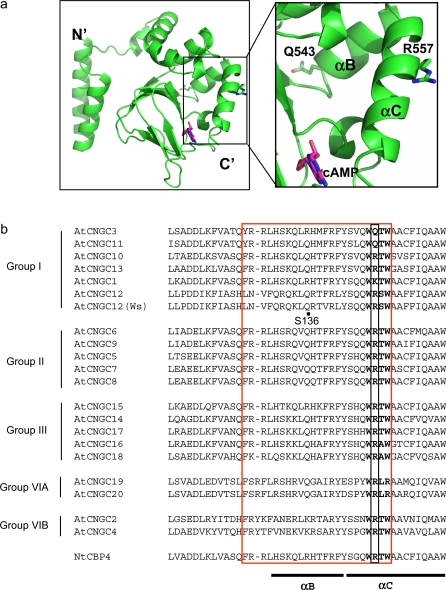
The location of R557 and Q543 in tertiary structure and amino acid sequence alignment. (a) Ribbon diagram of the cytoplasmic C-terminal region of AtCNGC11/12 (AtCNGC12) (left panel) and close-up of the indicated area of the left panel (right panel). R557 is located in the αC-helix and Q543 is located in the αB-helix of the CNBD. cAMP is indicated by pink colour. (b) Alignment of the area of R557 with 20 Arabidopsis CNGCs and tobacco NtCBP4. NCBI:AF079872, AtCNGC3:CAB40128, AtCNGC11:AAD20357, AtCNGC10:AAF73128, AtCNGC13:AAL27505, AtCNGC1:AAK43954, AtCNGC12:AAd23055, AtCNGC12 (Ws ecotype):EU541495, AtCNGC6:AAC63666, AtCNGC9:CAB79774, AtCNGC5:T52573, AtCNGC7:AAG12561, AtCNGC8:NP_173408, AtCNGC15:AAD29827, AtCNGC14:AAD23886, AtCNGC17:CAB81029, ATCNGC16:CAB41138, AtCNGC18:CAC01886, AtCNGC19:BAB02061, AtCNGC20:BAB02062, AtCNGC2:CAC01740, AtCNGC4:T52574. The black box indicates the position of R557. The red box indicates the CaM binding domain and bold characters highlight the critical four amino acids for the CaM binding suggested by Arazi et al. (2000). The location of Q543 (S136) is indicated by a black dot.
Fig. 6.
Fig. 6.
AtCNGC11/12:R557I expression induces cell death similarly to S58 in Nicotiana benthamiana at lower temperature. Quantitative analysis of cell death in N. benthamiana was assessed by electrolyte leakage of leaf discs. AtCNGC11/12:R557I expression induced cell death to the same degree as AtCNGC11/12:R557C (S58) after the temperature shift from 22 °C to 16 °C but not at 22 °C. (b) RT-PCR analysis of leaf discs from N. benthamiana leaves expressing AtCNGC11/12, S58 (AtCNGC11/12:R557C), AtCNGC11/12:R557I or empty vector (EV). The temperature shift did not significantly affect gene expression of AtCNGC11/12, AtCNGC11/12:R557C or AtCNGC11/12:R557I in N. benthamiana leaf discs. Actin (Act) served as a loading control.
Fig. 7.
Fig. 7.
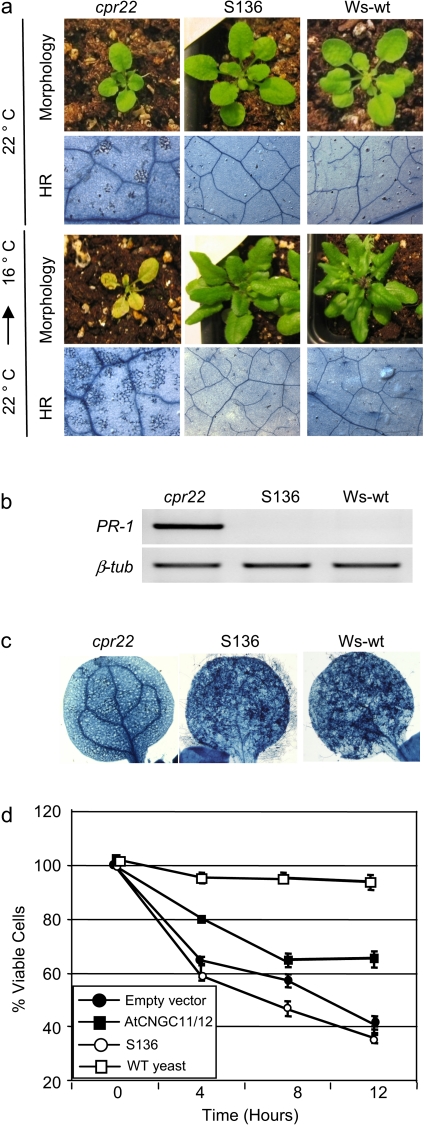
Characterization of the premature stop codon mutant, S136. (a) Morphological and cell death phenotypes of Ws-wt, cpr22 and S136 with and without temperature shift. S136, unlike S58 does not induce cell death after a shift from 22 °C to 16 °C. Samples were taken 7 d after the shift. (b) RT-PCR analysis for PR-1 gene expression in Ws-wt, cpr22, and S136. The samples were taken from approximately 4-week-old plants. β-tublin (β-tub) served as a loading control. (c) Growth of Hyaloperonospora arabidopsidis, isolate Emwa1 in Ws-wt, cpr22, and S136. Plants were infected by spraying a conidiospore suspension of 106 ml−1 on 7-d-old plants. The Trypan blue analysis 8 d after infection was done to visualize pathogen growth. (d) Yeast complementation analysis using the Ca2+-uptake deficient mutant K927. Only AtCNGC11/12 but not S136 (AtCNGC11/12: Q543X) rescued the K927 phenotype. Data are the average of three biological repeats ±SE. Student's t test shows a significant difference between AtCNGC11/12 and both empty vector and S136 at 12 h (P <0.05).The experiment has been repeated more than three times with similar results.

References

    1. Ali R, Zielinski RE, Berkowitz GA. Expression of plant cyclic nucleotide-gated cation channels in yeast. Journal of Experimental Botany. 2006;57:125–138. - PubMed
    1. Arazi T, Sunkar R, Kaplan B, Fromm H. A tobacco plasma membrane calmodulin-binding transporter confers Ni2+ tolerance and Pb2+ hypersensitivity in transgenic plants. The Plant Journal. 1999;20:171–182. - PubMed
    1. Arazi T, Kaplan B, Fromm H. A high-affinity calmodulin-binding site in tobacco plasma-membrane channel protein coincides with a characteristic element of cyclic nucleotide-binding domains. Plant Molecular Biology. 2000;42:591–601. - PubMed
    1. Ausubel FM, Bent R, Kingston RE, Moore DD, Seidman JG, Smith JA, Struhl K. Current protocols in molecular biology. New York: John Wiley and Sons; 1987.
    1. Baxter J, Moeder W, Urquhart W, Shahinas D, Chin K, Christendat D, Kang HG, Angelova M, Kato N, Yoshioka K. Identification of a functionally essential amino acid for Arabidopsis cyclic nucleotide gated ion channels using the chimeric AtCNGC11/12 gene. The Plant Journal. 2008;56:457–469. - PubMed

Publication types

MeSH terms

Substances