


Circulating insulin-like growth factor-1 and its binding protein-3: metabolic and genetic correlates in the community
- PMID: 20378848
- PMCID: PMC2891230
- DOI: 10.1161/ATVBAHA.110.203943
Circulating insulin-like growth factor-1 and its binding protein-3: metabolic and genetic correlates in the community
Abstract
Objective: The metabolic and genetic correlates of circulating insulin-like growth factor-1 (IGF-1) and its main circulating carrier, IGF-1-binding-protein-3 (IGFBP-3), are unclear.
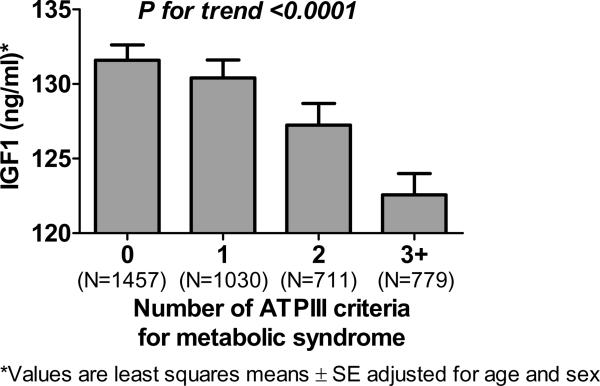
Methods and results: We measured serum IGF-1 and IGFBP-3 concentrations in a sample of the Framingham Heart Study (N=3977, aged 40+/-9 years, 46% male) and evaluated their relations to cardiovascular risk factors using multivariable regression. Serum IGF-1 was inversely correlated with age, body mass index, total cholesterol, the presence of diabetes, alcohol consumption, and glomerular filtration rate (all P<0.01), whereas the ratio of IGF-1:IGFBP-3 was lower in women and inversely related to age, triglycerides, high-density lipoprotein cholesterol, systolic blood pressure, and alcohol consumption (all P<0.0001). Circulating IGF-1 correlated negatively with insulin resistance (homeostatic model assessment) (r=-0.1; P<0.0001) and was lower in participants with more components of the metabolic syndrome (Adult Treatment Panel III criteria) (P<0.0001). Additive genetic factors (heritability) accounted for 43% and 39% of the variation of IGF-1 and IGFBP-3, respectively (both P<10(-27)).
Conclusions: Our cross-sectional observations in a large community-based sample link lower circulating IGF-1 to greater metabolic risk burden and underscore substantial genetic influences on IGF-1 concentrations. Prospective studies are warranted to elucidate whether lower IGF-1 concentrations predict greater metabolic risk longitudinally.
Figures
References
-
- Jones JI, Clemmons DR. Insulin-like growth factors and their binding proteins: biological actions. Endocr Rev. 1995;16:3–34. - PubMed
-
- Delafontaine P, Song YH, Li Y. Expression, regulation, and function of IGF-1, IGF-1R, and IGF-1 binding proteins in blood vessels. Arterioscler Thromb Vasc Biol. 2004;24:435–444. - PubMed
-
- Laughlin GA, Barrett-Connor E, Criqui MH, Kritz-Silverstein D. The prospective association of serum insulin-like growth factor I (IGF-I) and IGF-binding protein-1 levels with all cause and cardiovascular disease mortality in older adults: the Rancho Bernardo Study. J Clin Endocrinol Metab. 2004;89:114–120. - PubMed
-
- Andronico G, Mangano MT, Nardi E, Mule G, Piazza G, Cerasola G. Insulin-like growth factor 1 and sodium-lithium countertransport in essential hypertension and in hypertensive left ventricular hypertrophy. J Hypertens. 1993;11:1097–1101. - PubMed
-
- Landin-Wilhelmsen K, Wilhelmsen L, Lappas G, Rosen T, Lindstedt G, Lundberg PA, Bengtsson BA. Serum insulin-like growth factor I in a random population sample of men and women: relation to age, sex, smoking habits, coffee consumption and physical activity, blood pressure and concentrations of plasma lipids, fibrinogen, parathyroid hormone and osteocalcin. Clin Endocrinol (Oxf) 1994;41:351–357. - PubMed
Publication types
MeSH terms
Substances
Grants and funding
LinkOut - more resources
Full Text Sources
Miscellaneous
