Meta-Analysis
. 2010 Jun;17(3):470-8.
doi: 10.1007/s12350-010-9218-2. Epub 2010 Apr 9.

Diagnostic accuracy of 64-slice computed tomography coronary angiography for the detection of in-stent restenosis: a meta-analysis

Affiliations
Meta-Analysis

Diagnostic accuracy of 64-slice computed tomography coronary angiography for the detection of in-stent restenosis: a meta-analysis

Nazario Carrabba et al. J Nucl Cardiol. 2010 Jun.

Abstract

Background: We sought to evaluate the diagnostic accuracy of 64-slice multi-detector row computed tomography (MDCT) compared with invasive coronary angiography for in-stent restenosis (ISR) detection.

Methods: MEDLINE, Cochrane library, and BioMed Central database searches were performed until April 2009 for original articles. Inclusion criteria were (1) 64-MDCT was used as a diagnostic test for ISR, with >50% diameter stenosis selected as the cut-off criterion for significant ISR, using invasive coronary angiography and quantitative coronary angiography as the standard of reference; (2) absolute numbers of true positive, false positive, true negative, and false negative results could be derived. Standard meta-analytic methods were applied.

Results: Nine studies with a total of 598 patients with 978 stents included were considered eligible. On average, 9% of stents were unassessable (range 0-42%). Accuracy tests with 95% confidence intervals (CIs) comparing 64-MDCT vs invasive coronary angiography showed that pooled sensitivity, specificity, positive and negative likelihood ratio (random effect model) values were: 86% (95% CI 80-91%), 93% (95% CI 91-95%), 12.32 (95% CI 7.26-20.92), 0.18 (95% CI 0.12-0.28) for binary ISR detection. The symmetric area under the curve value was 0.94, indicating good agreement between 64-MDCT and invasive coronary angiography.

Conclusions: 64-MDCT has a good diagnostic accuracy for ISR detection with a particularly high negative predictive value. However, still a relatively large proportion of stents remains uninterpretable. Accordingly, only in selected patients, 64-MDCT may serve as a potential alternative noninvasive method to rule out ISR.


Figures
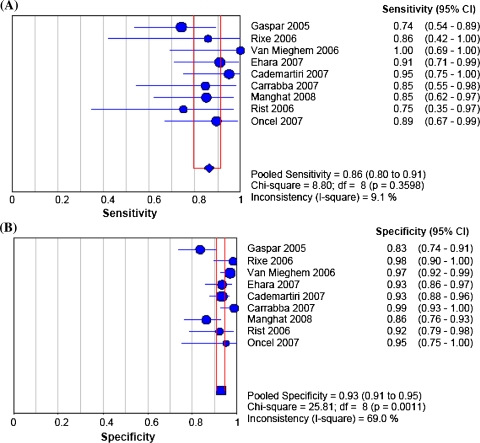
Figure 1
Figure 1
(A) Plot and table of in-stent restenosis detection sensitivity of 64-MDCT vs invasive coronary angiography; (B) plot and table of ISR detection specificity of 64-slice multi-detector computed tomography vs invasive coronary angiography
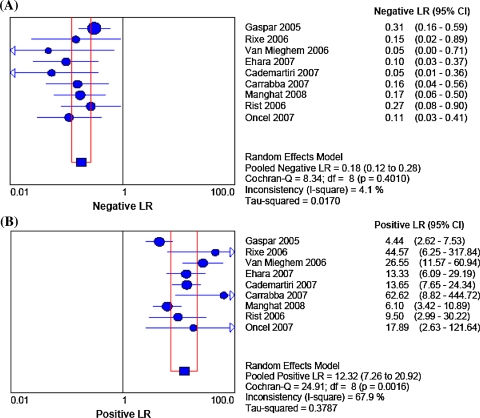
Figure 2
Figure 2
(A) Plot and table of in-stent restenosis detection negative likelihood ratio of 64-MDCT vs invasive coronary angiography; (B) plot and table of in-stent restenosis detection positive likelihood ratio of 64-slice multi-detector computed tomography vs invasive coronary angiography
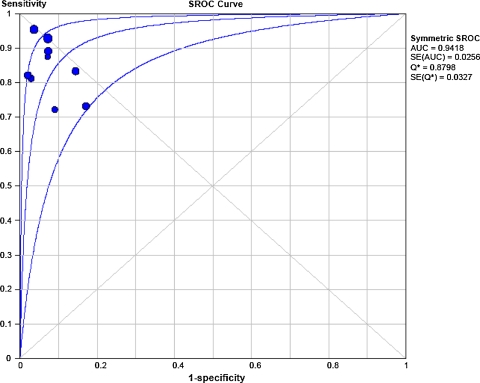
Figure 3
Figure 3
Receiver operator characteristic (ROC) curve analysis on a per stented segment basis (nine studies) comparing 64-MDCT vs invasive coronary angiography. The diagnostic accuracy is shown by plotting 1-specificity against sensitivity, area under curve (AUC), and Q* statistic with their standard errors (SE). The upper and lower lines indicate 95% CIs. SROC Summary receiver operating characteristics

References

    1. Fischman DL, Leon MB, Baim DS, et al. A randomized comparison of coronary-stent placement and balloon angioplasty in the treatment of coronary artery disease. Stent Restenosis Study Investigators. N Engl J Med. 1994;331:496–501. doi: 10.1056/NEJM199408253310802. - DOI - PubMed
    1. Serruys PW, de Jaegere P, Kiemeneij F, et al. A comparison of balloon-expandable-stent implantation with balloon angioplasty in patients with coronary artery disease. Benestent Study Group. N Engl J Med. 1994;331:489–495. doi: 10.1056/NEJM199408253310801. - DOI - PubMed
    1. Stone GW, Ellis SG, Cox DA, et al. A polymer-based, paclitaxel-eluting stent in patients with coronary artery disease. N Engl J Med. 2004;350:221–231. doi: 10.1056/NEJMoa032441. - DOI - PubMed
    1. Morice MC, Serruys PW, Sousa JE, et al. A randomized comparison of a sirolimus-eluting stent with a standard stent for coronary revascularization. N Engl J Med. 2002;346:1773–1780. doi: 10.1056/NEJMoa012843. - DOI - PubMed
    1. Zellweger MJ, Weinbacher M, Zutter AW, et al. Long-term outcome of patients with silent versus symptomatic ischemia six months after percutaneous coronary intervention and stenting. J Am Coll Cardiol. 2003;42:33–40. doi: 10.1016/S0735-1097(03)00557-6. - DOI - PubMed

Publication types