. 2010 May 14;86(5):696-706.
doi: 10.1016/j.ajhg.2010.03.004. Epub 2010 Apr 8.

LRP4 mutations alter Wnt/beta-catenin signaling and cause limb and kidney malformations in Cenani-Lenz syndrome

Affiliations

LRP4 mutations alter Wnt/beta-catenin signaling and cause limb and kidney malformations in Cenani-Lenz syndrome

Yun Li et al. Am J Hum Genet. .

Abstract

Cenani-Lenz syndrome (CLS) is an autosomal-recessive congenital disorder affecting distal limb development. It is characterized mainly by syndactyly and/or oligodactyly and is now shown to be commonly associated with kidney anomalies. We used a homozygosity-mapping approach to map the CLS1 locus to chromosome 11p11.2-q13.1. By sequencing candidate genes, we identified recessive LRP4 mutations in 12 families with CLS. LRP4 belongs to the low-density lipoprotein (LDL) receptor-related proteins (LRPs), which are essential for various developmental processes. LRP4 is known to antagonize LRP6-mediated activation of canonical Wnt signaling, a function that is lost by the identified mutations. Our findings increase the spectrum of congenital anomalies associated with abnormal lipoprotein receptor-dependent signaling.


Figures

Figure 1
Figure 1
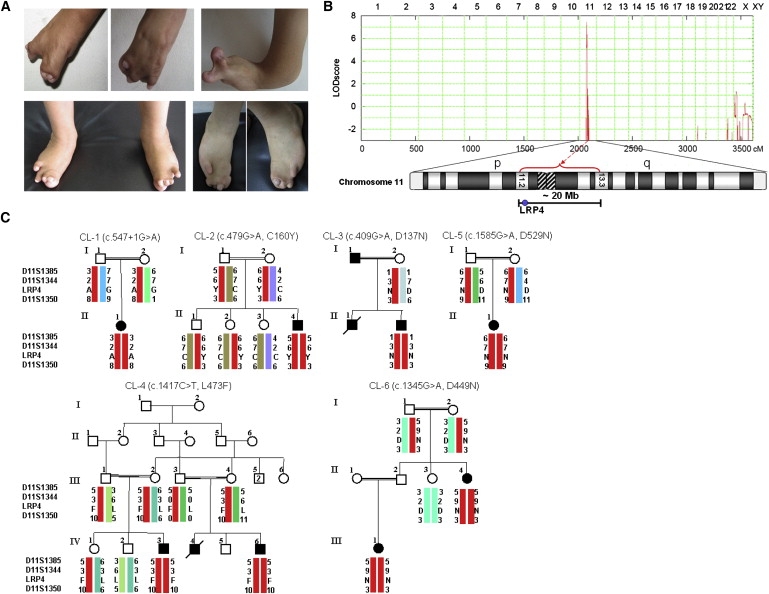
Clinical Findings in Families with CLS and Mapping of the CLS1 Locus (A) Typical hand and feet anomalies seen in CLS patients. (B) Graphical view of additive LOD-score calculations of genome-wide SNP mapping in families CL-1 to CL-6. Ideogram of chromosome 11 showing the localization of linked region. (C) Haplotypes of CLS families included in the initial linkage analysis.
Figure 2
Figure 2
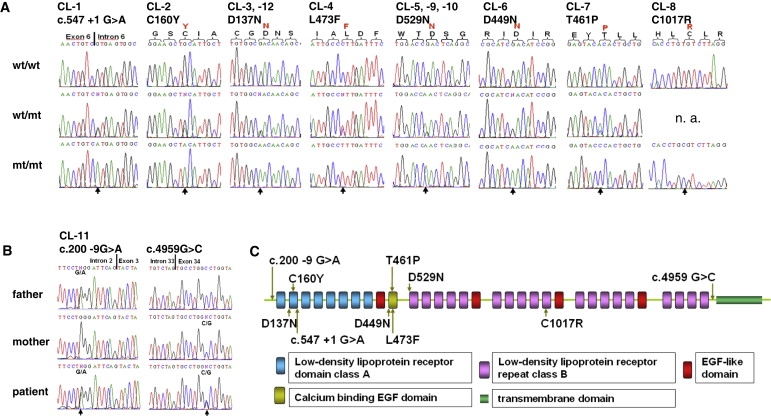
Mutations Identified in LRP4 (A) Electropherograms of identified homozygous LRP4 mutations compared with heterozygous carrier and WT sequences (n.a., not available). (B) Electropherograms of identified compound-heterozygous splice-site mutations in LRP4 causing aberrant splicing and premature protein truncation. (C) Schematic view of LRP4 receptor domains and localization of identified CLS mutations.
Figure 3
Figure 3
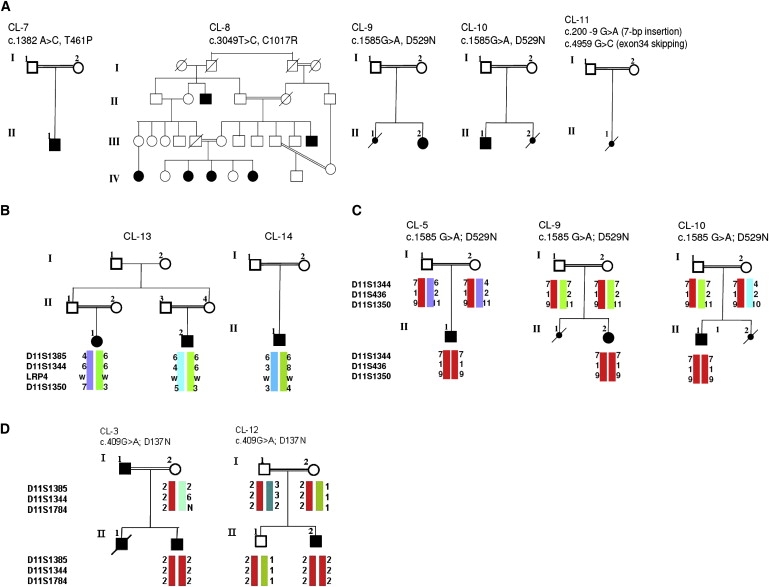
Additional CLS Families and Genetic Heterogeneity (A) Pedigrees of additional CLS families. (B) The LRP4 locus was excluded in families CL-13 and CL-14 by haplotype analysis. (C and D) Identification of an LRP4 founder mutation, p.D529N, in three Turkish CLS families (C) and of p.D137N in two families from Egypt (D). Identical haplotypes are shown in red.
Figure 4
Figure 4
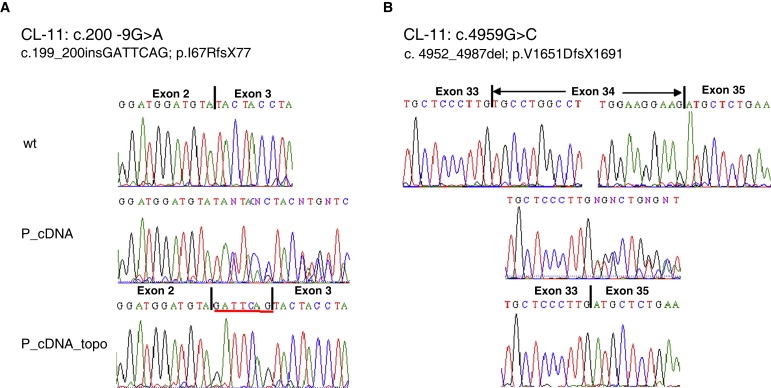
Splicing Effects of Mutations in Family CL-11 (A) Analysis of the heterozygous c.200-9G>A mutation. cDNA sequences of the exon 2-exon 3 boundary of wild-type (wt) and patient cDNA are shown (without [P_cDNA] and after subcloning via the TOPO-Vector system [P_cDNA_topo]). (B) Analysis of the heterozygous c.4959G>C mutation. Electropherograms show the cDNA sequences of LRP4 transcripts encoded by exon 33 to exon 35 of wild-type (wt), and skipping of exon 34 in the patient cDNA.
Figure 5
Figure 5
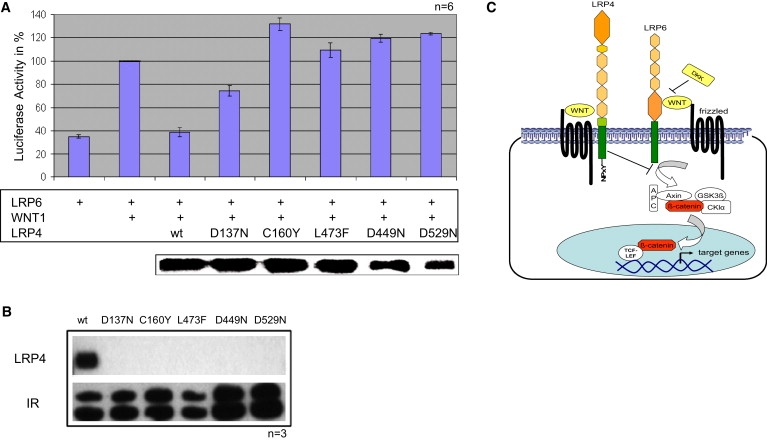
Functional Analysis of LRP4 Missense Mutations (A) Results from the Dual Luciferase Reporter Assay after coexpression of LRP6, WNT1, and wild-type and mutant LRP4 in different combinations. Graph depicting the relative Luciferase activities (mean and standard deviations of six experiments, in triplicate each time). Comparable steady-state expression levels of wild-type and mutant LRP4 proteins are shown by immunoblotting of total lysates after measurement of luciferase activity. (B) Compared to wild-type LRP4 and wild-type insulin receptor (IR), mutant LRP4 proteins are not detectable by cell-surface biotinylation. Results from three independent experiments are shown. (C) Schematic representation of LRP4 function in LRP6-mediated activation of Wnt/β-catenin signaling.

References

    1. Clevers H. Wnt/beta-catenin signaling in development and disease. Cell. 2006;127:469–480. - PubMed
    1. Gordon M.D., Nusse R. Wnt signaling: multiple pathways, multiple receptors, and multiple transcription factors. J. Biol. Chem. 2006;281:22429–22433. - PubMed
    1. Gong Y., Slee R.B., Fukai N., Rawadi G., Roman-Roman S., Reginato A.M., Wang H., Cundy T., Glorieux F.H., Lev D., Osteoporosis-Pseudoglioma Syndrome Collaborative Group LDL receptor-related protein 5 (LRP5) affects bone accrual and eye development. Cell. 2001;107:513–523. - PubMed
    1. Mani A., Radhakrishnan J., Wang H., Mani A., Mani M.A., Nelson-Williams C., Carew K.S., Mane S., Najmabadi H., Wu D., Lifton R.P. LRP6 mutation in a family with early coronary disease and metabolic risk factors. Science. 2007;315:1278–1282. - PMC - PubMed
    1. Styrkarsdottir U., Halldorsson B.V., Gretarsdottir S., Gudbjartsson D.F., Walters G.B., Ingvarsson T., Jonsdottir T., Saemundsdottir J., Snorradóttir S., Center J.R. New sequence variants associated with bone mineral density. Nat. Genet. 2009;41:15–17. - PubMed

Publication types

MeSH terms