


Longitudinal changes in disabled husbands' and wives' receipt of care
- PMID: 20382664
- PMCID: PMC2937250
- DOI: 10.1093/geront/gnq028
Longitudinal changes in disabled husbands' and wives' receipt of care
Abstract
Purpose of the study: This study contrasts 2-year adjustments in disabled husbands' and wives' amount of received care following both worsening and recovery in personal (activities of daily living [ADLs]) and routine care (instrumental activities of daily living [IADLs]) disability.
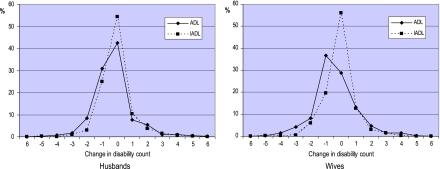
Design and methods: Using longitudinal data on 789 husbands and 778 wives from the Health and Retirement Study (2000 and 2002), changes in marital partners' monthly hours of spousal and nonspousal care were jointly modeled using bivariate Tobit models. In addition, asymmetry in the magnitude of responses to worsening and improvement of function was examined.
Results: Disabled husbands receive more hours of spousal and nonspousal care following worsening in ADL function than wives. Conversely, disabled wives lose more spousal and nonspousal care hours following improvements in ADL disability than husbands. Moreover, wives recovering in ADL function lose more hours of spousal care than they receive following worsening in personal care disability. There is no evidence of corresponding gender differences in the dynamics of assistance received following changes in IADL function.
Implications: Compared with husbands, disabled wives are disadvantaged in the adjustment of their personal care hours. Although disabled married community residents receive more hours of care than their unmarried counterparts, there are important gender differences in the advantages offered by marriage.
Figures
References
-
- Allen SM. Gender differences in spousal caregiving and unmet need for care. Journal of Gerontology. 1994;49:S187–S195. - PubMed
-
- Allen SM, Goldscheider F, Ciambrone DA. Gender roles, marital intimacy, and nomination of spouse as primary caregiver. The Gerontologist. 1999;39:150–158. - PubMed
-
- Amemiya T. Tobit models: A survey. Journal of Econometrics. 1984;24:3–61.
-
- Boaz RF, Hu J. Determining the amount of help used by disabled elderly persons at home: The role of coping resources. Journal of Gerontology Social Sciences. 1997;52:S317–S324. - PubMed
-
- Breen R. Regression models: Censored, sample-selected, or truncated data. Thousand Oaks, CA: Sage Publications; 1996.
Publication types
MeSH terms
LinkOut - more resources
Full Text Sources
Medical
Research Materials
