Review
. 2010 Jul;460(2):481-94.
doi: 10.1007/s00424-010-0826-0. Epub 2010 Apr 10.

Inositol trisphosphate receptor Ca2+ release channels in neurological diseases

Affiliations
Review

Inositol trisphosphate receptor Ca2+ release channels in neurological diseases

J Kevin Foskett. Pflugers Arch. 2010 Jul.

Abstract

The modulation of cytoplasmic Ca2+ concentration by release from internal stores through the inositol trisphosphate receptor (InsP3R) Ca2+ release channel is a ubiquitous signaling system involved in the regulation of numerous processes. Because of its ubiquitous expression and roles in regulating diverse cell physiological processes, it is not surprising that the InsP3R has been implicated in a number of disease states. However, relatively few mutations in InsP3R genes have been identified to date. Here, I will discuss mutations in the type 1 InsP3R that have been discovered by analyses of human patients and mice with neurological disorders. In addition, I will highlight diseases caused by mutations in other genes, including Huntington's and Alzheimer's diseases and some spinocerebellar ataxias, where the mutant proteins have been found to exert strong influences on InsP3R function that may link InsP3R to disease pathogenesis.


Figures
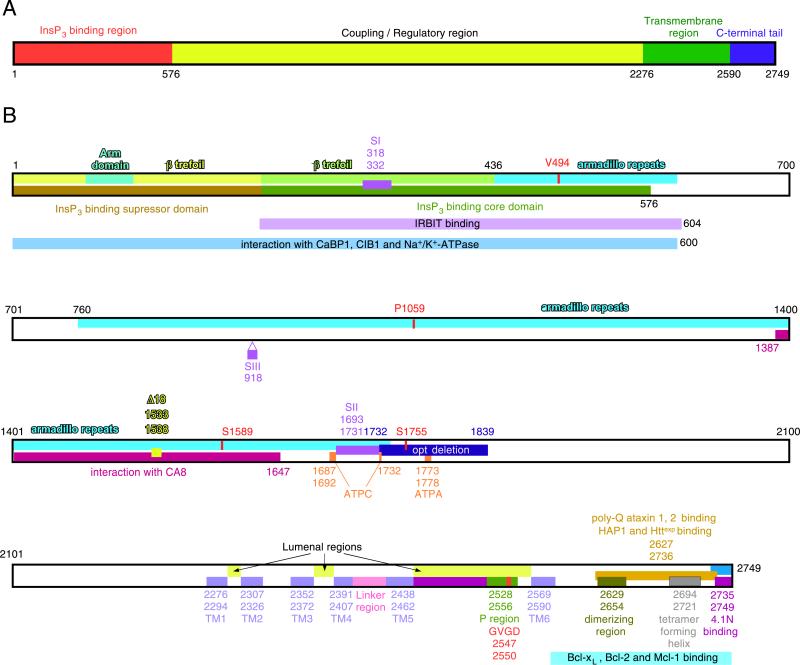
Fig. 1
Fig. 1
Structural determinants of the InsP3R. a Overall domain structure. The InsP3R molecule depicted as a linear amino acid sequence, with the amino terminal InsP3 binding region (red), coupling region (yellow), transmembrane region (green), and carboxyl tail (blue) depicted. b Linear amino acid sequence. Residues are numbered according to the rat type 1 SI+, SII+, SIII– sequence (protein accession number 121838). The structural features shown are: Arm sub-domain and β-trefoil in the InsP3-binding suppressor domain; β-trefoil and armadillo repeats in InsP3 binding core-domain; armadillo repeats in the coupling/regulatory domain; alternative splicing regions SI, SII, and SIII for type 1 InsP3R; opt deletion in type 1 InsP3Rmutant; Δ18 deletion in type 1 InsP3R; ATP-binding site ATPA; transmembrane helices TM1–6, and pore-forming P region with selectivity filter; dimerizing region; tetramer forming region; S1589 and S1755 are PKA/PKG phosphorylation sites; mutation of Pro1059 to Leu in type 1 InsP3R associated with SCA15; mutation of Val494 to Ile in type 1 InsP3R associated with SCA15. The sequences involved in the interaction of InsP3R channel with the following proteins are also depicted: CaBP1; IRBIT; CIB1; Na+/K+-ATPase; HAP1 and Httexp; poly-glutamine (poly-Q)-expanded ataxins 1 and 2; protein 4.1N; CA8; Bcl-2, Bcl-xL, and Mcl-1. Modified from [15] with permission from the American Physiological Society
Fig. 2
Fig. 2
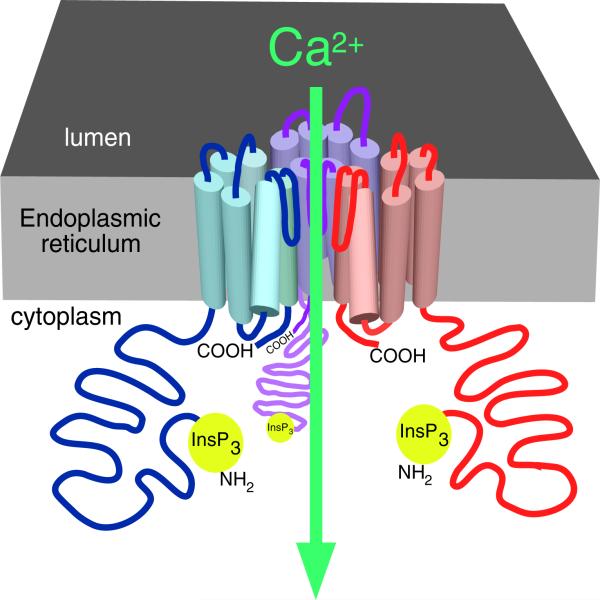
The InsP3R Ca2+ release channel. Cartoon depicting three of four InsP3R molecules (in different colors) in a single tetrameric channel structure. Part of the lumenal loop connecting transmembrane helices 5 and 6 of each monomer dips into the fourfold symmetrical axis, creating the permeation pathway for Ca2+ efflux from the lumen of the endoplasmic reticulum. Reproduced from [15] with permission from the American Physiological Society
Fig. 3
Fig. 3
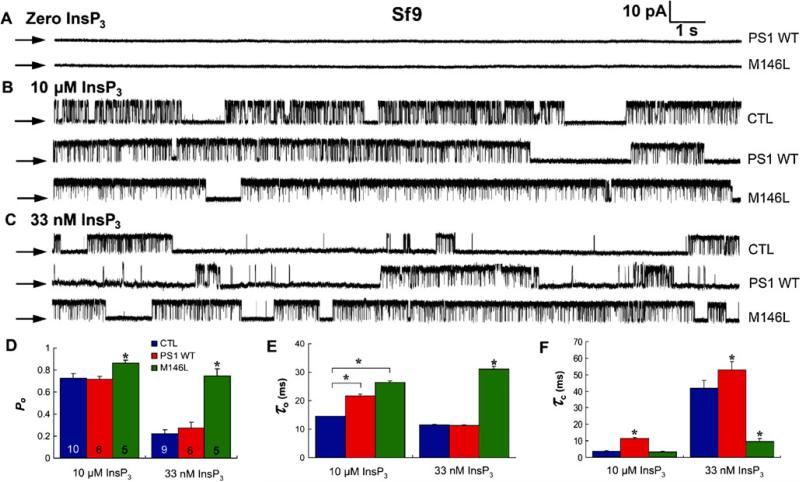
Effects of PS1 expression on InsP3R single channel activity in Sf9 cells. a–c Representative current recordings in isolated nuclei from Sf9 cells infected with PS1 WT or M146L baculoviruses in the absence (a) or presence of saturating (10 μM; b) or sub-saturating (33 nM; c) InsP3 in pipette solution. Channel activity was not evoked by PS1 alone in the absence of InsP3 (a), whereas InsP3R channels were activated in the presence of InsP3 (b, c). Pipette [Ca2+] was 1 μM; arrows, zero current level. Summary of effects of PS1 expression on InsP3R channel open probability Po (d) mean open time (τo) (e), and mean closed time (τc) (f). Asterisks, p<0.01, unpaired t-test. From [10] with permission from Elsevier
Fig. 4
Fig. 4
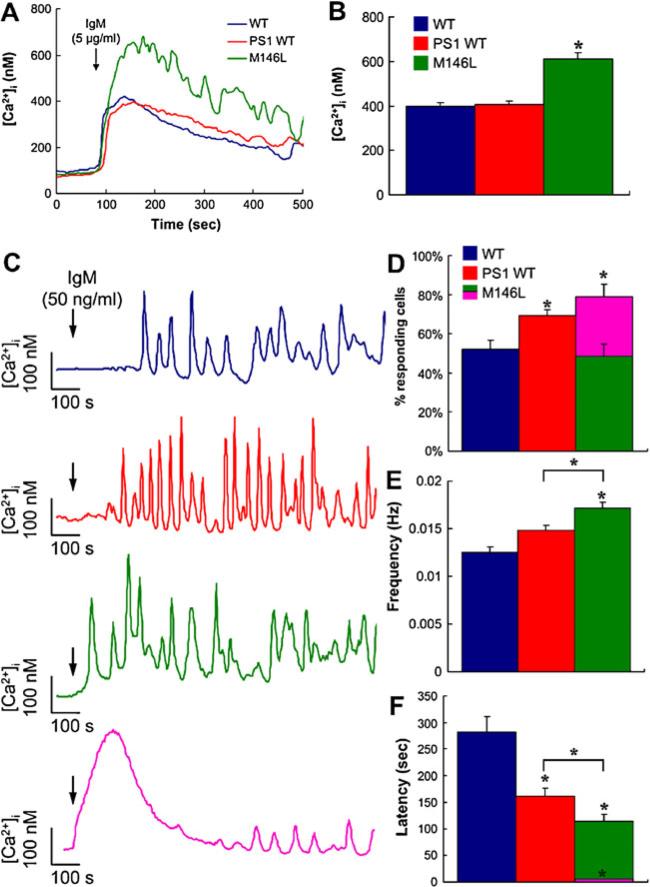
Exaggerated [Ca2+]i signaling in mutant PS-expressing DT40 cells. a, b Responses to strong stimulation by BCR antibody of DT40 cell [Ca2+]i. a Representative single-cell responses to 5 μg/ml anti-IgM (added at arrow) in untransfected (blue) and PS1-WT (red) and PS1-M146L (green) stably transfected DT40 cells. b Summary of peak [Ca2+]i responses triggered by 5 μg/ml anti-IgM (n=90). Asterisk, p<0.01 compared with WT and PS1-WT (c–f). Responses to weak stimulation by BCR antibody of DT40 cell [Ca2+]i. c Representative single cell [Ca2+]i responses to 50 ng/ml anti-IgM (IgM; added at arrow) stimulation of BCR in control (blue), PS1-WT (red), and PS1-M146L (green and pink) stably transfected DT40 cells. d Summary of percentage of cells responding to 50 ng/ml anti-IgM (n=90). Of PS1-M146L-expressing cells, ~30% (purple) exhibited a different, exaggerated [Ca2+]i response. e [Ca2+]i oscillation frequency triggered by anti-IgM in WT DT40, PS1-WT- and PS1-M146L-expressing cells. f Summary of latencies to first response in WT DT40, PS1-WT- and PS1-M146L-expressing cells. The 30% of PS1-M146L-expressing cells that exhibited the exaggerated response had nearly no latency (purple). Asterisks, p<0.01 compared with WT DT40 cells. Asterisks with bars, p<0.01 PS1-Wt vs PS1-M146L. From [10] with permission from Elsevier
Fig. 5
Fig. 5
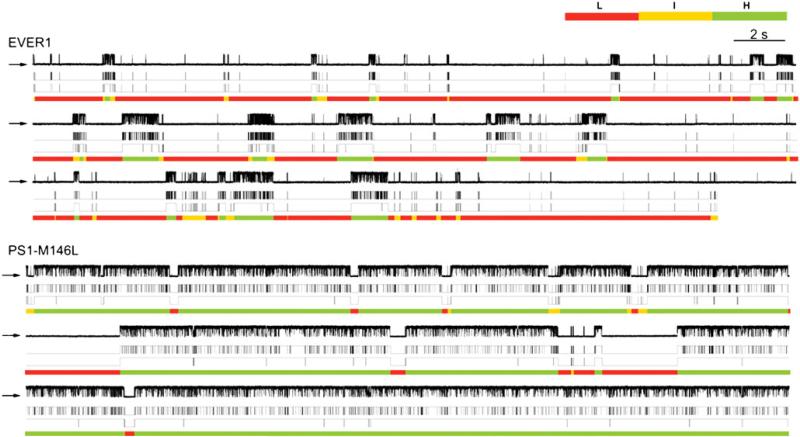
Modal gating analyses of InsP3R channels under the influence of FAD-linked mutant PS. Distinct single channel InsP3R gating behaviors from EVER1 (control) vs PS1-M146L-expressing Sf9 cells. Each section consists of a set of four traces of the same single channel current record: (top) unprocessed current trace, (second) idealized current trace generated using Qub software (third), idealized current trace after burst analysis (closing events <10 ms were filtered), and (bottom) modal assignment by analyzing channel burst (tb) and gap (tg) durations [28]. In EVER1-infected cells, low Po is associated with prevalence of L gating mode. In PS1-M146L infected cells, enhanced Po is manifested by increased tb and decreased tg. Channel occupancy of H mode is dominant, whereas occupancy of L gating mode is significantly decreased. From [9] with permission from the American Association for the Advancement of Science
Fig. 6
Fig. 6
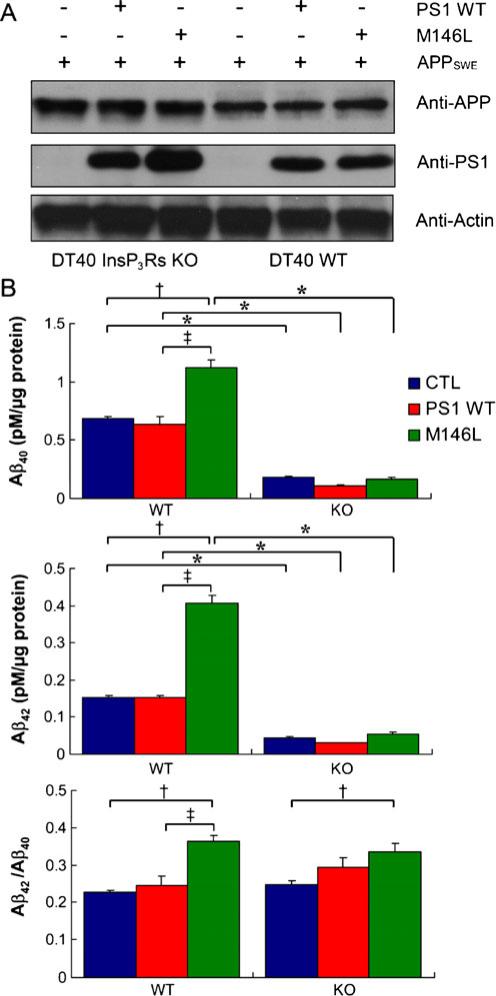
APP processing is dependent on InsP3R. a Stable expression of PS1-WT and PS1-M146L proteins in wild-type (WT) and InsP3R-deficient (KO) DT40 cell lines that stably expressed APPSWE. Actin probed as loading control. b ELISA measurements of Aβ40 (top), Aβ42 (middle), and Aβ42/Aβ40 ratio (bottom) secreted over 48 h by InsP3R-expressing wild-type (WT; left) or InsP3R-deficient (KO DT40 cells; right) DT40 cells stably expressing APPSWE alone (blue) or APPSWE with PS1-WT (red) or PS1-M146L (green). Asterisks, p< 0.01 compared with control WT cells. Cross, p<0.01 compared with control WT cells; double cross, p<0.01 compared with PS1-WT cells. From [10] with permission from Elsevier
Fig. 7
Fig. 7
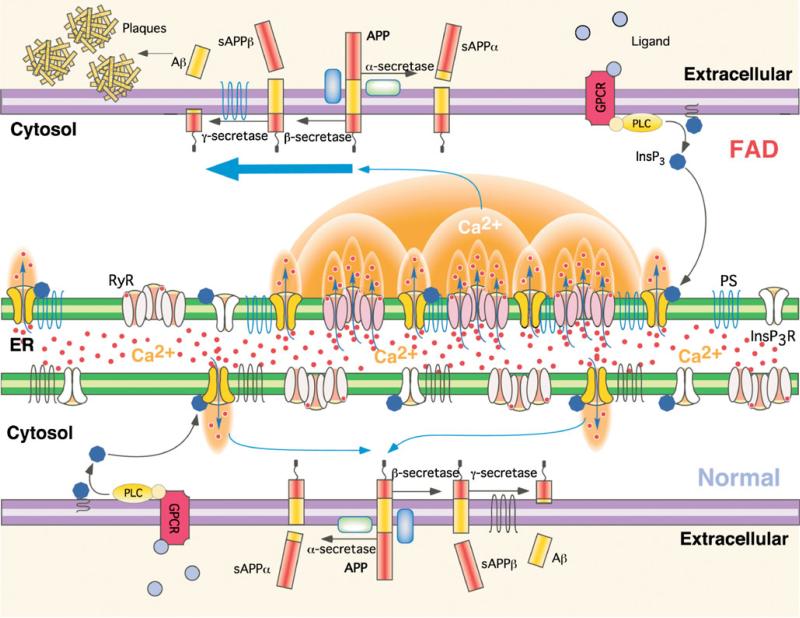
Hypothetical molecular mechanism of enhanced Aβ production due to Ca2+ disruption in FAD PS cells. APP is processed by either α-secretase or β-secretase, the latter leading to Aβ generation after subsequent cleavage by γ-secretase. Stimulation of G-protein coupled receptors or other cell surface receptors by extracellular ligands activates phospholipase C (PLC), which cleaves phosphatidylinositol bisphosphate to produce InsP3. InsP3 binds to and activates the InsP3R to release Ca2+ from ER stores, increasing cytoplasmic Ca2+ concentration. In normal cells, these Ca2+ signals are tightly regulated in time, space, and amplitude. In FAD cells, mutant PS exerts stimulatory effects on InsP3R gating by modal switching to the H mode associated with prolonged channel openings. H mode gating generates exaggerated Ca2+ signaling by promoting additional release channel recruitment by CICR. Increased cytoplasmic Ca2+ concentration promotes β-secretase activity [23] and Aβ production [19, 52] which, together with mutant PS-enhanced production of amyloidogenic Aβ, results in plaque formation. From [9] with permission from the American Association for the Advancement of Science

References

    1. Ando H, Mizutani A, Matsu-ura T, Mikoshiba K. IRBIT, a novel inositol 1,4,5-trisphosphate (IP3) receptor-binding protein, is released from the IP3 receptor upon IP3 binding to the receptor. J Biol Chem. 2003;278:10602–10612. - PubMed
    1. Berridge MJ, Bootman MD, Lipp P. Calcium—a life and death signal. Nature. 1998;395:645–648. - PubMed
    1. Bezprozvanny I, Mattson MP. Neuronal calcium mishandling and the pathogenesis of Alzheimer's disease. Trends Neurosci. 2008;31:454–463. - PMC - PubMed
    1. Boehning D, Mak D-OD, Foskett JK, Joseph SK. Molecular determinants of ion permeation and selectivity in inositol 1,4,5-trisphosphate receptor Ca2+ channels. J Biol Chem. 2001;276:13509–13512. - PubMed
    1. Bosanac I, Alattia JR, Mal TK, Chan J, Talarico S, Tong FK, Tong KI, Yoshikawa F, Furuichi T, Iwai M, Michikawa T, Mikoshiba K, Ikura M. Structure of the inositol 1,4,5-trisphosphate receptor binding core in complex with its ligand. Nature. 2002;420:696–700. - PubMed

Publication types

MeSH terms