


Chemopreventive mechanisms of α-keto acid metabolites of naturally occurring organoselenium compounds
- PMID: 20383543
- PMCID: PMC2965792
- DOI: 10.1007/s00726-010-0578-3
Chemopreventive mechanisms of α-keto acid metabolites of naturally occurring organoselenium compounds
Abstract
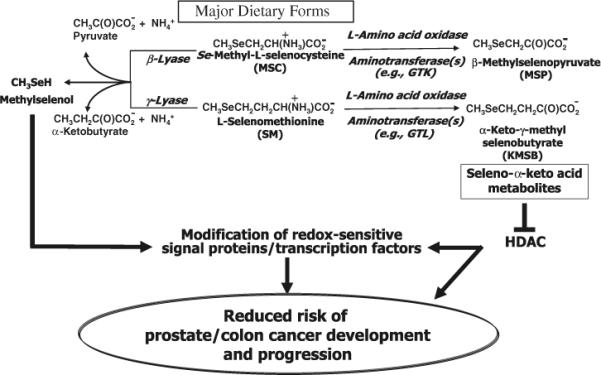
Previous studies on the chemopreventive mechanisms of dietary selenium have focused on its incorporation into antioxidative selenoproteins, such as glutathione peroxidase and thioredoxin reductase. Several studies, however, have revealed that dietary selenium in the form of L-selenomethionine and the 21st amino acid, selenocysteine, also have intrinsic anti-cancer properties. Biochemical mechanisms previously investigated to contribute to their anticancer effects involve β- and γ-lyase reactions. Some pyridoxal 5'-phosphate (PLP)-containing enzymes can catalyze a β-lyase reaction with Se-methyl-L-selenocysteine (MSC) generating pyruvate and ammonia. Other PLP-enzymes can catalyze a γ-lyase reaction with L-selenomethionine (SM) generating α-ketobutyrate and ammonia. In both cases, a purported third product is methylselenol (CH(3)SeH). Although not directly quantifiable, as a result of its extreme hydrophobicity and high vapor pressure, CH(3)SeH has been indirectly observed to act through the alteration of protein-sulfhydryl moieties on redox-responsive signal and transcription factors, thereby maintaining a non-proliferative intracellular environment. We have considered the possibility that α-keto acid analogues of MSC (i.e., methylselenopyruvate; MSP) and SM (i.e., α-keto-γ-methylselenobutyrate; KMSB), generated via a transamination and/or L-amino acid oxidase reaction may also be chemoprotective. Indeed, these compounds were shown to increase the level of histone-H3 acetylation in human prostate and colon cancer cells. MSP and KMSB structurally resemble butyrate, an inhibitor of several histone deacetylases. Thus, the seleno α-keto acid metabolites of MSC and SM, along with CH(3)SeH derived from β- and γ-lyase reactions, may be potential direct-acting metabolites of organoselenium that lead to de-repression of silenced tumor suppressor proteins and/or regulation of genes and signaling molecules.
Figures
References
-
- Blarzino C, Coccia R, Pensa B, Cini C, De Marco C. Selenomethionine as substrate for glutamine transaminase. Biochem Mol Biol Int. 1994;32:79–86. - PubMed
-
- Bolden JE, Peart MJ, Johnstone RW. Anticancer activities of histone deacetylase inhibitors. Nat Rev Drug Discov. 2006;5:769–784. - PubMed
-
- Boulland ML, Marquet J, Molinier-Frenkel V, Möller P, Guiter C, Lasoudris F, Copie-Bergman C, Baia M, Gaulard P, Leroy K, Castellano F. Human IL4I1 is a secreted L-phenylalanine oxidase expressed by mature dendritic cells that inhibits T-lymphocyte proliferation. Blood. 2007;110:220–227. - PubMed
-
- Carbonnelle-Puscian A, Copie-Bergman C, Baia M, Martin-Garcia N, Allory Y, Haioun C, Crémades A, Abd-Alsamad I, Farcet JP, Gaulard P, Castellano F, Molinier-Frenkel V. The novel immunosuppressive enzyme IL4I1 is expressed by neoplastic cells of several B-cell lymphomas and by tumor-associated macrophages. Leukemia. 2009;23:952–960. - PMC - PubMed
Publication types
MeSH terms
Substances
Grants and funding
LinkOut - more resources
Full Text Sources
Molecular Biology Databases
Research Materials
