


Adolescent behavior and adult health status in childhood cancer survivors
- PMID: 20383785
- PMCID: PMC3098531
- DOI: 10.1007/s11764-010-0123-0
Adolescent behavior and adult health status in childhood cancer survivors
Abstract
Introduction: This study examined the longitudinal association between adolescent psychological problems following cancer treatment and obesity, limited exercise, smoking, and excess sun exposure during adulthood in the Childhood Cancer Survivor Study cohort.
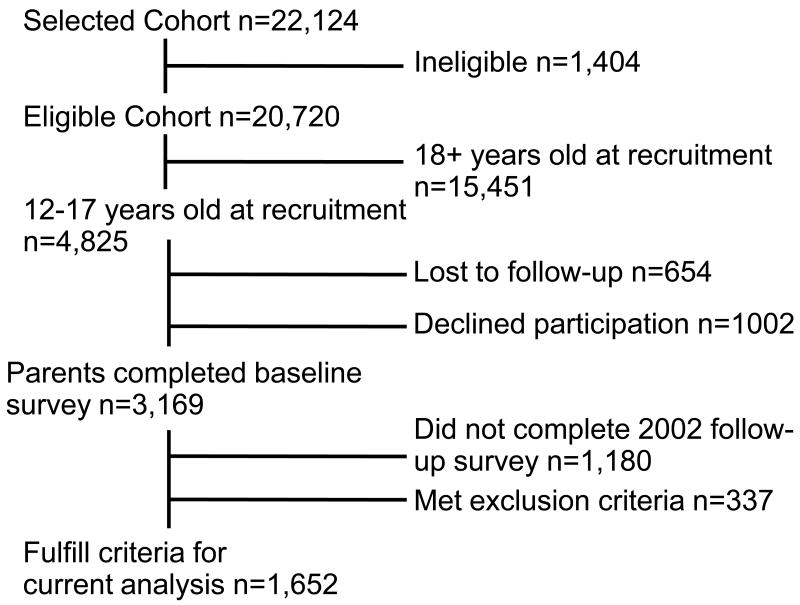
Methods: Participants included 1,652 adolescent survivors of childhood cancer and 406 siblings of cancer survivors, initially evaluated at 12-17 years of age and > or = 5 years post-diagnosis. A follow-up survey of these participants was conducted roughly 7 years later and included assessment of health status and health behaviors. Logistic regression models were used to assess the association between adolescent psychological problems and adult health behavior outcomes.
Results: During adolescence, survivors demonstrated higher rates of attention deficits, emotional problems, externalizing behavior and social withdrawal compared to sibling controls. Social withdrawal was associated with adult obesity (OR = 1.5, 95% CI = 1.1-2.1) and physical inactivity (OR = 1.7, 1.1-2.5). Use of stimulant medication during adolescence was also associated with adult obesity (OR = 1.9, 1.1-3.2), while antidepressant use was associated with physical inactivity (OR = 3.2, 1.2-8.2).
Discussion/conclusions: Adolescent survivors of childhood cancer display higher rates of psychological problems compared to siblings of cancer survivors. These psychological problems are associated with an increased risk for obesity and poor heath behavior in adulthood, which may increase future risk for chronic health conditions and secondary neoplasms.
Implications: In order to decrease risk of future health problems, adolescent survivors of childhood cancer should be routinely screened and treated for psychological problems following cancer therapy.
Conflict of interest statement
No authors report conflict of interest.
Figures
References
-
- Bassal M, Mertens AC, Taylor L, et al. Risk of selected subsequent carcinomas in survivors of childhood cancer: a report from the Childhood Cancer Survivor Study. J Clin Oncol. 2006;24(3):476–483. - PubMed
-
- Oeffinger KC, Mertens AC, Sklar CA, et al. Chronic health conditions in adult survivors of childhood cancer. N Engl J Med. 2006;355(15):1572–1582. - PubMed
-
- Hudson MM, Findlay S. Health-risk behaviors and health promotion in adolescent and young adult cancer survivors. Cancer. 2006;107(7 Suppl):1695–1701. - PubMed
-
- Cuijpers P, Schoevers RA. Increased mortality in depressive disorders: a review. Curr Psychiatry Rep. 2004;6(6):430–437. - PubMed
Publication types
MeSH terms
Grants and funding
LinkOut - more resources
Full Text Sources
Medical
