Perceived stress and severity of perimenstrual symptoms: the BioCycle Study
- PMID: 20384452
- PMCID: PMC2875955
- DOI: 10.1089/jwh.2009.1717
Perceived stress and severity of perimenstrual symptoms: the BioCycle Study
Abstract
Objective: To examine the longitudinal relation between perceived stress in the previous month and perimenstrual symptom severity across two cycles among regularly menstruating, healthy women (n = 259).
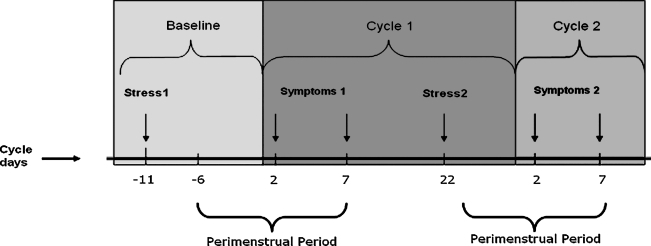
Methods: At baseline (11 days before the first cycle), participants completed the 4-item Perceived Stress Scale (PSS) for the previous month (first cycle exposure) and questionnaires on lifestyle factors. On cycle day 22 of a standardized 28-day cycle, participants again completed the PSS for the previous week (second cycle exposure) and each week rated the severity (none, mild, moderate, severe) of 17 psychological and physical symptoms (e.g., crying, cramping, pain). Mixed models estimated the association between perceived stress scores and number of moderate/severe symptoms and symptom severity scores, allowing both stress and perimenstrual symptoms to vary by cycle.
Results: Adjusting for age, education, passive and active smoking, and waist/height ratio (WHtR), high stress (fourth quartile PSS) was associated with an increased risk of reporting >or=8 or more (OR 7.2, 3.3-15.8) and >or=5 (OR 2.5, 1.6-4.1) symptoms as moderate/severe during the perimenstrual period compared with lower stress (quartiles one, two, and three). Stress scores were positively (p < 0.0001) associated with increased symptom severity scores for total, psychological, and physical symptoms.
Conclusions: These analyses show that higher perceived stress precedes an increased severity of perimenstrual symptoms. Stress reduction programs may be an effective, nonpharmaceutical treatment for physical and psychological symptom relief.
Figures
Similar articles
-
The role of emotion regulation in the experience of menstrual symptoms and perceived control over anxiety-related events across the menstrual cycle.Arch Womens Ment Health. 2016 Dec;19(6):1109-1117. doi: 10.1007/s00737-016-0661-1. Epub 2016 Aug 25. Arch Womens Ment Health. 2016. PMID: 27562823 Free PMC article.
-
Arousal and stress response across the menstrual cycle in women with three perimenstrual symptom patterns.Res Nurs Health. 1994 Apr;17(2):99-110. doi: 10.1002/nur.4770170205. Res Nurs Health. 1994. PMID: 8127998
-
Perimenstrual symptoms: relationships with chronic stress and selected lifestyle variables.Behav Med. 1989 Winter;15(4):149-59. doi: 10.1080/08964289.1989.9934578. Behav Med. 1989. PMID: 2597778
-
Perimenstrual symptoms: prevalence and risk factors.Psychosom Med. 1986 Jul-Aug;48(6):388-414. doi: 10.1097/00006842-198607000-00002. Psychosom Med. 1986. PMID: 3529156 Review.
-
Exacerbation of Psychosis During the Perimenstrual Phase of the Menstrual Cycle: Systematic Review and Meta-analysis.Schizophr Bull. 2020 Jan 4;46(1):78-90. doi: 10.1093/schbul/sbz030. Schizophr Bull. 2020. PMID: 31071226 Free PMC article.
Cited by
-
Psychological factors and premenstrual syndrome: A Spanish case-control study.PLoS One. 2019 Mar 6;14(3):e0212557. doi: 10.1371/journal.pone.0212557. eCollection 2019. PLoS One. 2019. PMID: 30840651 Free PMC article. Clinical Trial.
-
Characteristics of Perceived Stress and Salivary Levels of Secretory Immunoglobulin A and Cortisol in Japanese Women With Premenstrual Syndrome.Nurs Midwifery Stud. 2015 Jun;4(2):e24795. doi: 10.17795/nmsjournal24795. Epub 2015 Jun 27. Nurs Midwifery Stud. 2015. PMID: 26339665 Free PMC article.
-
Suicide Risk and the Menstrual Cycle: a Review of Candidate RDoC Mechanisms.Curr Psychiatry Rep. 2018 Oct 6;20(11):106. doi: 10.1007/s11920-018-0962-3. Curr Psychiatry Rep. 2018. PMID: 30293097 Free PMC article. Review.
-
Magnitude of premenstrual dysphoric disorder and its correlation with academic performance among female medical and health science students at University of Gondar, Ethiopia, 2019: a cross-sectional study.BMJ Open. 2020 Jul 29;10(7):e034166. doi: 10.1136/bmjopen-2019-034166. BMJ Open. 2020. PMID: 32727736 Free PMC article.
-
Influence of menstrual cycle and hormonal contraceptive use on MS symptom fluctuations: A pilot study.Mult Scler Relat Disord. 2023 Sep;77:104864. doi: 10.1016/j.msard.2023.104864. Epub 2023 Jun 30. Mult Scler Relat Disord. 2023. PMID: 37480738 Free PMC article.
References
-
- Borenstein J. Chiou CF. Dean B. Wong J. Wade S. Estimating direct and indirect costs of premenstrual syndrome. J Occup Environ Med. 2005;47:26–33. - PubMed
-
- Borenstein JE. Dean BB. Endicott J, et al. Health and economic impact of the premenstrual syndrome. J Reprod Med. 2003;48:515–524. - PubMed
-
- Dean BB. Borenstein JE. A prospective assessment investigating the relationship between work productivity and impairment with premenstrual syndrome. J Occup Environ Med. 2004;46:649–656. - PubMed
-
- Hourani LL. Yuan H. Bray RM. Psychosocial and lifestyle correlates of premenstrual symptoms among military women. J Womens Health. 2004;13:812–821. - PubMed
-
- Tabassum S. Afridi B. Aman Z. Tabassum W. Durrani R. Premenstrual syndrome: Frequency and severity in young college girls. J Pak Med Assoc. 2005;55:546–549. - PubMed
Publication types
MeSH terms
Grants and funding
LinkOut - more resources
Full Text Sources
Medical