


Are diagnostic criteria for eating disorders markers of medical severity?
- PMID: 20385643
- PMCID: PMC3078569
- DOI: 10.1542/peds.2008-1777
Are diagnostic criteria for eating disorders markers of medical severity?
Abstract
Objective: The objective of this study was to compare the medical severity of adolescents who had eating disorders not otherwise specified (EDNOS) with those who had anorexia nervosa (AN) and bulimia nervosa (BN).
Methods: Medical records of 1310 females aged 8 through 19 years and treated for AN, BN, or EDNOS were retrospectively reviewed. Patients with EDNOS were subcategorized into partial AN (pAN) and partial BN (pBN) when they met all Diagnostic and Statistical Manual of Mental Disorders, Fourth Edition criteria but 1 for AN or BN, respectively. Primary outcome variables were heart rate, systolic blood pressure, temperature, and QTc interval on electrocardiogram. Additional physiologically significant medical complications were also reviewed.
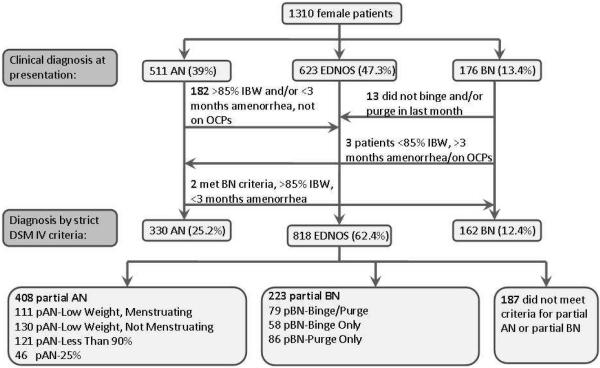
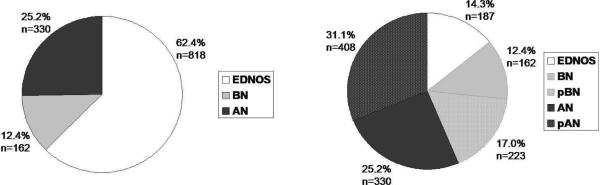
Results: A total of 25.2% of females had AN, 12.4% had BN, and 62.4% had EDNOS. The medical severity of patients with EDNOS was intermediate to that of patients with AN and BN in all primary outcomes. Patients with pAN had significantly higher heart rates, systolic blood pressures, and temperatures than those with AN; patients with pBN did not differ significantly from those with BN in any primary outcome variable; however, patients with pAN and pBN differed significantly from each other in all outcome variables. Patients with pBN and BN had longer QTc intervals and higher rates of additional medical complications reported at presentation than other groups.
Conclusions: EDNOS is a medically heterogeneous category with serious physiologic sequelae in children and adolescents. Broadening AN and BN criteria in pediatric patients to include pAN and pBN may prove to be clinically useful.
Figures
References
-
- Diagnostic and Statistical Manual of Mental Disorders, Fourth Edition, Text Revision (DSM-IV-TR) 4th ed. American Psychiatric Association; Arlington, VA: 2000.
-
- Treatment of patients with eating disorders,third edition. American Psychiatric Association. Am J Psychiatry. 2006;163(7 Suppl):4–54. - PubMed
-
- Bravender T, et al. Classification of child and adolescent eating disturbances. Workgroup for Classification of Eating Disorders in Children and Adolescents (WCEDCA) Int J Eat Disord. 2007;40(Suppl):S117–22. - PubMed
-
- Machado PP, et al. The prevalence of eating disorders not otherwise specified. Int J Eat Disord. 2007;40(3):212–7. - PubMed
Publication types
MeSH terms
Grants and funding
LinkOut - more resources
Full Text Sources
Other Literature Sources
Medical
Miscellaneous
