. 2010 Apr 27;107(17):7805-10.
doi: 10.1073/pnas.0914517107. Epub 2010 Apr 12.

Protein transduction from retroviral Gag precursors

Affiliations

Protein transduction from retroviral Gag precursors

Christine Voelkel et al. Proc Natl Acad Sci U S A. .

Abstract

Retroviral particles assemble a few thousand units of the Gag polyproteins. Proteolytic cleavage mediated by the retroviral protease forms the bioactive retroviral protein subunits before cell entry. We hypothesized that this process could be exploited for targeted, transient, and dose-controlled transduction of nonretroviral proteins into cultured cells. We demonstrate that gammaretroviral particles tolerate the incorporation of foreign protein at several positions of their Gag or Gag-Pol precursors. Receptor-mediated and thus potentially cell-specific uptake of engineered particles occurred within minutes after cell contact. Dose and kinetics of nonretroviral protein delivery were dependent upon the location within the polyprotein precursor. Proteins containing nuclear localization signals were incorporated into retroviral particles, and the proteins of interest were released from the precursor by the retroviral protease, recognizing engineered target sites. In contrast to integration-defective lentiviral vectors, protein transduction by retroviral polyprotein precursors was completely transient, as protein transducing retrovirus-like particles could be produced that did not transduce genes into target cells. Alternatively, bifunctional protein-delivering particle preparations were generated that maintained their ability to serve as vectors for retroviral transgenes. We show the potential of this approach for targeted genome engineering of induced pluripotent stem cells by delivering the site-specific DNA recombinase, Flp. Protein transduction of Flp after proteolytic release from the matrix position of Gag allowed excision of a lentivirally transduced cassette that concomitantly expresses the canonical reprogramming transcription factors (Oct4, Klf4, Sox2, c-Myc) and a fluorescent marker gene, thus generating induced pluripotent stem cells that are free of lentivirally transduced reprogramming genes.


Conflict of interest statement

The authors declare no conflict of interest.

Figures
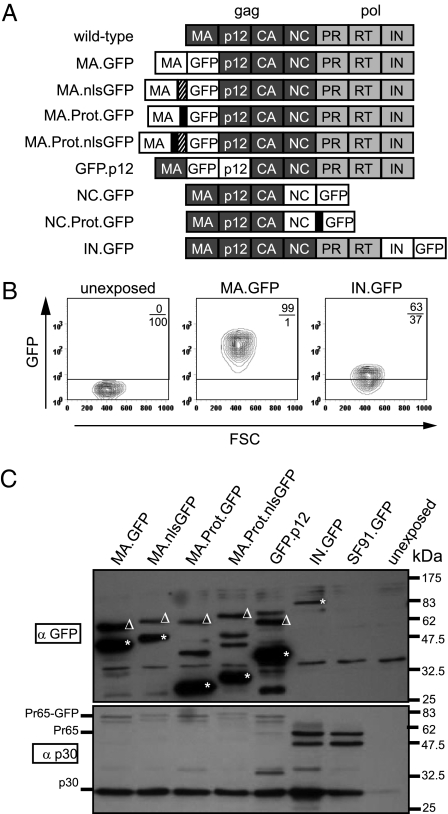
Fig. 1.
Fig. 1.
GFP embedded in the retroviral Gag-Pol polyprotein is tolerated, processed and delivered into target cells. (A) Schema of MLV Gag-Pol variants with protein subunits matrix (MA), p12, capsid (CA), nucleocapsid (NC), protease (PR), reverse transcriptase (RT), integrase (IN). GFP was incorporated in various Gag-Pol positions: C-terminal of MA (MA.GFP and derivatives), N-terminal of p12 (GFP.p12), and C-terminal of IN (IN.GFP). The MA position was also tested with a nuclear localization signal (hatched box, MA.nlsGFP), and an additional protease site (RSSLY/PALTP; black box, MA.Prot.GFP and MA.Prot.nlsGFP). GFP was also inserted C-terminal of NC replacing Pol with or without maintaining the natural protease site (QTSLL/TLDD) (NC.Prot.GFP or NC.GFP, respectively). (B) GFP transfer to SC1 fibroblasts by ecotropic particle preparations made with either MA.GFP or IN.GFP in the absence of WT Gag-Pol. FACS analysis 5 h posttransduction with 400 μL unconcentrated supernatants, indicating the percentage of GFP+ cells and fluorescence intensity. (C) Proteolytic maturation in HT1080mCAT cells 1.5 h posttransduction with concentrated ecotropic particles (lacking WT Gag-Pol). Supernatant of an integrating GFP vector (SF91.GFP) packaged with WT Gag-Pol served as control; polyclonal anti-GFP antibody (Upper). Asterisks represent processed products (Left to Right): MA.GFP, MA.nlsGFP, GFP, nlsGFP, GFP.p12, IN.GFP. Triangles represent associated unprocessed precursors (Pr). CA (p30) was detected with a polyclonal anti-Capsid (anti-p30) antibody and served as loading control (Lower). Sizes for Pr65-GFP, Pr65 (Gag precursor), and p30 (CA) are indicated.
Fig. 2.
Fig. 2.
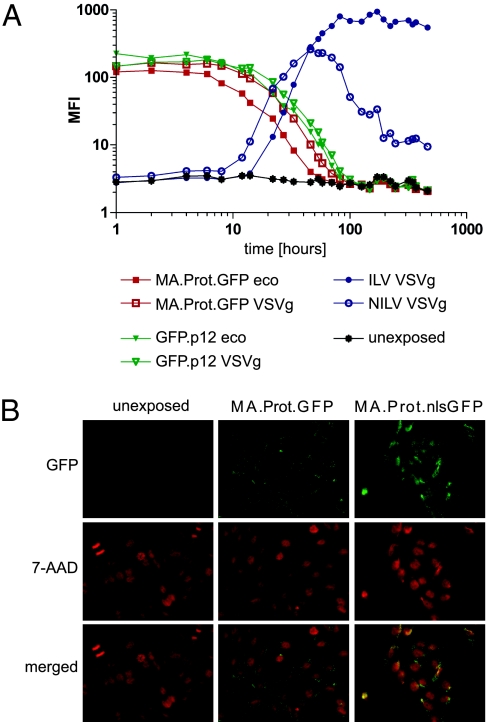
Gag-Pol polyprotein mediated delivery of GFP is rapid, transient, and redirected by a nuclear localization signal. (A) HT1080mCAT cells were transduced with particles produced with MA.Prot.GFP (red) or GFP.p12 (green) in the absence of WT Gag-Pol. GFP-encoding integrating (ILV) and nonintegrating lentiviral vectors (NILV, packaged with a D64V integrase mutant) pseudotyped with VSVg (blue) served as controls [multiplicity of infection (MOI) 2 based on copackaged reporter genes tCD34 or GFP]. For GFP.p12, we used lower MOIs (0.8 ecotropic; 0.1 VSVg) because of low titers. Gag precursor-mediated delivery of GFP decreased to baseline of unexposed cells (black). (B) The intracytoplasmic distribution of transduced protein is affected by a nuclear localization signal. SC1 cells 4.5 h posttransduction with ecotropic MA.Prot.GFP or MA.Prot.nlsGFP particles (MOI 0.2), nuclei stained by 7-AAD. 400× magnification.
Fig. 3.
Fig. 3.
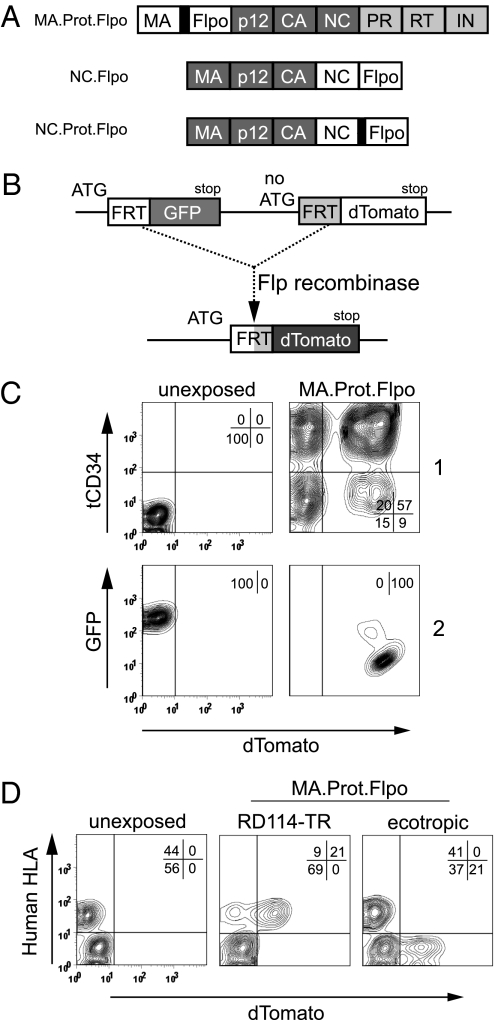
Gag precursor-mediated Flp transduction does not require codelivery of retroviral genomes. (A) Codon-optimized Flp (Flpo) was fused C-terminal of MA with an additional MA/p12 protease site (MA.Prot.Flpo), or C-terminal of NC without (NC.Flpo), or with the natural protease site separating NC from PR (NC.Prot.Flpo). The NC constructs lacked Pol. In all Flp experiments, WT Gag-Pol was cotransfected for particle production. (B) Schema of the Flp-indicator cassette: GFP flanked by Flp recombinase target (FRT) sites followed by dTomato lacking the ATG start codon. FRT recombination switches expression from GFP to dTomato. (C) [Upper (1)] SF11tCD34 vector was cotransfected with VSVg and MA.Prot.Flpo. 5 × 10⁴ Flp-indicator SC1 cells transduced with 400 μL unconcentrated supernatant. tCD34 expression detected by an APC-antibody was analyzed in relation to dTomato fluorescence 3d posttransduction. [Lower (2)] The same experiment devoid of SF11tCD34. GFP in relation to dTomato fluorescence. (D) Flp transduction from Gag precursors is receptor mediated. Mixed murine SC1 and human HT1080 cells carrying the Flp-indicator construct were transduced with unconcentrated MA.Prot.Flpo particles pseudotyped with RD114-TR (human specific) or the ecotropic envelope (murine specific). After 2 h the cells were washed and cultivated in virus-free medium before flow cytometry using anti-human HLA(A, B, C).
Fig. 4.
Fig. 4.
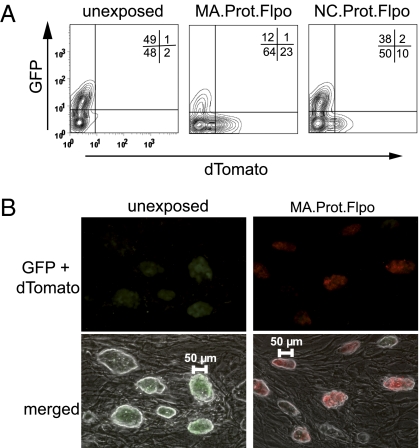
Modification of iPSCs by protein transduction of Flp. (A) 1 × 10⁵ iPSCs containing the Flp-indicator construct (Fig. 3B) transduced with MA.Prot.Flpo or NC.Prot.Flpo particles (100 μL, concentrated, VSVg pseudotyped), FACS analysis 3 d posttransduction showing dTomato+ cells. (B) Experiment as in A transducing 7 × 10⁴ clonal iPSCs with 30 μL of concentrated MA.Prot.Flpo supernatant. Fluorescence microscopy 3 d posttransduction. (100x magnification).
Fig. 5.
Fig. 5.
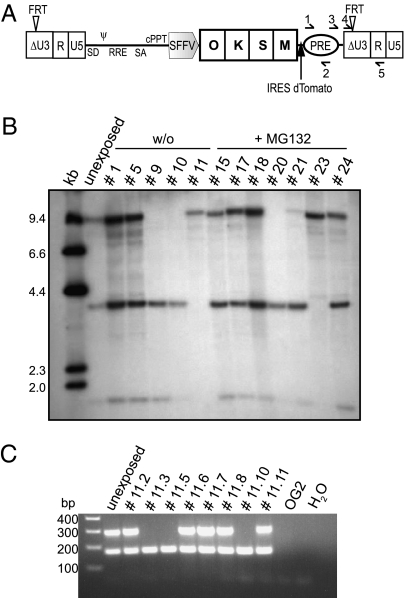
Excision of a reprogramming cassette by Flp delivery from Gag precursors. (A) The lentiviral vector used for reprogramming mouse embryonic OG2 fibroblasts contained a cassette composed of the factors Oct4 (O), Klf4 (K), Sox2 (S), and c-Myc (M) separated by 2A cleavage sites, with FRT-sites in the ΔU3 region of the LTR. Primers detecting PRE (arrows 1 and 2) were used for qPCR. Primers detecting the LTR (arrows 3, 4, and 5) were used for semiquantitative PCR. (B) 5 × 10⁴ murine iPSCs were transduced with 50 μL concentrated MA.Prot.Flpo particles ± 0.5 μM MG132. Twelve clones each were isolated and Southern blotting was accomplished on EcoRV-digested gDNA with PRE-specific probes. All three vector integrations were accessible to excision by Flp. In lane “unexposed” less gDNA was loaded; compare with Fig. S7A. (C) Next, 5 × 10⁴ cells of clone #11 containing a single copy of the reprogramming vector as shown in B were transduced with 60 μL concentrated MA.Prot.Flpo particles. Eight subclones were analyzed by semiquantitative PCR using primers 3, 4, and 5 simultaneously. Primers 3 and 5 produce a 290-bp amplicon which cannot be obtained following Flp recombination of the vector. Primers 4 and 5 produce a 170-bp amplicon regardless of Flp recombination. OG2 fibroblasts and H2O served as controls.

References

    1. Gump JM, Dowdy SF. TAT transduction: The molecular mechanism and therapeutic prospects. Trends Mol Med. 2007;13:443–448. - PubMed
    1. Schwarze SR, Ho A, Vocero-Akbani A, Dowdy SF. In vivo protein transduction: Delivery of a biologically active protein into the mouse. Science. 1999;285:1569–1572. - PubMed
    1. Morris MC, Depollier J, Mery J, Heitz F, Divita G. A peptide carrier for the delivery of biologically active proteins into mammalian cells. Nat Biotechnol. 2001;19:1173–1176. - PubMed
    1. Ford KG, Souberbielle BE, Darling D, Farzaneh F. Protein transduction: An alternative to genetic intervention? Gene Ther. 2001;8:1–4. - PubMed
    1. Derossi D, Joliot AH, Chassaing G, Prochiantz A. The third helix of the Antennapedia homeodomain translocates through biological membranes. J Biol Chem. 1994;269:10444–10450. - PubMed

Publication types

MeSH terms