Coxiella burnetii in humans and ticks in rural Senegal
- PMID: 20386603
- PMCID: PMC2850317
- DOI: 10.1371/journal.pntd.0000654
Coxiella burnetii in humans and ticks in rural Senegal
Expression of concern in
-
Expression of Concern: Coxiella burnetii in Humans and Ticks in Rural Senegal.PLoS Negl Trop Dis. 2022 Dec 13;16(12):e0010955. doi: 10.1371/journal.pntd.0010955. eCollection 2022 Dec. PLoS Negl Trop Dis. 2022. PMID: 36512532 Free PMC article. No abstract available.
Abstract
Background: Q fever is a worldwide zoonotic disease caused by Coxiella burnetii. Epidemiologically, animals are considered reservoirs and humans incidental hosts.
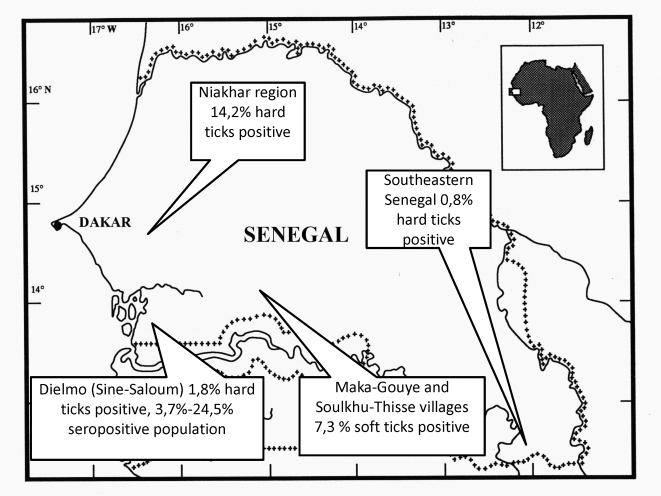
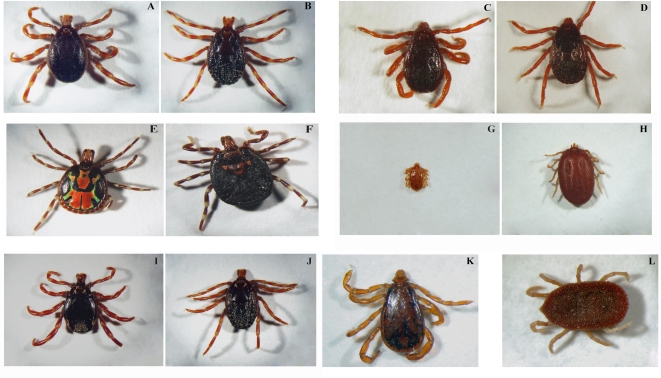
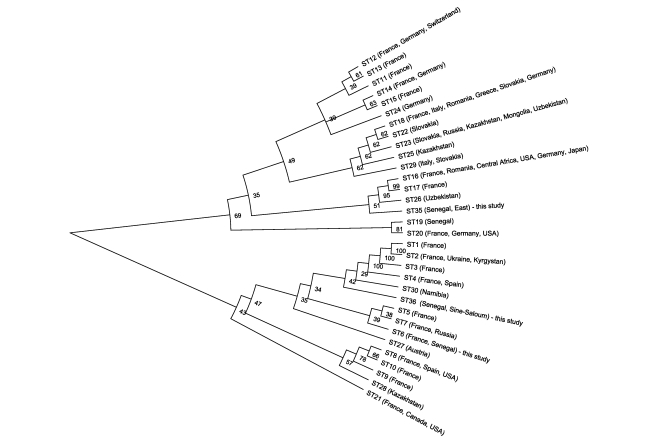
Methodology/principal findings: We investigated Q fever in rural Senegal. Human samples (e.g., sera, saliva, breast milk, feces) were screened in the generally healthy population of two villages of the Sine-Saloum region. Ticks were collected in four regions. Seroprevalence was studied by immunofluorescence, and all other samples were tested by two qPCR systems for detection of C. burnetii. Positive samples were genotyped (multispacer typing) by amplification and sequencing of three spacers. Strains were isolated by cell culture. We found that the seroprevalence may be as high as 24.5% (59 of 238 studied) in Dielmo village. We identified spontaneous excretion of C. burnetii by humans through faeces and milk. Hard and soft ticks (8 species) were infected in 0-37.6%. We identified three genotypes of C. burnetii. The previously identified genotype 6 was the most common in ticks in all studied regions and the only one found in human samples. Three strains of genotype 6 of C. burnetii were also recovered from soft tick Ornithodoros sonrai. Two other genotypes found in ticks, 35 and 36, were identified for the first time.
Conclusions/significance: Q fever should be considered a significant public health threat in Senegal. Humans, similar to other mammals, may continuously excrete C. burnetii.
Conflict of interest statement
The authors have declared that no competing interests exist.
Figures
References
-
- Tissot-Dupont H, Raoult D. Q fever. Infect Dis Clin North Am. 2008;22:505–14. - PubMed
-
- Raoult D. Reemergence of Q fever after 11 September 2001. Clin Infect Dis. 2009;48:558–559. - PubMed
-
- Marrie TJ. Epidemiology of Q fever. In: Raoult D, Parola P, editors. Rickettsial diseases. New York: Informa Healthcare USA, Inc; 2007. pp. 281–289.
-
- Philip CB. Observations on experimental Q fever. J Parasitol. 1948;34:457. - PubMed
-
- Smith DJW, Brown HE, Derrick EH. Further series of laboratoriy infections with the Rickettsia of “Q” fever. Med J Australia. 1939;1:13–20.
MeSH terms
Substances
LinkOut - more resources
Full Text Sources