


Cluster analysis of the Yale Global Tic Severity Scale (YGTSS): symptom dimensions and clinical correlates in an outpatient youth sample
- PMID: 20386987
- PMCID: PMC2902733
- DOI: 10.1007/s10802-010-9410-5
Cluster analysis of the Yale Global Tic Severity Scale (YGTSS): symptom dimensions and clinical correlates in an outpatient youth sample
Abstract
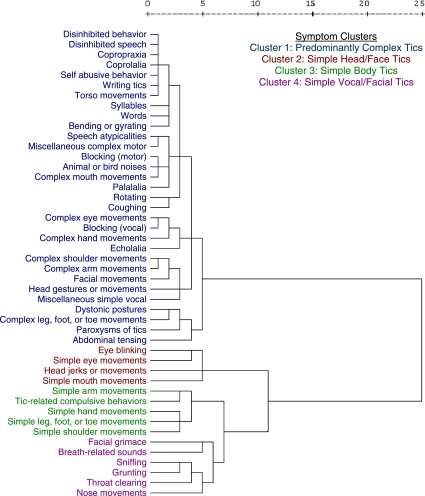
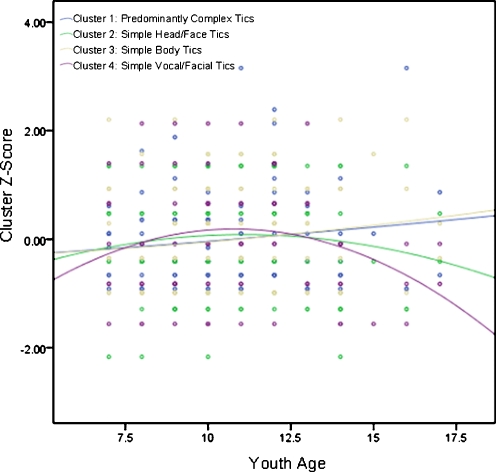
Tic disorders are heterogeneous, with symptoms varying widely both within and across patients. Exploration of symptom clusters may aid in the identification of symptom dimensions of empirical and treatment import. This article presents the results of two studies investigating tic symptom clusters using a sample of 99 youth (M age = 10.7, 81% male, 77% Caucasian) diagnosed with a primary tic disorder (Tourette's disorder or chronic tic disorder), across two university-based outpatient clinics specializing in tic and related disorders. In Study 1, a cluster analysis of the Yale Global Tic Severity Scale (YGTSS) identified four symptom dimensions: predominantly complex tics; simple head/face tics; simple body tics; and simple vocal/facial tics. In Study 2, these clusters were shown to be differentially associated with demographic and clinical characteristics. Findings lend support to prior research on tic phenomenology, help to organize treatment goals, and suggest symptom dimensions of tic disorders for further evaluation.
Figures
References
-
- Achenbach TM. Manual for the child behavior checklist/4-18 and 1991 child profile. Burlington: University of Vermont Department of Psychiatry; 1991.
-
- Achenbach TM, Rescorla L. Manual for the ASEBA school-age forms and profiles. Burlington: Research Center for Children, Youth, and Families; 2001.
-
- American Psychiatric Association . Diagnostic and statistical manual of mental disorders. 4. Washington: American Psychiatric Association; 2000.
