. 2010 Apr 14:2:9.
doi: 10.1186/2040-7378-2-9.

G-CSF, rt-PA and combination therapy after experimental thromboembolic stroke

Affiliations

G-CSF, rt-PA and combination therapy after experimental thromboembolic stroke

Rainer Kollmar et al. Exp Transl Stroke Med. .

Abstract

Background: Granulocyte Colony-Stimulating Factor (G-CSF) has remarkable neuroprotective properties. Due to its proven safety profile, G-CSF is currently used in clinical stroke trials. As neuroprotectants are considered to be more effective in the early phase of cerebral ischemia and during reperfusion, G-CSF should to be tested in combination with thrombolysis. Therefore, combination therapy was investigated in an experimental model of thromboembolic stroke.

Methods: Male Wistar rats (n = 72) were subjected to a model of thromboembolic occlusion (TE) of the middle cerebral artery. Different groups (n = 12 each) treated by recombinant tissue-plasminogen activator (rt-PA) or/and G-CSF: group control (control), group early G-CSF (G-CSF 60 min after TE), group rt-PA (rt-PA 60 min after TE), group com (combination rt-PA/G-CSF), group delayed rt-PA (rt-PA after 180 min), group deco (G-CSF after 60 min, rt-PA after 180 min). Animals were investigated by magnetic resonance imaging (MRI) and silver infarct staining (SIS) 24 hours after TE.

Results: Early G-CSF or rt-PA reduced the infarct size compared to all groups (p < 0.05 to p < 0.01) with the exception of group com, (p = n.s.) as measured by T2, DWI, and SIS. Late administration of rt-PA lead to high mortality and larger infarcts compared to all other groups (p < 0.05 to p < 0.01). Pre-treatment by G-CSF (deco) reduced infarct site compared to delayed rt-PA treatment (p < 0.05). G-CSF did not significantly influence PWI when combined with rt-PA. All animals treated by rt-PA showed improved parameters in PWI indicating reperfusion.

Conclusions: G-CSF was neuroprotective when given early after TE. Early combination with rt-PA showed no additional benefit compared to rt-PA or G-CSF alone, but did not lead to side effects. Pretreatment by G-CSF was able to reduce deleterious effects of late rt-PA treatment.


Figures
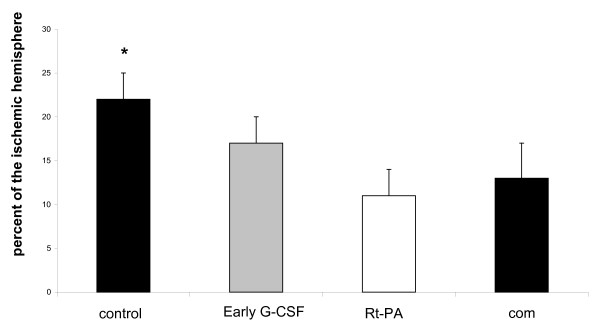
Figure 1
Figure 1
Infarct volume in SIS. Cerebral infarct is shown as calculated from SIS after 24 hours. Infarct size is larger in the control group (control) compared to early G-CSF (G-CSF), early rt-PA (rt-PA), and early combination (com) as indicated by the asterisks (p < 0.05).
Figure 2
Figure 2
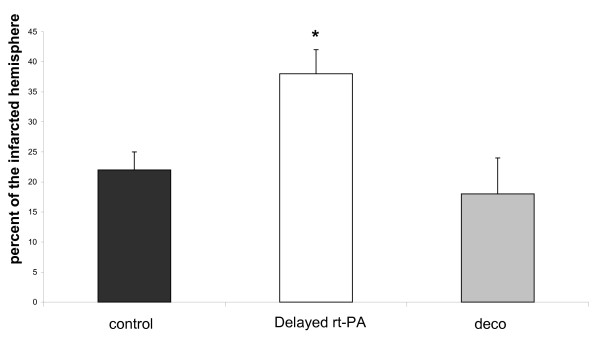
Infarct volume in SIS after delayed rt-PA treatment. Cerebral infarct is shown as calculated from SIS after 24 hours. Infarct size is larger in the delayed rt-PA group (delayed rt-PA) compared to the control group (control), and delayed combination (deco) as indicated by the asterisks (p < 0.05).
Figure 3
Figure 3
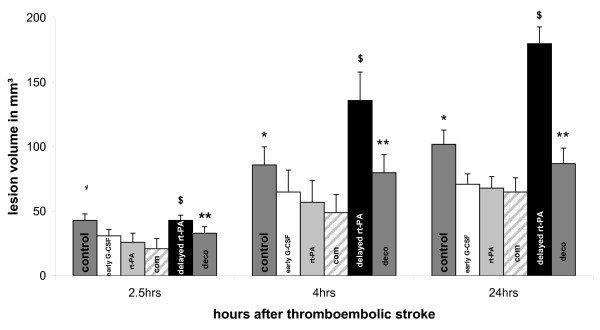
Lesion volume in MRI. Lesion volume is shown as calculated from DWI and expressed as means ± SD. The lesion volume in the control group was larger compared to early rt-PA (rt-PA) and early combination group (com) after 2.5 hours, and larger than the early rt-PA, early G-CSF (G-CSF) and early combination group after 4 and 24 hours as shown by the single asterisks. Delayed rt-PA treatment (delayed rt-PA) resulted in larger lesion volume than the early rt-PA, early G-CSF and early combination group after 2.5 hours, and additionally larger than the control group after 4 hours. It was larger than all others after 24 hours as shown by the string sign. The late combination group (deco) showed larger infarcts than the early combination after 2.5 hours. After 4 hours, lesion volume was larger than all others with exception of delayed rt-PA. After 24 hours, there was a difference compared to the early rt-PA and early combination as indicated by the double asterisks. Levels of significance are given in table 2.

References

    1. Schabitz WR, Kollmar R, Schwaninger M, Juettler E, Bardutzky J, Scholzke MN, Sommer C, Schwab S. Neuroprotective effect of granulocyte colony-stimulating factor after focal cerebral ischemia. Stroke. 2003;34:745–51. doi: 10.1161/01.STR.0000057814.70180.17. - DOI - PubMed
    1. Six I, Gasan G, Mura E, Bordet R. Beneficial effect of pharmacological mobilization of bone marrow in experimental cerebral ischemia. Eur J Pharmacol. 2003;458:327–8. doi: 10.1016/S0014-2999(02)02785-1. - DOI - PubMed
    1. Komine-Kobayashi M, Zhang N, Liu M, Tanaka R, Hara H, Osaka A, Mochizuki H, Mizuno Y, Urabe T. Neuroprotective effect of recombinant human granulocyte colony-stimulating factor in transient focal ischemia of mice. J Cereb Blood Flow Metab. 2006;26:402–13. doi: 10.1038/sj.jcbfm.9600195. - DOI - PubMed
    1. Solaroglu I, Tsubokawa T, Cahill J, Zhang JH. Anti-apoptotic effect of granulocyte-colony stimulating factor after focal cerebral ischemia in the rat. Neuroscience. 2006;143:965–74. doi: 10.1016/j.neuroscience.2006.09.014. - DOI - PMC - PubMed
    1. Gibson CL, Bath PM, Murphy SP. G-CSF reduces infarct volume and improves functional outcome after transient focal cerebral ischemia in mice. J Cereb Blood Flow Metab. 2005;25:431–9. doi: 10.1038/sj.jcbfm.9600033. - DOI - PubMed

LinkOut - more resources