


Mapping LIDC, RadLex™, and lung nodule image features
- PMID: 20390436
- PMCID: PMC3056962
- DOI: 10.1007/s10278-010-9285-6
Mapping LIDC, RadLex™, and lung nodule image features
Abstract
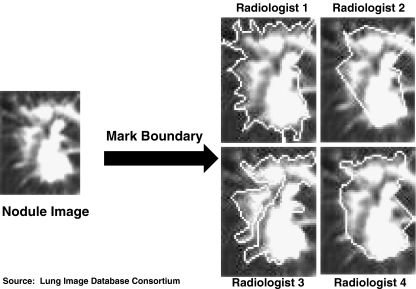
Ideally, an image should be reported and interpreted in the same way (e.g., the same perceived likelihood of malignancy) or similarly by any two radiologists; however, as much research has demonstrated, this is not often the case. Various efforts have made an attempt at tackling the problem of reducing the variability in radiologists’ interpretations of images. The Lung Image Database Consortium (LIDC) has provided a database of lung nodule images and associated radiologist ratings in an effort to provide images to aid in the analysis of computer-aided tools. Likewise, the Radiological Society of North America has developed a radiological lexicon called RadLex. As such, the goal of this paper is to investigate the feasibility of associating LIDC characteristics and terminology with RadLex terminology. If matches between LIDC characteristics and RadLex terms are found, probabilistic models based on image features may be used as decision-based rules to predict if an image or lung nodule could be characterized or classified as an associated RadLex term. The results of this study were matches for 25 (74%) out of 34 LIDC terms in RadLex. This suggests that LIDC characteristics and associated rating terminology may be better conceptualized or reduced to produce even more matches with RadLex. Ultimately, the goal is to identify and establish a more standardized rating system and terminology to reduce the subjective variability between radiologist annotations. A standardized rating system can then be utilized by future researchers to develop automatic annotation models and tools for computer-aided decision systems.
Figures


References
-
- Reeves AP, Biancardi AM, Apanasovich TV, Meyer CR, MacMahon H, Beek EJR, Kazerooni EA, et al. The Lung Image Database Consortium (LIDC): pulmonary nodule measurements, the variation, and the difference between different size metrics. Proc SPIE Int Soc Opt Eng. 2007;8:65140J.1–65140J.8.
-
- Raicu DS, Varutbangkul E, Furst JD, Armato SG., III Modeling semantics from image data: opportunities from LIDC. IJBET. 2008;2:1–22. doi: 10.1504/IJBE.2008.016838. - DOI
-
- Ochs R, Kim HJ, Angel E, Panknin C, McNitt-Gray M, Brown M. Forming a reference standard from LIDC data: impact of reader agreement on reported CAD performance, Medical Imaging 2007: Computer-Aided Diagnosis. Proc SPIE Int Soc Opt Eng. 2007;6514:65142A.
-
- Eberl MM, Fox CH, Edge SB, Carter CA, Mahoney MC: BI-RADS Classification for management of abnormal mammograms. JABFM 19:161–164 - PubMed
MeSH terms
LinkOut - more resources
Full Text Sources
Medical
Research Materials
