


Longitudinal prediction of adolescent nonsuicidal self-injury: examination of a cognitive vulnerability-stress model
- PMID: 20390800
- PMCID: PMC4626882
- DOI: 10.1080/15374410903401195
Longitudinal prediction of adolescent nonsuicidal self-injury: examination of a cognitive vulnerability-stress model
Abstract
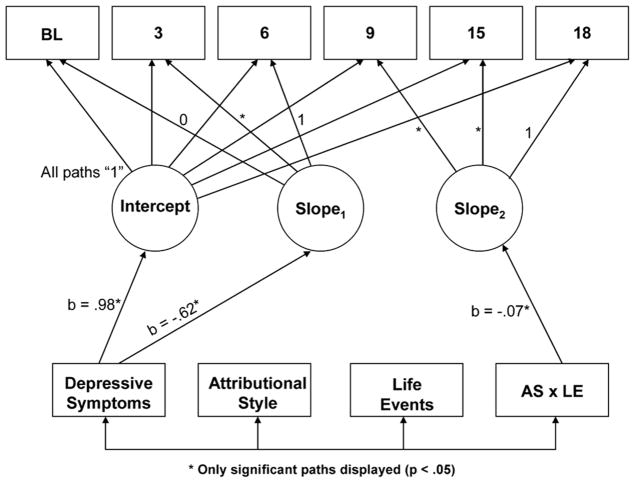
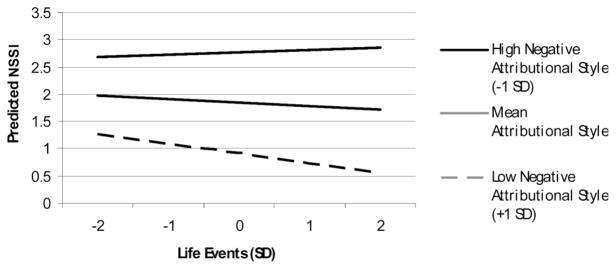
Virtually no longitudinal research has examined psychological characteristics or events that may lead to adolescent nonsuicidal self-injury (NSSI). This study tested a cognitive vulnerability-stress model as a predictor of NSSI trajectories. Clinically-referred adolescents (n = 143; 72% girls) completed measures of NSSI, depression, attributional style, and interpersonal stressors during baseline hospitalization. Levels of NSSI were reassessed 3, 6, 9, 15, and 18 months later. Latent growth curve analyses suggested that a cognitive vulnerability-stress interaction significantly predicted increases in NSSI between 9 and 18 months post-baseline. This association remained significant while considering the longitudinal association between depressive symptoms and NSSI; results were not significantly mediated by depressive symptoms at 9 months.
Figures
References
-
- Abramson LY, Alloy LB, Hogan ME, Whitehouse WG, Donovan P, Rose DT, et al. Cognitive vulnerability to depression: Theory and evidence. In: Leahy RL, Dowd ET, editors. Clinical advances in cognitive psychotherapy: Theory and application. New York: Springer; 2002. pp. 75–92.
-
- Abramson LY, Metalsky GI, Alloy LB. Hopelessness depression: A theory-based subtype of depression. Psychological Review. 1989;96:358–372.
-
- Armey MF, Crowther JH. A comparison of linear versus non-linear models of aversive self-awareness, dissociation, and nonsuicidal self-injury among young adults. Journal of Consulting and Clinical Psychology. 2008;76:9–14. - PubMed
-
- Beck AT. Cognitive models of depression. Journal of Cognitive Psychotherapy. 1987;1:5–37.
-
- Bhugra D, Thompson N, Singh J, Fellow-Smith E. Inception rates of deliberate self-harm among adolescents in West London. International Journal of Social Psychiatry. 2003;49:247–250. - PubMed
MeSH terms
Grants and funding
LinkOut - more resources
Full Text Sources
Medical
