. 2010 Aug;299(2):F300-9.
doi: 10.1152/ajprenal.00441.2009. Epub 2010 Apr 14.

RasGRP1 stimulation enhances ubiquitination and endocytosis of the sodium-chloride cotransporter

Affiliations

RasGRP1 stimulation enhances ubiquitination and endocytosis of the sodium-chloride cotransporter

Benjamin Ko et al. Am J Physiol Renal Physiol. 2010 Aug.

Abstract

The sodium-chloride cotransporter (NCC) is the principal salt-absorptive pathway in the distal convoluted tubule. Recently, we described a novel pathway of NCC regulation in which phorbol esters (PE) stimulate Ras guanyl-releasing protein 1 (RasGRP1), triggering a cascade ultimately activating ERK1/2 MAPK and decreasing NCC cell surface expression (Ko B, Joshi LM, Cooke LL, Vazquez N, Musch MW, Hebert SC, Gamba G, Hoover RS. Proc Natl Acad Sci USA 104: 20120-20125, 2007). Little is known about the mechanisms which underlie these effects on NCC activity. Regulation of NCC via changes in NCC surface expression has been reported, but endocytosis of NCC has not been demonstrated. In this study, utilizing biotinylation, internalization assays, and a dynamin dominant-negative construct, we demonstrate that the regulation of NCC by PE occurs via an enhancement in internalization of NCC and is dynamin dependent. In addition, immunoprecipitation of NCC and subsequent immunoblotting for ubiquitin showed increased ubiquitination of NCC with phorbol ester treatment. MEK1/2 inhibitors and gene silencing of RasGRP1 indicated that this effect was dependent on RasGRP1 and ERK1/2 activation. Inhibition of ubiquitination prevents any PE-mediated decrease in NCC surface expression as measured by biotinylation or NCC activity as measured by radiotracer uptake. These findings confirmed that the PE effect on NCC is mediated by endocytosis of NCC. Furthermore, ubiquitination of NCC is essential for this process and this ubiquitination is dependent upon RasGRP1-mediated ERK1/2 activation.


Figures
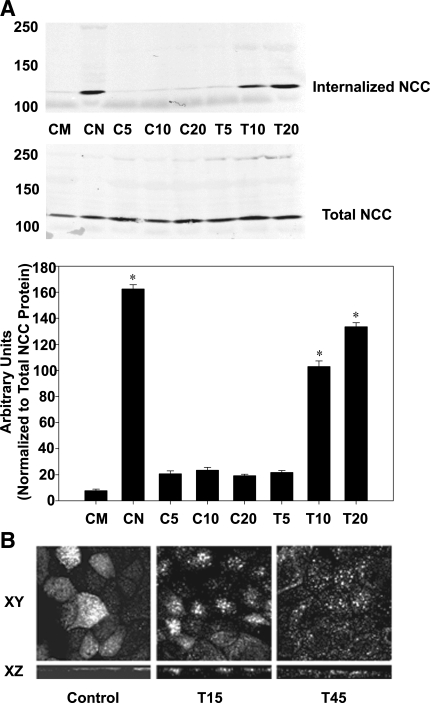
Fig. 1.
Fig. 1.
Internalization of sodium-chloride cotransporter (NCC) with TPA treatment. A: mouse distal convoluted tubule (mDCT) cells were grown to confluence, labeled with biotin at 4°C, then rewarmed at treated with 100 nM TPA or vehicle for the indicated times. Then, remaining surface biotin was stripped using mercaptoethanesulfonic acid (MesNa). Cells were lysed and biotinylated (internalized) proteins were recovered using streptavidin-agarose and immunoblotted for NCC. Densitometry is shown, normalized to total cellular NCC (n = 4). CM, time 0 control with MesNa; CN, time 0 control no MesNa; C5, DMSO control 5 min; C10, DMSO control 10 min; C20, DMSO control 20 min; T5, TPA 5 min; T10, TPA 10 min; T20, TPA 20 min. *P < 0.05 vs. control at similar time point. B: Madin-Darby canine kidney cells (MDCK) cells expressing Flag-NCC were grown to confluence on permeable supports, treated with TPA for 15 and 45 min (T15 and T45, respectively), fixed, and subjected to immunofluorescence using Flag antibodies. Confocal images were obtained in the XY and XZ planes.
Fig. 2.
Fig. 2.
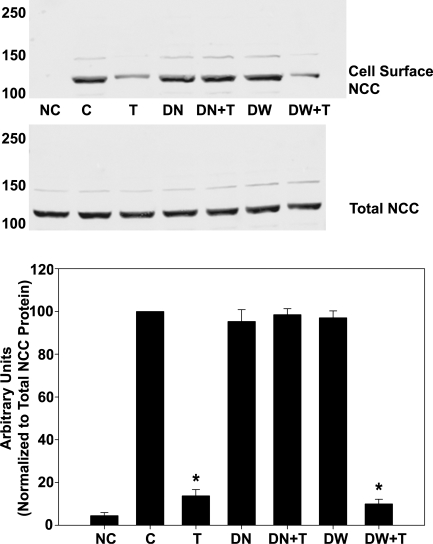
NCC surface expression after TPA treatment in cells expressing K44A dynamin. mDCT cells were grown to confluence, transfected with hemeagglutinin-tagged with either wild-type (DW) or K44A (DN) dynamin as described, then treated with 100 nM TPA (T) or vehicle (C) for 15 min before labeling with biotin at 4°C. Biotinylated (cell surface) proteins were recovered using streptavidin-agarose and immunoblotted for NCC. NC, no biotin control; DW+T, wild-type dynamin plus TPA; DN+T, DN plus TPA. Accompanying densitometry is shown (n = 4). *P < 0.05.
Fig. 3.
Fig. 3.
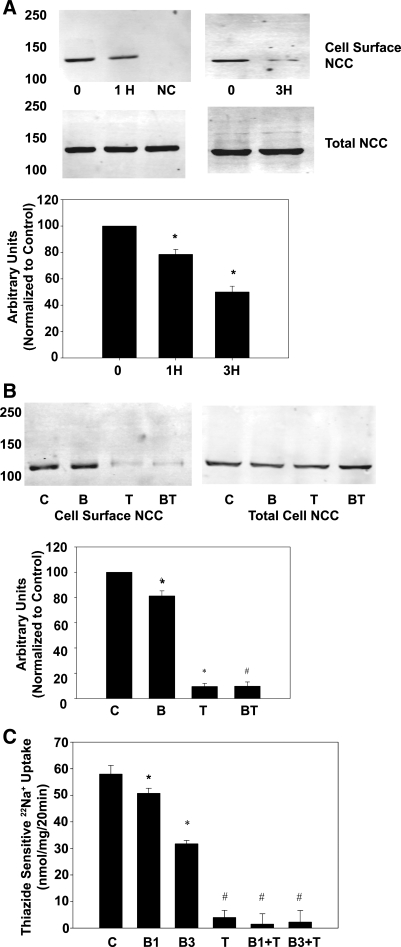
Role of forward trafficking in TPA effect on surface expression and NCC activity. A: mDCT cells were grown to confluence, treated with 10 μM befreldin A (BFA) for 0, 1 (1H), or 3 h (3H) before labeling with biotin at 4°C. Biotinylated (cell surface) proteins were recovered using streptavidin-agarose and immunoblotted for NCC. NC, no biotin control. Accompanying densitometry is shown (n = 4). *P < 0.05 compared with time 0. B: mDCT cells prepared as above were treated with 10 μM BFA or vehicle for 1 h before treatment with 100 nM TPA. Cells were then labeled with biotin at 4°C. Biotinylated (cell surface) proteins were recovered using streptavidin-agarose and immunoblotted for NCC. C, vehicle; B, BFA alone; T, TPA alone; BT, BFA plus TPA. Accompanying densitometry is shown (n = 4). *P < 0.05 compared with control. #P < 0.05 compared with BFA group. C: mDCT cells were grown to confluence, treated with BFA or vehicle for either 1 or 3 h, and then treated with 100 nM TPA (T) or vehicle for 15 min. Cells were subsequently incubated in uptake medium with 22Na+ and either vehicle or 1 mM metolazone. Radioactive uptake was determined as in materials and methods. Thiazide-sensitive uptake was calculated as the difference in radiotracer uptake between the metolazone-containing and the metolazone-free groups. C, control, B1, BFA 1 h; B3, BFA 3 h; T, TPA; B1+T, BFA 1 h plus TPA; B3+T, BFA 3 h plus TPA (n = 4). *P < 0.05 compared with control. #P < 0.05 compared with control, B1, or B3 (no statistical difference among T, B1+T, and B3+T).
Fig. 4.
Fig. 4.
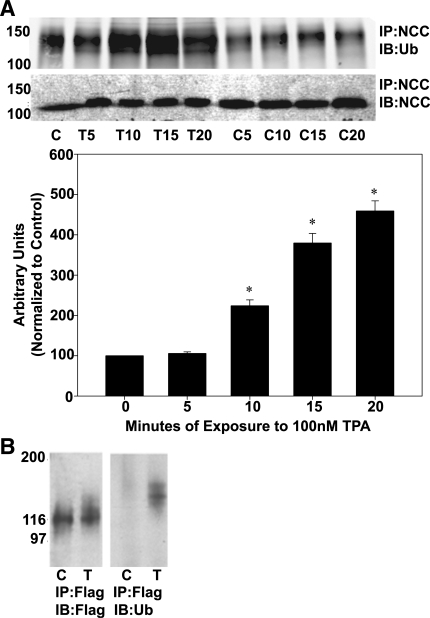
Ubiquitination of NCC after TPA treatment. A: mDCT cells were grown to confluence, treated with 100 nM TPA (T) or vehicle (DMSO, C) for the indicated times before lysis in RIPA buffer. NCC was then immunoprecipitated using NCC antibodies before immunoblotting with anti-ubiquitin or anti-NCC antibodies. Accompanying densitometry is shown (n = 4). *P < 0.01. B: MDCK cells stably expressing FLAG-tagged NCC were grown to confluence, treated for 5 min with (T) or without (C) TPA and lysed. The transporters were immunoprecipitated using rabbit FLAG antibodies (IP:Flag), and the immunoprecipitates were immunoblotted for ubiquitin (IB:Ub) or Flag (IB:Flag). Marker bands are indicated on the left by their molecular weights (in kDa).
Fig. 5.
Fig. 5.
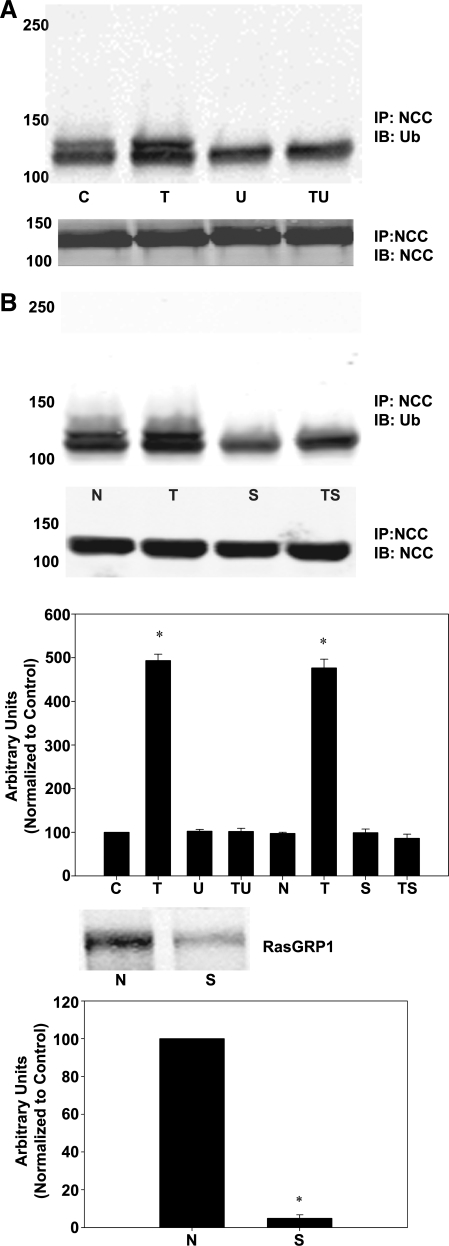
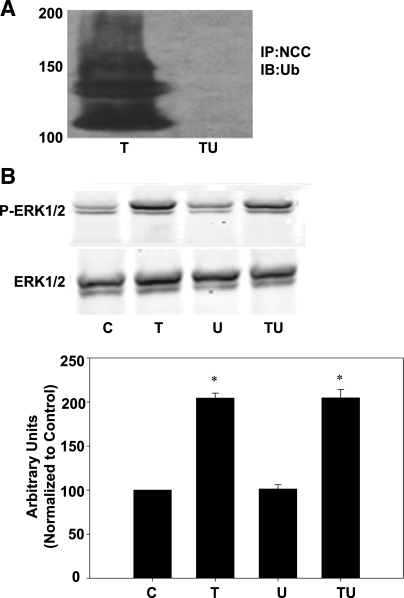
NCC ubiquitination with TPA treatment with inhibition of the Ras guanyl-releasing protein 1 (RasGRP1) ERK1/2 pathway. A: mDCT cells were grown to confluence and treated with 10 nM U0126 (U) or vehicle (DMSO, C). Cells were then treated with 100 nM TPA (T) or vehicle (DMSO, C) for 15 min before lysis in RIPA buffer. NCC was then immunoprecipitated using NCC antibodies before immunoblotting with anti-ubiquitin (Ub) or anti-NCC antibodies (NCC). TU, TPA plus U0126 group. Accompanying densitometry is shown (n = 4). *P < 0.01. B: mDCT cells were grown to confluence and transfected with siRNA for RasGRP1 (S) or nontargeting small interfering (si) RNA (N) as described. Suppression of RasGRP1 expression is shown in immunoblot (P < 0.05, n = 4). Cells were then treated with 100 nM TPA (T) or vehicle (DMSO, C) for 15 min before lysis in RIPA buffer. NCC was then immunoprecipitated before immunoblotting with anti-ubiquitin or anti-NCC antibodies as above. TS, TPA+siRNA for RasGRP1. Accompanying densitometry is shown (n = 4). *P < 0.05.
Fig. 6.
Fig. 6.
Inhibition of ubiquitination does not affect TPA-mediated ERK1/2 phosphorylation A: mDCT cells were grown to confluence, treated with 100 nM TPA (T) in the presence or absence of UBEI-41 (U) for 15 min before lysis in RIPA buffer. TU, TPA+UBEI-41. NCC was then immunoprecipitated using NCC antibodies before immunoblotting with anti-ubiquitin or anti-NCC antibodies; n = 4. B: cells treated as described in A were lysed and immunoblotted for phospho-ERK1/2 and ERK1/2; n = 4. C, control. *P < 0.05.
Fig. 7.
Fig. 7.
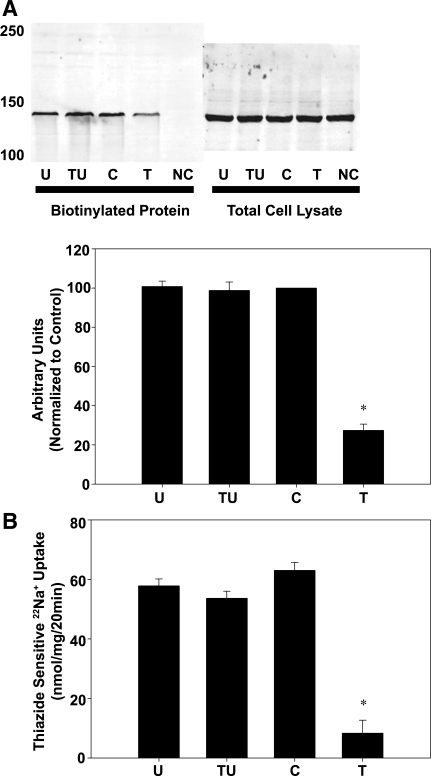
Inhibition of ubiquitination prevents a TPA-mediated decrease in NCC activity. mDCT cells were grown to confluence, treated with UBEI-41 (U) or vehicle for 15 min, and then treated with 100 nM TPA (T) or vehicle (DMSO, C) for 15 min. A: cells treated as described were labeled with biotin at 4°C. Biotinylated (cell surface) proteins were recovered using streptavidin-agarose and immunoblotted for NCC. NC, no biotin control. Accompanying densitometry is shown (n = 4). *P < 0.05. B: cells treated as above were subsequently incubated in uptake medium with 22Na+ and either vehicle or 1 mM metolazone. Radioactive uptake was determined as in materials and methods. Thiazide-sensitive uptake was calculated as the difference in radiotracer uptake between the metolazone-containing and the metolazone-free groups. TU, TPA+UBEI-41 (n = 6). *P < 0.01.

Comment in

  • Regulated endocytosis of NCC.
    Mount DB. Mount DB. Am J Physiol Renal Physiol. 2010 Aug;299(2):F297-9. doi: 10.1152/ajprenal.00280.2010. Epub 2010 May 26. Am J Physiol Renal Physiol. 2010. PMID: 20504880 Free PMC article. No abstract available.

References

    1. Anonymous Whither RNAi? Nat Cell Biol 5: 489–490, 2003 - PubMed
    1. Booth RE, Stockand JD. Targeted degradation of ENaC in response to PKC activation of the ERK1/2 cascade. Am J Physiol Renal Physiol 284: F938–F947, 2003 - PubMed
    1. Butterworth MB, Edinger RS, Ovaa H, Burg D, Johnson JP, Frizzell RA. The deubiquitinating enzyme UCH-L3 regulates the apical membrane recycling of the epithelial sodium channel. J Biol Chem 282: 37885–37893, 2007 - PubMed
    1. Cai H, Cebotaru V, Wang YH, Zhang XM, Cebotaru L, Guggino SE, Guggino WB. WNK4 kinase regulates surface expression of the human sodium chloride cotransporter in mammalian cells. Kidney Int 69: 2162–2170, 2006 - PubMed
    1. Damke H, Baba T, Warnock DE, Schmid SL. Induction of mutant dynamin specifically blocks endocytic coated vesicle formation. J Cell Biol 127: 915–934, 1994 - PMC - PubMed

Publication types

MeSH terms