


Comparison of single- and double-bundle anterior cruciate ligament reconstructions in restoration of knee kinematics and anterior cruciate ligament forces
- PMID: 20392968
- PMCID: PMC3831352
- DOI: 10.1177/0363546510361494
Comparison of single- and double-bundle anterior cruciate ligament reconstructions in restoration of knee kinematics and anterior cruciate ligament forces
Abstract
Background: Anterior cruciate ligament (ACL) deficiency alters 6 degrees of freedom knee kinematics, yet only anterior translation and internal rotation have been the primary measures in previous studies.
Purpose: To compare the 6 degrees of freedom knee kinematics and the graft forces after single- and double-bundle ACL reconstructions under various external loading conditions.
Study design: Controlled laboratory study.
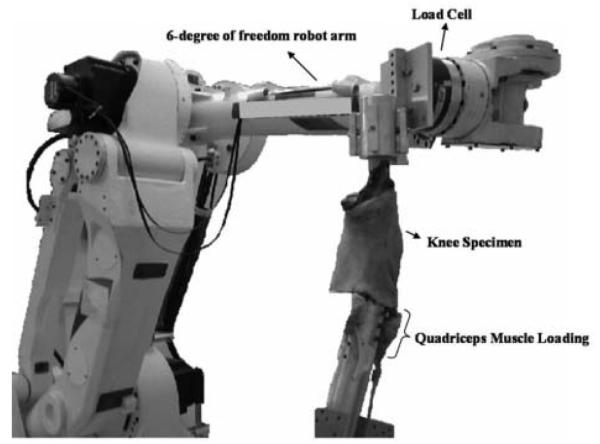
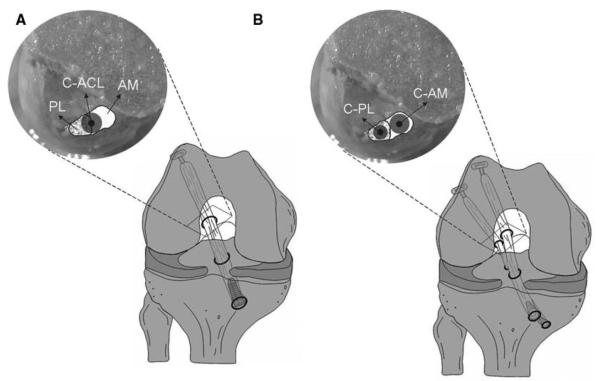
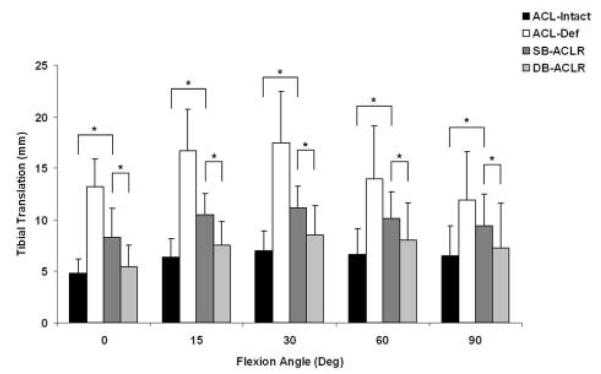
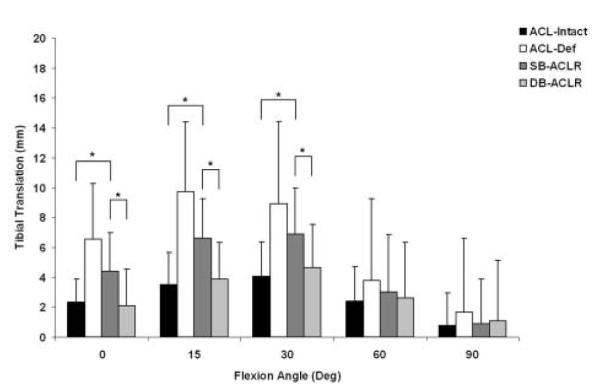
Methods: Ten human cadaveric knees were tested with a robotic testing system under 4 conditions: intact, ACL deficient, single-bundle reconstructed with a quadrupled hamstring tendon graft, and double-bundle reconstructed with 2 looped hamstring tendon grafts. Knee kinematics and forces of the ACL or ACL graft in each knee were measured under 3 loading conditions: an anterior tibial load of 134 N, a simulated quadriceps muscle load of 400 N, and combined tibial torques (10 N.m valgus and 5 N.m internal tibial torques) at 0 degrees , 15 degrees , 30 degrees , 60 degrees , and 90 degrees of knee flexion.
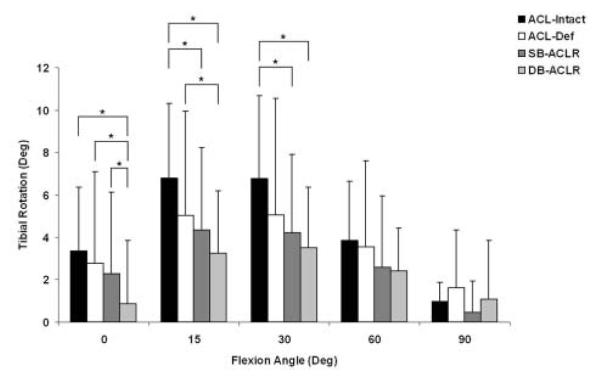
Results: The double-bundle reconstruction restored the anterior and medial laxities closer to the intact knee than the single-bundle reconstruction. However, the internal rotation of the tibia under the simulated quadriceps muscle load was significantly decreased when compared with the intact knee after both reconstructions, more so after double-bundle reconstruction (P < .05). The entire graft force of the double-bundle reconstruction was more similar to that of the intact ACL than that of the single-bundle reconstruction. However, the posterolateral bundle graft in the double-bundle reconstructed knee was overloaded as compared with the intact posterolateral bundle.
Conclusion: The double-bundle reconstruction can better restore the normal anterior-posterior and medial-lateral laxities than the single-bundle reconstruction can, but an overloading of the posterolateral bundle graft can occur in a double-bundle reconstructed knee.
Clinical relevance: Both single-bundle and double-bundle techniques cannot restore the rotational laxities and the ACL force distributions of the intact knee.
Figures
References
-
- Andriacchi TP, Briant PL, Bevill SL, Koo S. Rotational changes at the knee after ACL injury cause cartilage thinning. Clin Orthop Relat Res. 2006;442:39–44. - PubMed
-
- Diermann N, Schumacher T, Schanz S, Raschke MJ, Petersen W, Zantop T. Rotational instability of the knee: internal tibial rotation under a simulated pivot shift test. Arch Orthop Trauma Surg. 2009;129(3):353–358. - PubMed
-
- Fu FH, Shen W, Starman JS, Okeke N, Irrgang JJ. Primary anatomic double-bundle anterior cruciate ligament reconstruction: a preliminary 2-year prospective study. Am J Sports Med. 2008;36(7):1263–1274. - PubMed
Publication types
MeSH terms
Grants and funding
LinkOut - more resources
Full Text Sources
Other Literature Sources
Medical
