


Extraction of individual muscle mechanical action from endpoint force
- PMID: 20393065
- PMCID: PMC2888544
- DOI: 10.1152/jn.00956.2009
Extraction of individual muscle mechanical action from endpoint force
Abstract
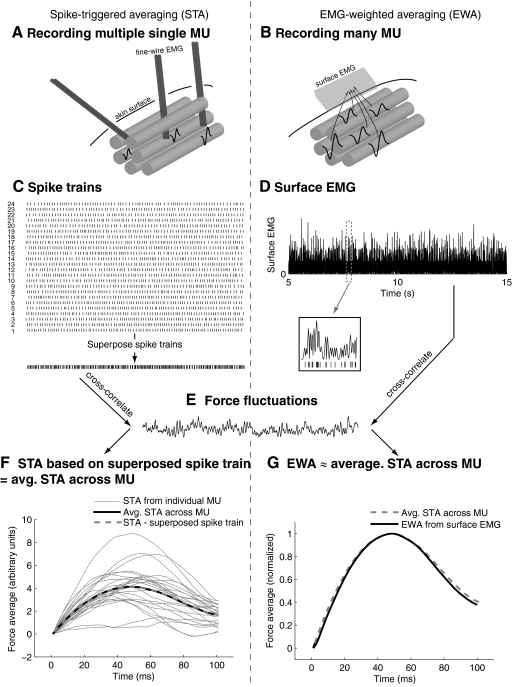
Most motor tasks require the simultaneous coordination of multiple muscles. That coordination is poorly understood in part because there is no noninvasive means of isolating a single muscle's contribution to the resultant endpoint force. The contribution of a single motor unit to isometric tasks can, however, be characterized using the spike-triggered averaging (STA) technique, applied to a single motor unit's spike train. We propose that a technique analogous to STA, which we call electromyogram (EMG)-weighted averaging (EWA), can be applied to surface EMGs to extract muscle mechanical action from the natural endpoint force fluctuations generated during steady isometric contraction. We demonstrate this technique on simultaneous recordings of fingertip force and surface EMG from the first dorsal interosseous (FDI) and extensor indicis (EI) of humans. The EWA direction was approximately the same across a wide range of fingertip force directions, and the average EWA direction was consistent with mechanical action direction of these muscles estimated from cadaveric and imaging data: the EWA directions were 193 +/- 2 degrees for the FDI and 71 +/- 5 degrees for the EI (95% confidence). EWA transient behavior also appears to capture temporal characteristics of muscle force fluctuations with peak force time and general waveform shape similar to that of the associated spike-triggered averages from single motor units. The EWA may provide a means of empirically characterizing the complex transformation between muscle force and endpoint force without the need for invasive electrode recordings or complex anatomical measurements of musculoskeletal geometry.
Figures
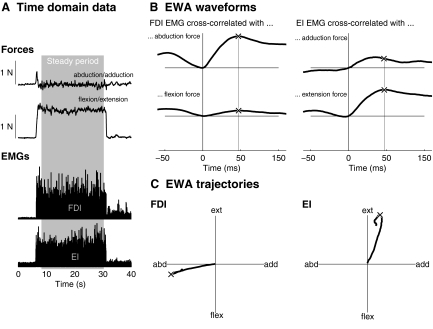
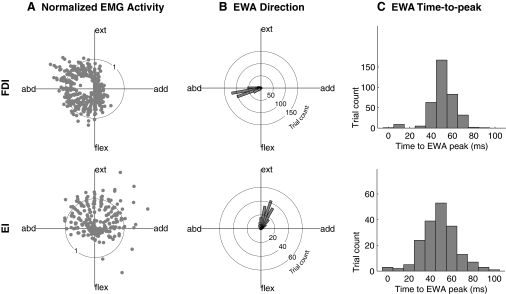
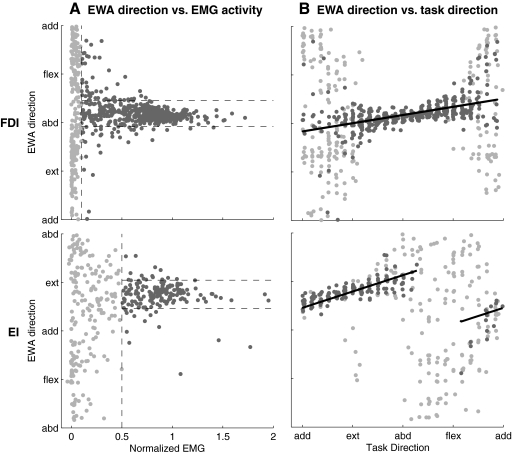
 ) trials. A linear fit (—) to the above-threshold trials illustrates small but predictable shifts in EWA direction with changes in task direction.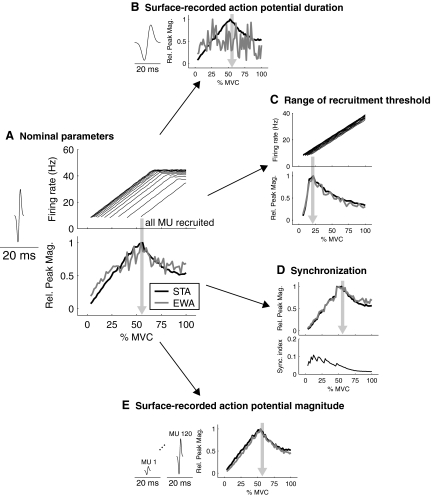
References
-
- An KN, Ueba Y, Chao EY, Cooney WP, Linscheid RL. Tendon excursion and moment arm of index finger muscles. J Biomechan 16: 419–425, 1983 - PubMed
-
- Berens P. Circstat: a matlab toolbox for circular statistics. J Stat Software 31: 1–21, 2009
-
- Binder MD, Powers RK. Relationship between simulated common synaptic input and discharge synchrony in cat spinal motoneurons. J Neurophysiol 86: 2266–2275, 2001 - PubMed
-
- Blaschak MJ, Powers RK, Rymer WZ. Disturbances of motor output in a cat hindlimb muscle after acute dorsal spinal hemisection. Exp Brain Res 71: 377–387, 1988 - PubMed
Publication types
MeSH terms
Grants and funding
LinkOut - more resources
Full Text Sources
Miscellaneous
