. 2010 Apr 15;464(7291):1012-7.
doi: 10.1038/nature08925.

Real-time tRNA transit on single translating ribosomes at codon resolution

Affiliations

Real-time tRNA transit on single translating ribosomes at codon resolution

Sotaro Uemura et al. Nature. .

Abstract

Translation by the ribosome occurs by a complex mechanism involving the coordinated interaction of multiple nucleic acid and protein ligands. Here we use zero-mode waveguides (ZMWs) and sophisticated detection instrumentation to allow real-time observation of translation at physiologically relevant micromolar ligand concentrations. Translation at each codon is monitored by stable binding of transfer RNAs (tRNAs)-labelled with distinct fluorophores-to translating ribosomes, which allows direct detection of the identity of tRNA molecules bound to the ribosome and therefore the underlying messenger RNA (mRNA) sequence. We observe the transit of tRNAs on single translating ribosomes and determine the number of tRNA molecules simultaneously bound to the ribosome, at each codon of an mRNA molecule. Our results show that ribosomes are only briefly occupied by two tRNA molecules and that release of deacylated tRNA from the exit (E) site is uncoupled from binding of aminoacyl-tRNA site (A-site) tRNA and occurs rapidly after translocation. The methods outlined here have broad application to the study of mRNA sequences, and the mechanism and regulation of translation.


Figures

Figure 1
Figure 1. Translation in zero-mode waveguides
a. Schematic of experimental setup. ZMWs are cylindrical nanostructures with varying diameters (~50-200 nm). The aluminum side wall and quartz bottom surfaces are derivatized to allow specific biotin-streptavidin interactions on the quartz surface and to block non-specific interactions of molecules with ZMWs,. Ribosomal complexes are specifically immobilized in the bottom of derivatized ZMWs using biotinylated mRNAs. Ternary complexes Cy5-labeled Phe-tRNAPhe -EF-Tu(GTP) and Cy2-labeled Lys-tRNALys -EF-Tu(GTP), along with EF-G(GTP), are delivered to a ZMW surface-immobilized, initial ribosome complex containing Cy3-labeled fMet-tRNAfMet. Fluorescence is excited by illumination at 488, 532 and 642 nm, and Cy2, Cy3 and Cy5 fluorescence are simultaneously detected using previously described instrumentation, b. Expected signal sequence. Initiation complexes are detected by fluorescence of fMet-(Cy3)tRNAfMet bound at an initiation codon. Fluorescent tRNAs are delivered as TCs. Arrival of Phe-(Cy5)tRNAPhe or Lys-(Cy2)tRNALys at the ribosomal A site is marked by red or blue fluorescent pulse. At low TC concentration, tRNA arrival times are slow (>>1 s), and Cy5- or Cy2-labeled tRNAs can photobleach on the ribosome while waiting for translocation. In the absence of photobleaching, the length of a pulse represents the transit time of that tRNA on the ribosome. At high TC concentrations, tRNA arrival times are fast (<<1 s), and fluorescent pulses are overlapped, which indicates simultaneous occupancy by 2 tRNAs. The tRNA occupancy count is shown below the schematic trace.
Figure 2
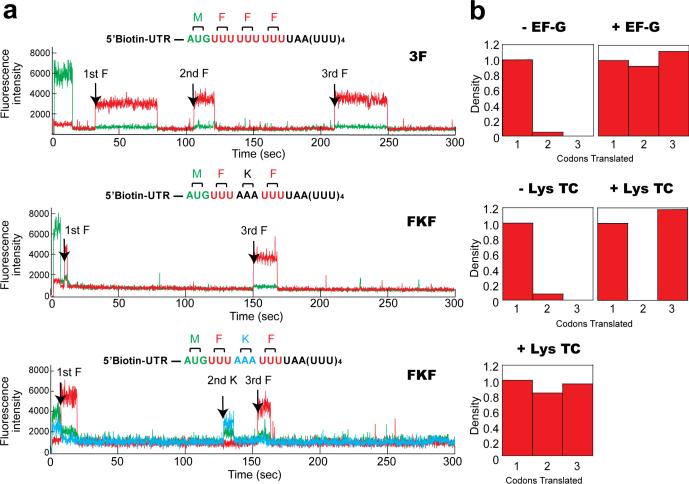
Figure 2. Monitoring translation via fluorescent tRNA binding events
a. Representative single-ZMW traces of ribosomes translating MFFF mRNA (top) and MFKF mRNA (bottom) in the presence of 30 nM EF-G and 30 nM TC. b. The number of fluorescent pulses observed in ZMWs depends on the presence of EF-G and TC. Event histograms for the three experiments in the absence (n=341) and presence (n=304) of 30 nM EF-G (top), and in the absence (n=278) and presence (n=297) of 30 nM unlabeled Lys-tRNALys TC (middle) and presence (n=355) of 30 nM Lys-(Cy2)-tRNALys TC (bottom). Histograms are normalized by the number of ribosomes showing single events.
Figure 3
Figure 3. Real-time translation at near physiological concentrations
a. Two heteropolymeric mRNAs encoding 13 amino acids were used: M(FK)6 and M(FKK)4. Translation was observed in the presence of 200 nM Phe-(Cy5)tRNAPhe, 200 nM Lys-(Cy2)tRNALys TC and 500 nM EF-G as a series of fluorescent pulses that mirror the mRNA sequence. A long Cy2 pulse is observed upon arrival of the ribosome at the stop codon. Brief sampling pulses (<100 ms) of both Lys-(Cy2)tRNALys and Phe-(Cy5)tRNAPhe TC are observed after arrival at the stop codon. b. Event histograms for translation of M(FK)6 showing translation out to 12 elongation codons (red, n=381). In the presence of 1 μM erythromycin, translation (blue, n=201) is stalled at codon 8 of the mRNA. c. Analysis of translation rates at each codon in M(FK)6. Mean times (avg. ± s. d.) between tRNA arrival events are plotted for translation in the presence of 200nM TC and 30, 100 and 500 nM EF-G. d. Overall tRNA transit times (avg. ± s. d.) for codons 2-12 at (from left) 200 nM TC and 30, 100, or 200 nM EF-G; 500 nM TC and 500 nM EF-G; and 200 nM TC/500 nM EF-G in the presence of 1 μM fusidic acid. e. Cumulative translation times (avg. ± s. d.) for each codon in M(FK)6 at 200 nM TC and 30, 100, or 200 nM EF-G; 500 nM TC and 500 nM EF-G, and 200 nM TC/500 nM EF-G in the presence of 1 μM fusidic acid.
Figure 4
Figure 4. A-site sampling on ribosomes stalled at the stop codon
a. Fast sampling events at the stop codon position of the M(FK)6 template were observed in the presence of 200 nM Phe-(Cy5)tRNAPhe, 200 nM Lys-(Cy2)tRNALys TC and 500 nM EF-G . b. Dwell time histograms individual sampling pulses of Phe-(Cy5)tRNAPhe (left) and Lys-(Cy2)tRNALys (right). Both histograms are well approximated by a single exponential fit. c. The frequency of fast sampling (avg. ± s. d.) increased linearly with TC concentration (left), while sampling dwell time (avg. ± s. d.) did not depend on TC concentration (right).
Figure 5
Figure 5. Monitoring the dynamic tRNA occupancy of translating ribosomes
a. Post-synchronization plots for time-resolved tRNA occupancy at codons 2-6 during translation of M(FK)6. Two-dimensional histograms are post-synchronized in time with respect to each tRNA transit event (1st F~5th F) at 500, 100, and 30 nM EF-G, and at 500 nM EF-G in the presence of fusidic acid. b. tRNA occupancy time (avg. ± s. d.) at 500, 100, and 30 nM EF-G, and at 500 nM EF-G in the presence of fusidic acid.

Comment in

References

    1. Green R, Noller HF. Ribosomes and translation. Annu. Rev. Biochem. 1997;66:679–716. - PubMed
    1. Moazed D, Noller HF. Intermediate states in the movement of transfer RNA in the ribosome. Nature. 1989;342:142–148. - PubMed
    1. Hausner TP, Geigenmüller U, Nierhaus KH. The allosteric three –site model for the ribosomal elongation cycle. New insights into the inhibition mechanism of aminoglycosides, thiostrepton, and viomycin. J. Biol. Chem. 1988;263:13103–13111. - PubMed
    1. Rodnina MW, Wintermeyer W. Fidelity of aminoacyl-tRNA selection on the ribosome : kinetic and structural mechanisms. Annu. Rev. Biochem. 2001;70:415–435. - PubMed
    1. Agirrezabala X, et al. Visualization of the hybrid state of tRNA binding promoted by spontaneous racheting of the ribosome. Mol. Cell. 2008;32:190–197. - PMC - PubMed

Publication types