. 2010 Jun 1;201(11):1743-52.
doi: 10.1086/652497.

Genetic requirements for the survival of tubercle bacilli in primates

Affiliations

Genetic requirements for the survival of tubercle bacilli in primates

Noton K Dutta et al. J Infect Dis. .

Abstract

Background: Tuberculosis (TB) leads to the death of 1.7 million people annually. The failure of the bacille Calmette-Guérin vaccine, synergy between AIDS and TB, and the emergence of drug resistance have worsened this situation. It is imperative to delineate the mechanisms employed by Mycobacterium tuberculosis to successfully infect and persist in mammalian lungs.

Methods: Nonhuman primates (NHPs) are arguably the best animal system to model critical aspects of human TB. We studied genes essential for growth and survival of M. tuberculosis in the lungs of NHPs experimentally exposed to aerosols of an M. tuberculosis transposon mutant library.

Results: Mutants in 108 M. tuberculosis genes (33.13% of all genes tested) were attenuated for in vivo growth. Comparable studies have reported the attenuation of only approximately 6% of mutants in mice. The M. tuberculosis mutants attenuated for in vivo survival in primates were involved in the transport of various biomolecules, including lipid virulence factors; biosynthesis of cell-wall arabinan and peptidoglycan; DNA repair; sterol metabolism; and mammalian cell entry.

Conclusions: Our study highlights the various virulence mechanisms employed by M. tuberculosis to overcome the hostile environment encountered during infection of primates. Prophylactic approaches aimed against bacterial factors that respond to such in vivo stressors have the potential to prevent infection at an early stage, thus likely reducing the extent of transmission of M. tuberculosis.


Conflict of interest statement

The authors have no conflicts of interest with this manuscript. Contributions: Funding -DK and AAL; Research design - DK, NKD, SM, MR and AAL; Mtb Himar1 mutants -GL and SKJ; research -NKD, SM, XA, NAB, CJR, PJD, LAD, data analysis: DK, NKD, GL, MRL; Writing -DK, with contributions from NKD and AAL. A preliminary analysis of these results was presented at the Keystone meeting on Tuberculosis: Biology, Pathology and Therapy (Poster abstract # 189), January 25 – 30, 2009.

Figures

Figure 1
Figure 1
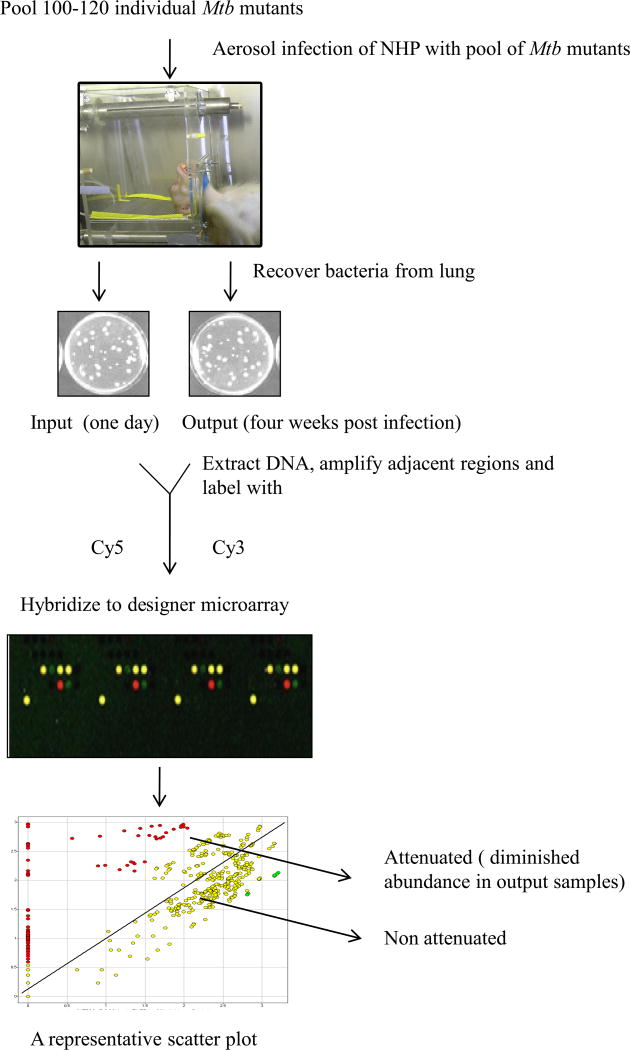
The DeADMAn approach. Individual Mtb mutants were used to form three distinct pools, each comprising on an equal quantity of 100–120 mutants. NHPs are exposed to infectious aerosols of each pool, and are either subjected to necropsy 24 hr after infection (input), or euthanized when they develop (28.7±4.5 days) pulmonary TB (output). Mtb CFUs obtained from both groups of animals are then used for DeADMAn, to identify Mtb genes required for survival in primate lungs.
Figure 2
Figure 2
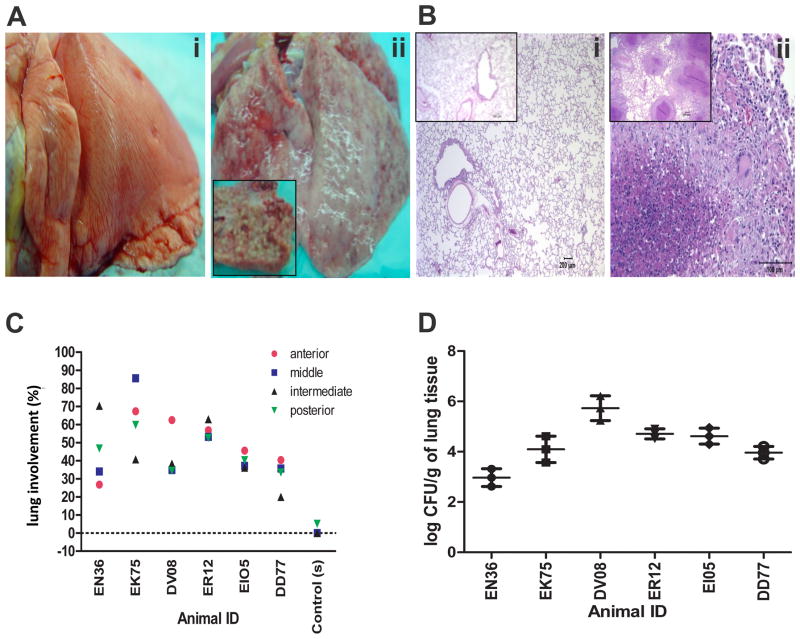
Disease progression (A) Gross lung pathology (i) lung (input pool -BG22) without gross lesions, (ii) lung (output pool - EI05). Inset: Cross section of the left caudal lobe displays miliary 2mm white granulomas throughout the parenchyma. (B) Histological evaluation of lung tissue sections of Day 1(Input pool) and 4 weeks (Output pool) post-infected macaques. (i) animals belonging to the input pool [DG82 and BD62 (Inset)] displayed normal lung pathology whereas (ii) animals belonging to the output pool [EN36 and EK75(Inset)] exhibited typical pulmonary granulomas. (C) Pathology score of infected animals - percent involvement from a random sample selected from each lobe of the right lung. Line paralleled to 0 indicates the average value of six input animals. (D) The output pool was obtained by harvesting NHP lungs 4 weeks post infection. The results are shown as mean CFU / g ± SD of three replicates.
Figure 3
Figure 3
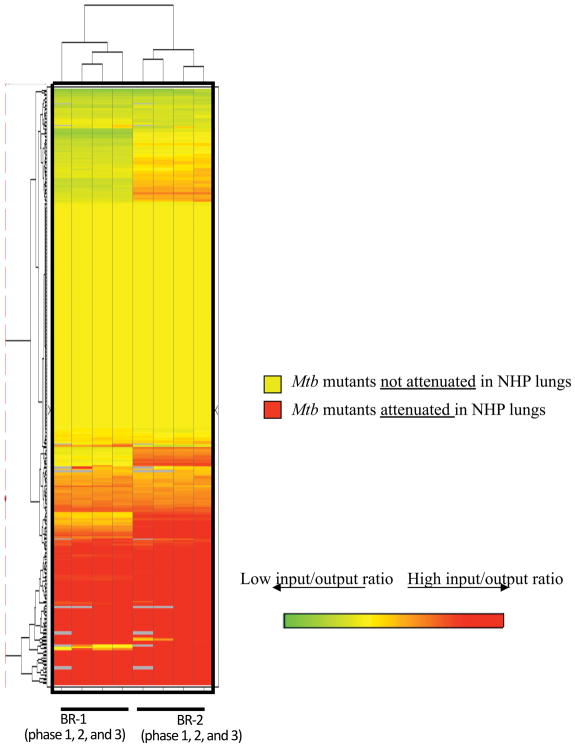
Hierarchical clustering of genes required for survival in NHPs. Log2 ratios were calculated based on log2 transformed output and input signals. BR-1: Normalized log2 ratio (input/output) from the first biological replicate animal of all three phases (six animals in total); BR-2: Normalized log2 ratio (input/output) from the second biological replicate animal of all three phases (six animals in total).
Figure 4
Figure 4
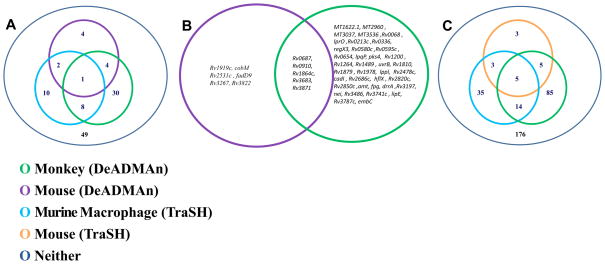
Venn diagrams show the degree of association between the attenuated mutants of Mtb genes in different models. (A) Out of 108 tested mutants, nine and five Mtb Tn mutants, attenuated for survival in the macrophage TraSH and mouse DeADMAn models respectively are common with the NHP DeADMAn model. (B) List of Mtb transposon (Tn) mutants, attenuated for survival in both the monkey and mouse aerosol DeADMAn models. (C) Out of 326 tested mutants, ten and nineteen Mtb Tn mutants, attenuated for survival in the mouse and macrophage TraSH models respectively were also attenuated in NHPs. Significant pair wise association between different experiments and models was tested based on a chi squared test and phi coefficient.

References

    1. Dye C. Global epidemiology of tuberculosis. Lancet. 2006;367:938–40. - PubMed
    1. Rohde K, Yates RM, Purdy GE, Russell DG. Mycobacterium tuberculosis and the environment within the phagosome. Immunol Rev. 2007;219:37–54. - PubMed
    1. Smith I. Mycobacterium tuberculosis pathogenesis and molecular determinants of virulence. Clin Microbiol Rev. 2003;16:463–96. - PMC - PubMed
    1. Sassetti CM, Rubin EJ. Genetic requirements for mycobacterial survival during infection. Proc Natl Acad Sci USA. 2003;100:12989–94. - PMC - PubMed
    1. Rengarajan J, Bloom BR, Rubin EJ. Genome-wide requirements for Mycobacterium tuberculosis adaptation and survival in macrophages. Proc Natl Acad Sci USA. 2005;102:8327–32. - PMC - PubMed

Publication types