Socioeconomic status and prevalence of obesity and diabetes in a Mexican American community, Cameron County, Texas, 2004-2007
- PMID: 20394692
- PMCID: PMC2879985
Socioeconomic status and prevalence of obesity and diabetes in a Mexican American community, Cameron County, Texas, 2004-2007
Abstract
Introduction: Mexican Americans are at increased risk for obesity and diabetes. We established a cohort on the United States-Mexico border to determine the prevalence of obesity and diabetes in this Mexican American population and to see whether minor economic advantages had any effect on health.
Methods: We randomly selected and extensively documented 810 people aged 35 to 64 years. Weighted data were analyzed to establish prevalence of obesity and diabetes and other markers of poor health such as elevated glycated hemoglobin levels.
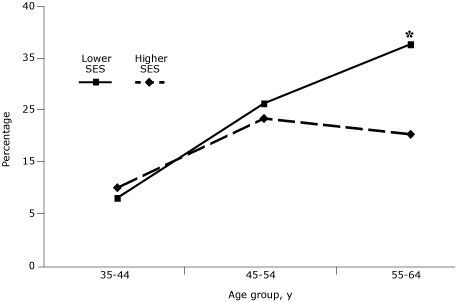
Results: Rates of obesity (body mass index > or = 30 kg/m(2)) were 57% in the first (lower) of 4 socioeconomic strata by income and were 55.5% in the third (higher). People in the higher socioeconomic stratum were significantly less likely to have undiagnosed diabetes (2% vs 9%). Among people aged 55 to 64 years, rates of diabetes were significantly higher among those in the lower socioeconomic stratum than among those in the higher stratum. Rates of undiagnosed diabetes had similar differences. Approximately three-fourths of the respondents reported having no health insurance, and we found no difference between people in different socioeconomic strata.
Conclusion: Rates of obesity and diabetes in this border community are among the highest in the United States. Belonging to the lower socioeconomic stratum significantly increased the likelihood of having undiagnosed diabetes and, in patients too young to be eligible for Medicare, the overall risk of developing diabetes. Modest improvement in income has a beneficial effect on health in this racial/ethnic minority community.
Figures
References
-
- Cowie CC, Rust KF, Byrd-Holt DD, Eberhardt MS, Flegal KM, Engelgau MM, et al. Prevalence of diabetes and impaired fasting glucose in adults in the U.S. population: National Health and Nutrition Examination Survey 1999-2002. Diabetes Care. 2006;29(6):1263–1268. - PubMed
-
- Umpierrez GE, Gonzalez A, Umpierrez D, Pimentel D. Diabetes mellitus in the Hispanic/Latino population: an increasing health care challenge in the United States. Am J Med Sci. 2007;334(4):274–282. - PubMed
-
- Ogden CL, Carroll MD, Curtin LR, McDowell MA, Tabak CJ, Flegal KM. Prevalence of overweight and obesity in the United States, 1999-2004. JAMA. 2006;295(13):1549–1555. - PubMed
-
- Gregg EW, Cheng YJ, Narayan KM, Thompson TJ, Williamson DF. The relative contributions of different levels of overweight and obesity to the increased prevalence of diabetes in the United States: 1976-2004. Prev Med. 2007;45(5):348–352. - PubMed
-
- Harris MI, Flegal KM, Cowie CC, Eberhardt MS, Goldstein DE, Little RR, et al. Prevalence of diabetes, impaired fasting glucose, and impaired glucose tolerance in U.S. adults. The Third National Health and Nutrition Examination Survey, 1988-1994. Diabetes Care. 1998;21(4):518–524. - PubMed
Publication types
MeSH terms
Grants and funding
LinkOut - more resources
Full Text Sources
Medical