


Mouse model predicts effects of smoking and varenicline on event-related potentials in humans
- PMID: 20395358
- PMCID: PMC2878727
- DOI: 10.1093/ntr/ntq049
Mouse model predicts effects of smoking and varenicline on event-related potentials in humans
Abstract
Background: Nicotine alters auditory event-related potentials (ERPs) in rodents and humans and is an effective treatment for smoking cessation. Less is known about the effects of the partial nicotine agonist varenicline on ERPs.
Methods: We measured the effects of varenicline and nicotine on the mouse P20 and varenicline and smoking on the human P50 in a paired-click task. Eighteen mice were tested following nicotine, varenicline, and their combination. One hundred and fourteen current smokers enrolled in a placebo-controlled within-subject crossover study to test the effects of varenicline during smoking and abstinence. Thirty-two subjects participated in the ERP study, with half receiving placebo first and half varenicline first (VP).
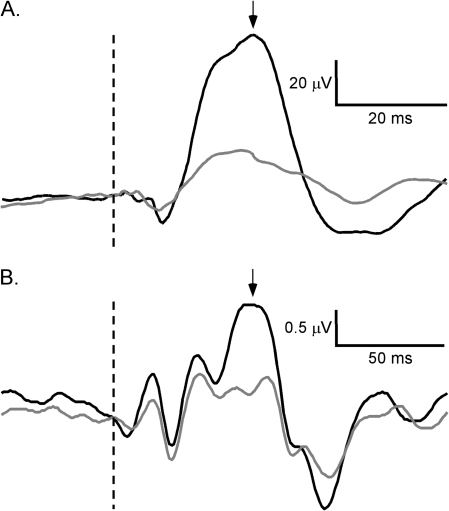
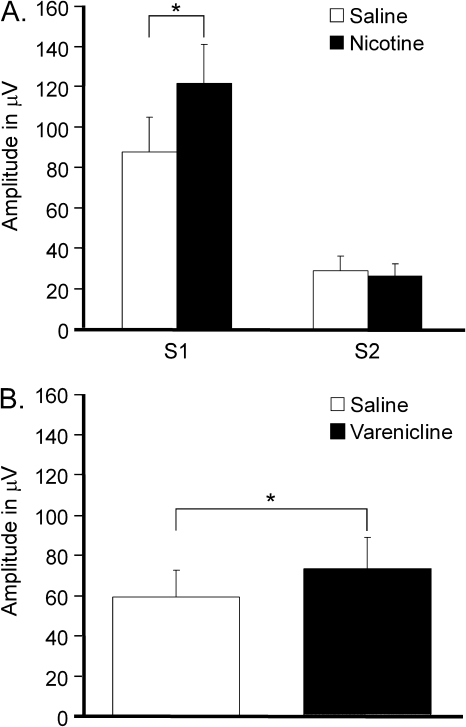
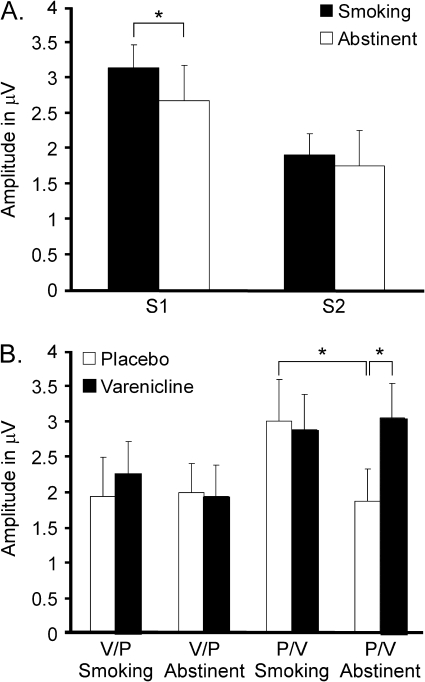
Results: Nicotine and varenicline enhanced mouse P20 amplitude, while nicotine improved P20 habituation by selectively increasing the first-click response. Similar to mice, abstinence reduced P50 habituation relative to smoking by reducing the first-click response. There was no effect of varenicline on P50 amplitude during abstinence across subjects. However, there was a significant effect of medication order on P50 amplitude during abstinence. Subjects in the PV group displayed reduced P50 during abstinence, which was blocked by varenicline. However, subjects in the VP group did not display abstinence-induced P50 reduction.
Conclusions: Data suggest that smoking improves sensory processing. Varenicline mimics amplitude changes associated with nicotine and smoking but fails to alter habituation. The effect of medication order suggests a possible carryover effect from the previous arm. This study supports the predictive validity of ERPs in mice as a marker of drug effects in human studies.
Figures
References
-
- Adler LE, Hoffer LD, Wiser A, Freedman R. Normalization of auditory physiology by cigarette smoking in schizophrenic patients. American Journal of Psychiatry. 1993;150:1856–1861. - PubMed
-
- Adler LE, Hoffer LJ, Griffith J, Waldo MC, Freedman R. Normalization by nicotine of deficient auditory sensory gating in the relatives of schizophrenics. Biological Psychiatry. 1992;32:607–616. - PubMed
-
- Adler LE, Olincy A, Waldo M, Harris JG, Griffith J, Stevens K, et al. Schizophrenia, sensory gating, and nicotinic receptors. Schizophrenia Bulletin. 1998;24:189–202. - PubMed
-
- Adler LE, Pang K, Gerhardt G, Rose GM. Modulation of the gating of auditory evoked potentials by norepinephrine: Pharmacological evidence obtained using a selective neurotoxin. Biological Psychiatry. 1988;24:179–190. - PubMed
Publication types
MeSH terms
Substances
LinkOut - more resources
Full Text Sources
Medical
Research Materials
