Review
. 2010:2010:845396.
doi: 10.1155/2010/845396. Epub 2010 Apr 8.

The bright and the dark sides of DNA repair in stem cells

Affiliations
Review

The bright and the dark sides of DNA repair in stem cells

Guido Frosina. J Biomed Biotechnol. 2010.

Abstract

DNA repair is a double-edged sword in stem cells. It protects normal stem cells in both embryonic and adult tissues from genetic damage, thus allowing perpetuation of intact genomes into new tissues. Fast and efficient DNA repair mechanisms have evolved in normal stem and progenitor cells. Upon differentiation, a certain degree of somatic mutations becomes more acceptable and, consequently, DNA repair dims. DNA repair turns into a problem when stem cells transform and become cancerous. Transformed stem cells drive growth of a number of tumours (e.g., high grade gliomas) and being particularly resistant to chemo- and radiotherapeutic agents often cause relapses. The contribution of DNA repair to resistance of these tumour-driving cells is the subject of intense research, in order to find novel agents that may sensitize them to chemotherapy and radiotherapy.


Figures
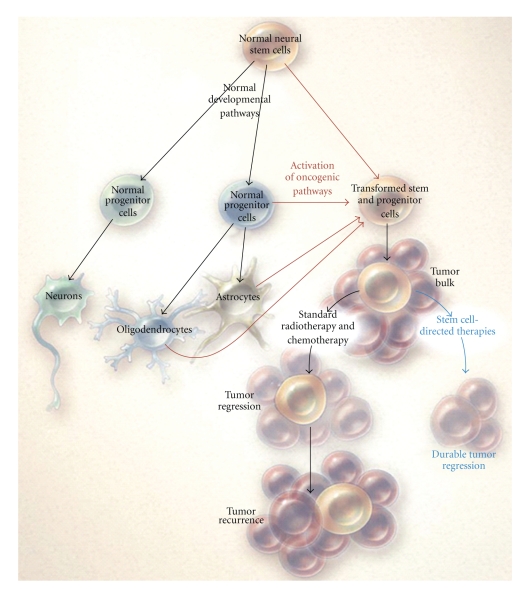
Figure 1
Figure 1
Resistance in GSC. Normal NSC self-renew and give rise to multipotential progenitor cells that form neurons, oligodendroglia, and astrocytes. GSC arise from the transformation of either NSC or progenitor cells (red) or, less likely, from de-differentiation of oligodendrocytes or astrocytes (thin red arrows) and lead to malignant gliomas. GSC are relatively resistant to standard treatments such as radiation and chemotherapy and lead to regrowth of the tumor after treatment. Therapies directed at stem cells can deplete these cells and potentially lead to more durable tumor regression (blue) (from [60] with permission).
Figure 2
Figure 2
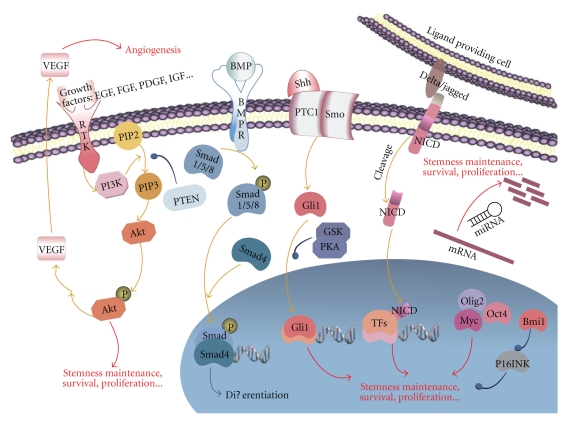
Complex signal pathways and cellular factors regulate GSC. GSC are controlled at multiple levels by complicated regulatory networks. Signals initiated by receptor tyrosine kinases (RTK), bone morphogenetic protein receptors (BMPR), Hedgehog, and Notch result in complicated intracellular events to help balance self-renewal and differentiation of GSC as well as the promotion of cell survival and proliferation. Intracellular regulators including transcriptional factors (Olig2, Myc, Oct4, etc.), epigenetic modifiers (Bmi1), and microRNAs are also highly potent of maintaining GSC populations due to their ability to regulate massive downstream targets simultaneously (from [74] with permission).
Figure 3
Figure 3
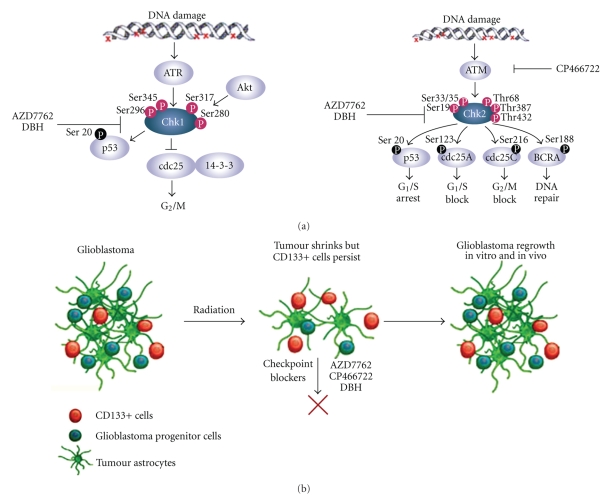
Cell cycle checkpoint pathways, possible targets in GSC. (a) Once DNA damage is identified with the aid of sensors, the checkpoint transducers ATM and ATR undergo conformational change and/or localisation, resulting in their activation. ATM and ATR activate a series of downstream molecules, including the checkpoint kinases Chk1 and Chk2. The latter inactivate CDC25 phosphatases, culminating in cell cycle arrest. AZD7762 (AstraZeneca) and DBH are specific inhibitors of Chk1 and Chk2 kinases. CP466722 (Pfizer) is a specific inhibitor of ATM (modified from [82] with permission). (b) Targeting GSC may yield durable tumor regression. Glioblastomas are heterogeneous tumours containing CD133-positive GSC among other, more differentiated, CD133-negative cells, including glioblastoma progenitor cells. Following radiation, the bulk glioblastoma responds and the tumour shrinks but CD133-positive cells activate checkpoint controls for DNA repair more strongly than CD133-negative cells, resist radiation and prompt the tumour to regrow. These cells could be targeted with DNA-checkpoint blockers (e.g., AZD7762, CP466722 and DBH) to render them radiosensitive (modified from [83] with permission).

References

    1. Hong Y, Cervantes RB, Tichy E, Tischfield JA, Stambrook PJ. Protecting genomic integrity in somatic cells and embryonic stem cells. Mutation Research. 2007;614(1-2):48–55. - PubMed
    1. Tichy ED, Stambrook PJ. DNA repair in murine embryonic stem cells and differentiated cells. Experimental Cell Research. 2008;314(9):1929–1936. - PMC - PubMed
    1. Park Y, Gerson SL. DNA repair defects in stem cell function and aging. Annual Review of Medicine. 2005;56:495–508. - PubMed
    1. Lin Q, Donahue SL, Ruley HE. Genome maintenance and mutagenesis in embryonic stem cells. Cell Cycle. 2006;5(23):2710–2714. - PubMed
    1. Maynard S, Swistowska AM, Lee JW, et al. Human embryonic stem cells have enhanced repair of multiple forms of DNA damage. Stem Cells. 2008;26(9):2266–2274. - PMC - PubMed

Publication types