


Impact of dronedarone in atrial fibrillation and flutter on stroke reduction
- PMID: 20396635
- PMCID: PMC2854052
- DOI: 10.2147/cia.s8883
Impact of dronedarone in atrial fibrillation and flutter on stroke reduction
Abstract
Background: Dronedarone has been developed for treatment of atrial fibrillation (AF) or atrial flutter (AFL). It is an amiodarone analogue but noniodinized and without the same adverse effects as amiodarone.
Objective and methods: This is a review of 7 studies (DAFNE, ADONIS, EURIDIS, ATHENA, ANDROMEDA, ERATO and DIONYSOS) on dronedarone focusing on efficacy, safety and prevention of stroke. There was a dose-finding study (DAFNE), 3 studies focusing on maintenance of sinus rhythm (ADONIS, EURIDIS and DIONYSOS), 1 study focusing on rate control (ERATO) and 2 studies investigating mortality and morbidity (ANDROMEDA and ATHENA).
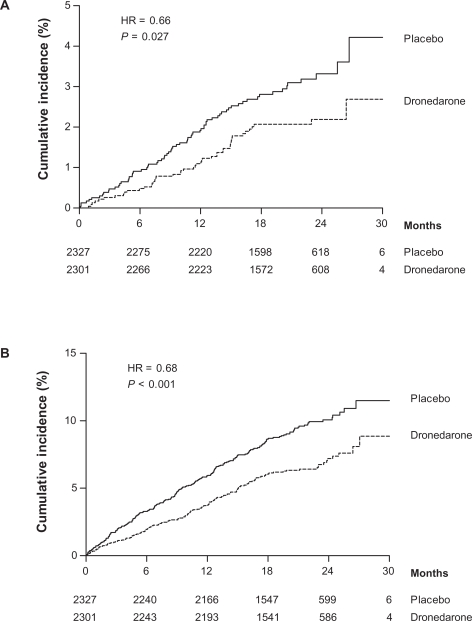
Results: The target dose for dronedarone was established in the DAFNE study to be 400 mg twice daily. Both EURIDIS and ADONIS studies demonstrated that dronedarone was superior to placebo for maintaining sinus rhythm. However, DIONYSOS found that dronedarone is less efficient at maintaining sinus rhythm than amiodarone. ERATO concluded that dronedarone reduces ventricular rate in patients with chronic AF. The ANDROMEDA study in patients with severe heart failure was discontinued because of increased mortality in dronedarone group. Dronedarone reduced cardiovascular hospitalizations and mortality in patients with AF or AFL in the ATHENA trial. Secondly, according to a post hoc analysis a significant reduction in stroke was observed (annual rate 1.2% on dronedarone vs 1.8% on placebo, respectively [hazard ratio 0.66, confidence interval 0.46 to 0.96, P = 0.027]). In total, 54 cases of stroke occurred in 3439 patients (crude rate 1.6%) receiving dronedarone compared to 76 strokes in 3048 patients on placebo (crude rate 2.5%), respectively.
Conclusion: Dronedarone can be used for maintenance of sinus rhythm and can reduce stroke in patients with AF who receive usual care, which includes antithrombotic therapy and heart rate control.
Keywords: atrial fibrillation; dronedarone; stroke.
Figures
References
-
- Murray CJ, Lopez AD. Mortality by cause for eight regions of the world: Global Burden of Disease Study. Lancet. 1997;349:1269–1276. - PubMed
-
- Bonita R. Epidemiology of stroke. Lancet. 1992;339:342–344. - PubMed
-
- Wolf PA, Abbott RD, Kannel WB. Atrial fibrillation as an independent risk factor for stroke: the Framingham Study. Stroke. 1991;22:983–988. - PubMed
-
- Sherman DG, Kim SG, Boop BS, et al. Occurrence and characteristics of stroke events in the Atrial Fibrillation Follow-up Investigation of Sinus Rhythm Management (AFFIRM) study. Arch Intern Med. 2005;165:1185–1191. - PubMed
-
- de Denus S, Sanoski CA, Carlsson J, Opolski G, Spinler SA. Rate vs rhythm control in patients with atrial fibrillation: a meta-analysis. Arch Intern Med. 2005;165:258–262. - PubMed
Publication types
MeSH terms
Substances
LinkOut - more resources
Full Text Sources
Medical
