


Low serum creatinine is associated with type 2 diabetes in morbidly obese women and men: a cross-sectional study
- PMID: 20398422
- PMCID: PMC2861032
- DOI: 10.1186/1472-6823-10-6
Low serum creatinine is associated with type 2 diabetes in morbidly obese women and men: a cross-sectional study
Abstract
Background: Low skeletal muscle mass is associated with insulin resistance and metabolic syndrome. Serum creatinine may serve as a surrogate marker of muscle mass, and a possible relationship between low serum creatinine and type 2 diabetes has recently been demonstrated. We aimed to validate this finding in a population of Caucasian morbidly obese subjects.
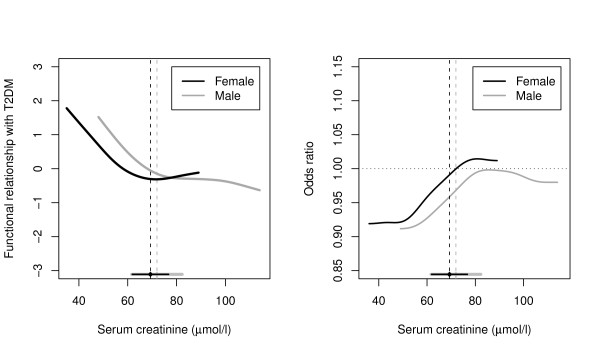
Methods: Cross-sectional study of 1,017 consecutive morbidly obese patients with an estimated glomerular filtration rate >60 ml/min/1.73 m2. Logistic regression (univariate and multiple) was used to assess the association between serum creatinine and prevalent type 2 diabetes, including statistically testing for the possibility of non-linearity in the relationship by implementation of Generalized Additive Models (GAM) and piecewise linear regression. Possible confounding variables such as age, family history of diabetes, waist-to-hip ratio, hypertension, current smoking, serum magnesium, albuminuria and insulin resistance (log HOMA-IR) were adjusted for in three separate multiple logistic regression models.
Results: The unadjusted GAM analysis suggested a piecewise linear relationship between serum creatinine and diabetes. Each 1 mumol/l increase in serum creatinine was associated with 6% (95% CI; 3%-8%) and 7% (95% CI; 2%-13%) lower odds of diabetes below serum creatinine levels of 69 and 72 mumol/l in women and men, respectively. Above these breakpoints the serum creatinine concentrations did not reduce the odds further. Adjustments for non-modifiable and modifiable risk factors left the piecewise effect for both women and men largely unchanged. In the fully adjusted model, which includes serum magnesium, albuminuria and log HOMA-IR, the piecewise effect for men was statistically non-significant, but it remained present for women. Patients with creatinine levels below median had approximately 50% (women) and 75% (men) increased odds of diabetes.
Conclusions: Low serum creatinine is a predictor of type 2 diabetes in Caucasian morbidly obese patients, independent of age, gender, family history of diabetes, anthropometric measures, hypertension, and current smoking. Longitudinal studies of both obese and non-obese populations are needed to investigate whether serum creatinine may be causally linked with type 2 diabetes, and if so, precisely how they are linked.
Figures
References
-
- Haffner SM, Stern MP, Dunn J, Mobley M, Blackwell J, Bergman RN. Diminished insulin sensitivity and increased insulin response in nonobese, nondiabetic Mexican Americans. Metabolism: Clinical and Experimental. 1990;39:842–847. - PubMed
-
- Atlantis E, Martin SA, Haren MT, Taylor AW, Wittert GA. Members of the Florey Adelaide Male Ageing Study. Inverse associations between muscle mass, strength, and the metabolic syndrome. Metabolism: Clinical and Experimental. 2009;58:1013–1022. - PubMed
LinkOut - more resources
Full Text Sources
