. 2010 May 14;86(5):773-82.
doi: 10.1016/j.ajhg.2010.03.010. Epub 2010 Apr 15.

Distinct variants at LIN28B influence growth in height from birth to adulthood

Affiliations

Distinct variants at LIN28B influence growth in height from birth to adulthood

Elisabeth Widén et al. Am J Hum Genet. .

Abstract

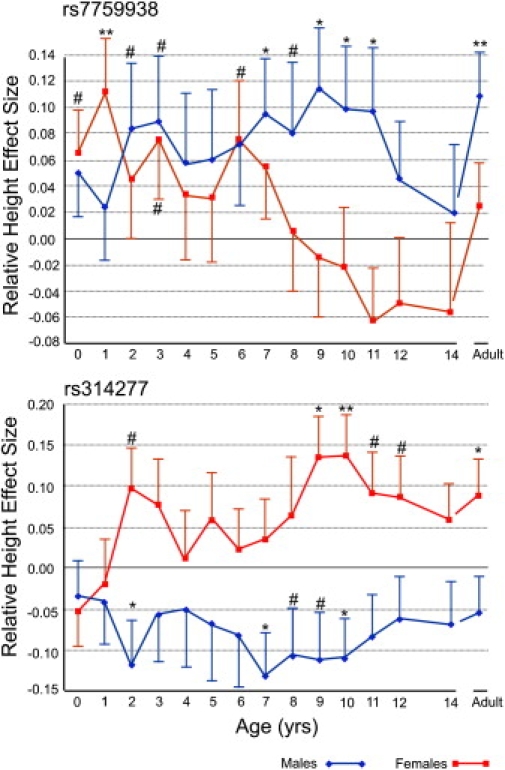
We have studied the largely unknown genetic underpinnings of height growth by using a unique resource of longitudinal childhood height data available in Finnish population cohorts. After applying GWAS mapping of potential genes influencing pubertal height growth followed by further characterization of the genetic effects on complete postnatal growth trajectories, we have identified strong association between variants near LIN28B and pubertal growth (rs7759938; female p = 4.0 x 10(-9), male p = 1.5 x 10(-4), combined p = 5.0 x 10(-11), n = 5038). Analysis of growth during early puberty confirmed an effect on the timing of the growth spurt. Correlated SNPs have previously been implicated as influencing both adult stature and age at menarche, the same alleles associating with taller height and later age of menarche in other studies as with later pubertal growth here. Additionally, a partially correlated LIN28B SNP, rs314277, has been associated previously with final height. Testing both rs7759938 and rs314277 (pairwise r(2) = 0.29) for independent effects on postnatal growth in 8903 subjects indicated that the pubertal timing-associated marker rs7759938 affects prepubertal growth in females (p = 7 x 10(-5)) and final height in males (p = 5 x 10(-4)), whereas rs314277 has sex-specific effects on growth (p for interaction = 0.005) that were distinct from those observed at rs7759938. In conclusion, partially correlated variants at LIN28B tag distinctive, complex, and sex-specific height-growth-regulating effects, influencing the entire period of postnatal growth. These findings imply a critical role for LIN28B in the regulation of human growth.


Figures

Figure 1
Figure 1
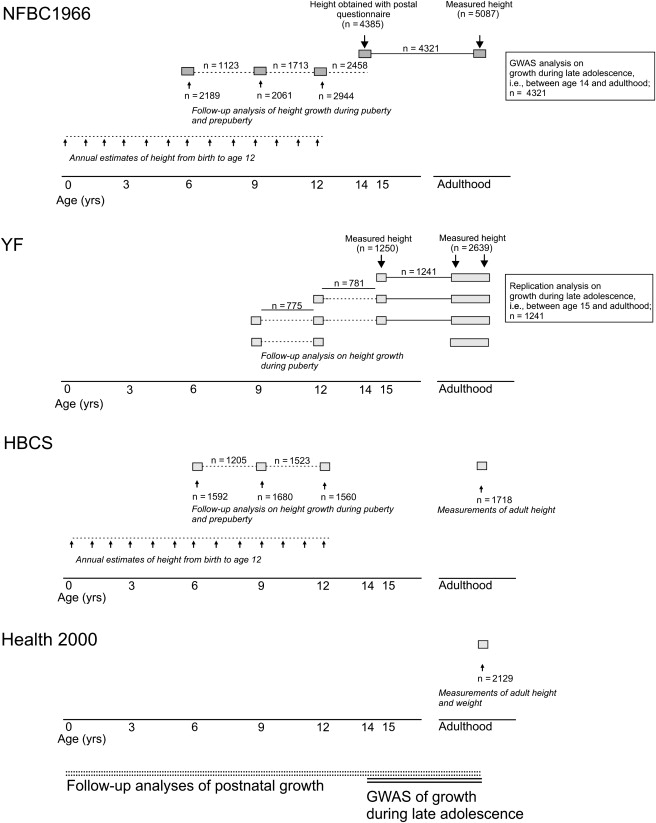
Study Populations and Design Study samples: Northern Finland Birth Cohort 1966 (NFBC1966) is a prospective cohort study conducted in the two northernmost provinces of Finland, Oulu and Lapland, representing 96% of all births in these provinces. The offspring were followed up at 6 mos. and at 1, 14, and 31 yrs of age. Height at 14 yrs was obtained by self-report from questionnaires mailed to the adolescents. At age 31, a representative subsample of the study subjects (cohort members still living in Northern Finland or in the capital area) were invited for clinical examination. At the clinical visit, the participants' (n = 5654) height and weight were assessed, and a blood sample was obtained, from which DNA was extracted. Extended data on height and weight from 1 to 12 yrs were retrospectively obtained from growth records originally collected by the school health care service and thereafter archived at communal health clinics. In case there were two height measurements within ±1 year of a specific birthday, the height at the birthday was extrapolated from the measurements, assuming a linear relationship. For the remaining subjects, the corresponding height was evaluated by specific linear regression only if there was one measurement within ±0.5 yrs of the birthday. Cardiovascular Risk of Young Finns Study (YF) is a prospective cohort study conducted at five university departments of medical schools in Finland (i.e., Turku, Helsinki, Kuopio, Tampere, and Oulu), with the aim of studying the levels of cardiovascular risk factors in children and adolescents in different parts of the country. The baseline study was conducted in 1980, and the study subjects were followed with 3 yr intervals until 1992; more recently in 2001, when blood samples for DNA extraction were drawn (n = 2620); and in 2007. Height and weight were measured at each clinical visit. Adult stature was measured between ages 24 and 42. Helsinki Birth Cohort Study (HBCS) includes 8760 subjects born in Helsinki between 1934 and 1944. Between 2000 and 2002, a representative subset of 928 males and 1075 females participated in a clinical study focusing upon cardiovascular and metabolic outcomes and cognitive function. Height during childhood until age 12 was obtained from child welfare and school health care records, and height at specific birth days was extracted as described by Eriksson et al. Adult stature was measured when the study subjects were between ages 59 and 70. Adult height was available in the Health 2000 study (H2000), which was a health interview/examination survey carried out by the National Institute for Health and Welfare in Finland from fall 2000 to spring 2001, with a nationally representative sample of 10,000 individuals drawn from the Finnish population aged 18 and older. The main topics of the study were health status, major chronic conditions, functional ability and limitations, determinants of health, and use of health care. From a subcohort of 6000 individuals representative of the Finnish population over age 30, roughly 1000 nondiabetic subjects meeting the International Diabetes Federation criteria for metabolic syndrome and a control cohort of 1000 subjects matched for sex, age, and residence were selected for GWAS analyses. The age range was between ages 30 and 75. In the current study, the data for two genotyped markers were used. All cohort studies were approved by their corresponding local ethical committees, and the study subjects gave their informed consent according to the approved protocols. Study design: The primary GWAS analysis on height growth during late adolescence (solid line) was analyzed based on height growth between age 14 and adulthood, and the replication analyses were carried out in YF via a similar estimate of pubertal height growth, i.e., the increase in height between age 15 and adulthood. Growth during early and midadolescence (broken line) was assessed as the increase in height between ages 9 and 12 in YF and HBCS or as the increase in height between ages 12 and 14 in NFBC1966 and between ages 12 and 15 in YF. Further follow-up studies of the entire growth trajectory from birth to age 12 were carried out in NFBC1966 and HBCS.
Figure 2
Figure 2
Linear Regression Analysis of Postnatal Height Evaluating the Independent Effects of rs7759938 and rs314277 The results of linear regression of standardized birth length, standardized height at 1 yr intervals between age 1 and 12, standardized height at age 14, and adult stature in Northern Finland Birth Cohort 1966 and Helsinki Birth Cohort Study at marker locus rs7759938 are shown in the upper panel and at rs314277 are shown in the lower panel. The sex-specific effect sizes and standard errors were calculated, including both rs7759938 and rs314277 in the regression model. For clarity, only one-sided standard errors are shown. The nominal p values of the sex specific effects are indicated in the figure as follows: #p < 0.1–0.05, p < 0.05–0.01, ∗∗p < 0.01. The effect alleles are G and A at rs7759938 and rs314277, respectively. n at ages 0, 1, 2, 3, 4, 5, 6, 7, 8, 9, 10, 11, 12, and 14 and at adulthood equals 2315, 2199, 1925, 1590, 1356, 1335, 1702, 2254, 1855, 1744, 1767, 2153, 2127, 2042, and 3136 in males and 2638, 2537, 2176, 1852, 1630, 1577, 2010, 2 514, 2054, 1935, 2001, 2417, 2292, 2208, and 3555 in females. Height data was available for both cohorts up until age 12 and as an adult. Height at age 14 was available only in NFBC1966. Birth length in both cohorts has been adjusted for gestational age.

References

    1. Okasha M., Gunnell D., Holly J., Davey Smith G. Childhood growth and adult cancer. Best Pract. Res. Clin. Endocrinol. Metab. 2002;16:225–241. - PubMed
    1. Weedon M.N., Frayling T.M. Reaching new heights: Insights into the genetics of human stature. Trends Genet. 2008;24:595–603. - PubMed
    1. Silventoinen K., Pietiläinen K.H., Tynelius P., Sørensen T.I., Kaprio J., Rasmussen F. Genetic regulation of growth from birth to 18 years of age: The Swedish young male twins study. Am. J. Hum. Biol. 2008;20:292–298. - PubMed
    1. Kaprio J., Rimpelä A., Winter T., Viken R.J., Rimpelä M., Rose R.J. Common genetic influences on BMI and age at menarche. Hum. Biol. 1995;67:739–753. - PubMed
    1. Lettre G. Genetic regulation of adult stature. Curr. Opin. Pediatr. 2009;21:515–522. - PubMed

Publication types

LinkOut - more resources