


Review
doi: 10.1016/j.tins.2010.03.004.
Epub 2010 Apr 14.
Roles of trinucleotide-repeat RNA in neurological disease and degeneration
Affiliations
- PMID: 20398949
- PMCID: PMC5720136
- DOI: 10.1016/j.tins.2010.03.004
Item in Clipboard
Review
Roles of trinucleotide-repeat RNA in neurological disease and degeneration
Trends Neurosci.
2010 Jun.
Abstract
A large number of human diseases are caused by expansion of repeat sequences - typically trinucleotide repeats - within the respective disease genes. The abnormally expanded sequence can lead to a variety of effects on the gene: sometimes the gene is silenced, but in many cases the expanded repeat sequences confer toxicity to the mRNA and, in the case of polyglutamine diseases, to the encoded protein. This article highlights mechanisms by which the mRNAs with abnormally expanded repeats can confer toxicity leading to neuronal dysfunction and loss. Greater understanding of these mechanisms will provide the foundation for therapeutic advances for this set of human disorders.
Figures
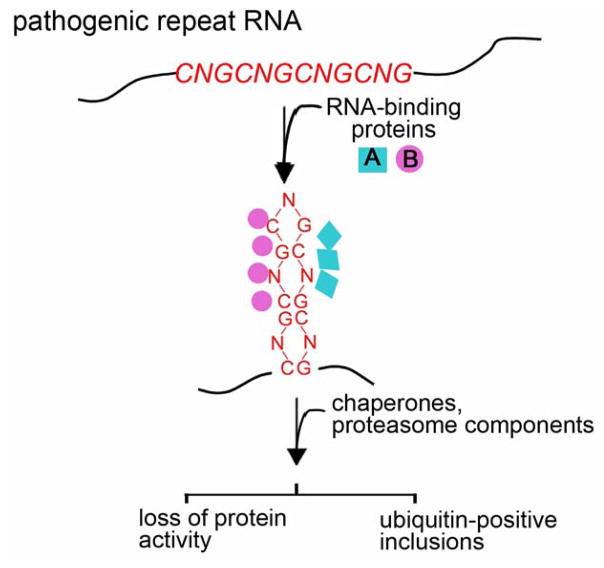
Dominant effects of a pathogenic repeat RNA on protein functions. Expansion of a trinucleotide repeat within an RNA can cause aberrant RNA-protein interactions. This could sequester proteins such as MBNL1 and Pur α (represented by proteins A and B in the figure), leading to their depletion and loss of their normal functions. This binding could also lead to abnormal RNA-protein complexes, which form inclusions and may affect protein quality control pathways, for example, inducing localization of chaperone and proteasome components.
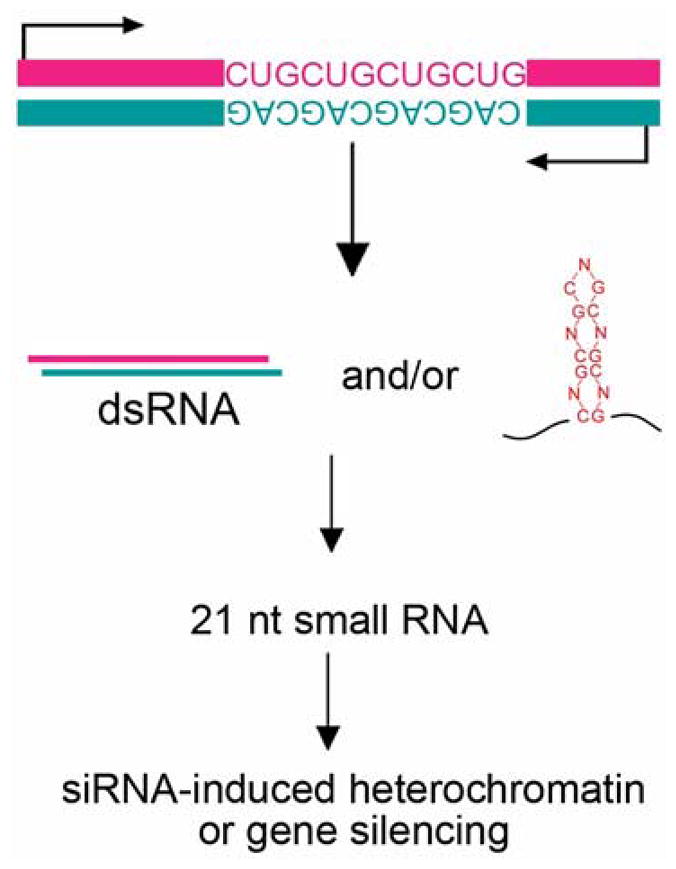
Expanded trinucleotide repeat RNA could induce dominant effects through the generation of small RNAs. In disease loci where anti-sense RNA that contains the repeats is generated, interactions between sense and anti-sense transcripts could form dsRNA and be a substrate recognized by the RNAi pathway and processed by into small RNAs. Alternatively, some studies suggest that the expanded repeat RNA hairpin itself can be processed into small RNAs. Small RNAs generated may target the expression of other genes with sequence homology and cause silencing [34], or have other deleterious effects, such as chromatin silencing [30].
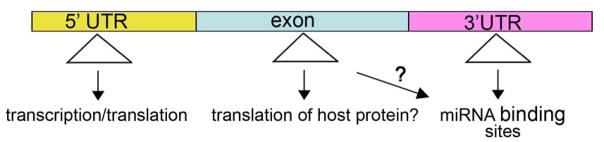
The expanded repeat may regulate the expression of the host gene. Expansions within the 5′ UTR may affect transcription, translation, and stability of the mRNA. Expansions within the open reading frame not only affect function of the protein, but may also affect the translation of the protein. Repeat expansions within the 3′UTR may affect the expression of a gene, RNA stability, translation or regulation, such as affecting protein translation through miRNA binding sites, or causing frameshifting.
References
-
- Orr HT, Zoghbi HY. Trinucleotide repeat disorders. Annu Rev Neurosci. 2007;30:575–621. - PubMed
-
- Ranum LP, Cooper TA. RNA-mediated neuromuscular disorders. Annu Rev Neurosci. 2006;29:259–277. - PubMed
-
- Wheeler TM, Thornton CA. Myotonic dystrophy: RNA-mediated muscle disease. Curr Opin Neurol. 2007;20:572–576. - PubMed
-
- Savkur RS, et al. Aberrant regulation of insulin receptor alternative splicing is associated with insulin resistance in myotonic dystrophy. Nat Genet. 2001;29:40–47. - PubMed
Publication types
MeSH terms
Substances
Grants and funding
LinkOut - more resources
Full Text Sources
Medical
Molecular Biology Databases
