


The glial cell modulator and phosphodiesterase inhibitor, AV411 (ibudilast), attenuates prime- and stress-induced methamphetamine relapse
- PMID: 20399770
- PMCID: PMC2878837
- DOI: 10.1016/j.ejphar.2010.04.010
The glial cell modulator and phosphodiesterase inhibitor, AV411 (ibudilast), attenuates prime- and stress-induced methamphetamine relapse
Abstract
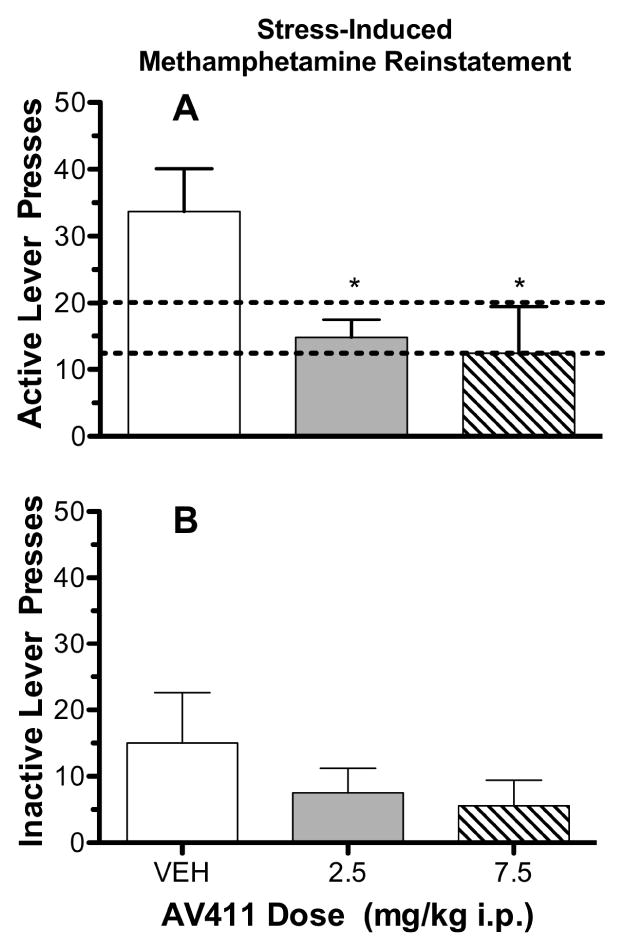
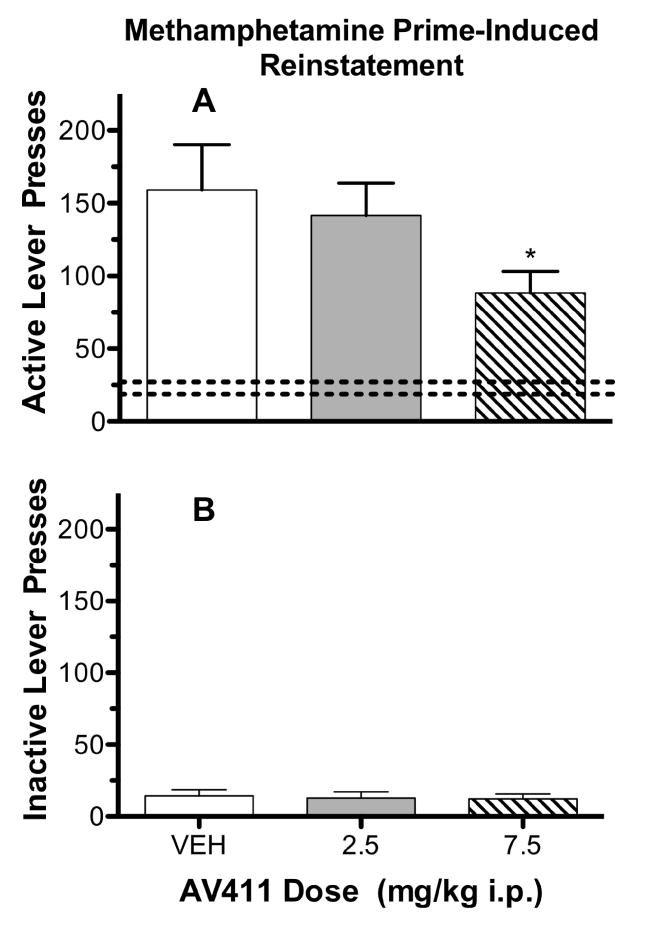
Stress and renewed contact with drug (a "slip") have been linked to persisting relapse of methamphetamine abuse. Human brain microglial activation has been linked with methamphetamine abuse, and inhibitors of glial cell activation, certain phosphodiesterase (PDE) inhibitors, and glial cell derived neurotrophic factor (GDNF) have been reported to modulate drug abuse effects. Our objective was to determine whether the glial cell attenuator, 3-isobutyryl-2-isopropylpyrazolo-[1,5-a]pyridine (AV411, ibudilast), a non-selective PDE inhibitor and promoter of GDNF, could reduce stress- and methamphetamine prime-induced reinstatement of methamphetamine-seeking behavior. Male Long-Evans hooded rats were trained to lever press reinforced with 0.1 mg/kg i.v. methamphetamine infusion according to fixed-ratio 1 (FR1) reinforcement schedules during daily, 2-hour experimental sessions. After performance had stabilized, lever pressing was extinguished for 12 consecutive sessions and doses of 0 (vehicle), 2.5 and 7.5 mg/kg AV411 were then administered intraperitoneally b.i.d. on the last 2 days of extinction and then once on the testday to separate groups of 12 rats. During testing, the rats were given 15 min of intermittent footshock or a 1 mg/kg i.p. methamphetamine prime followed by a 2-hour reinstatement test session. AV411 significantly reduced response levels of footshock-induced (2.5 and 7.5 mg/kg) and prime-induced (7.5 mg/kg) reinstatement of extinguished methamphetamine-maintained responding. AV411 has properties consistent with the ability to attenuate relapse precipitated by stress and methamphetamine "slips" during abstinence. These results thus reinforce interest in atypical neurobiological mechanisms which could be exploited for developing novel medications for treating drug abuse disorders.
Copyright 2010 Elsevier B.V. All rights reserved.
Figures
References
-
- Anggadiredja K, Nakamichi M, Hiranita T, Tanaka H, Shoyama Y, Watanabe S, Yamamoto T. Endocannabinoid system modulates relapse to methamphetamine seeking: possible mediation by the arachidonic acid cascade. Neuropsychopharmacology. 2004;29:1470–1478. - PubMed
-
- Anonymous. GlobeNewswire. GlobeNewswire, Inc.; Los Angeles, CA: 2009. Avigen announces positive data for AV411 in pain relief and drug addiction.
-
- Benz B, Grima G, Do KQ. Glutamate-induced homocysteic acid release from astrocytes: possible implication in glia-neuron signaling. Neuroscience. 2004;124:377–386. - PubMed
-
- Bezzi P, Carmignoto G, Pasti L, Vesce S, Rossi D, Rizzini BL, Pozzan T, Volterra A. Prostaglandins stimulate calcium-dependent glutamate release in astrocytes. Nature. 1998;391:281–285. - PubMed
-
- Boger HA, Middaugh LD, Patrick KS, Ramamoorthy S, Denehy ED, Zhu H, Pacchioni AM, Granholm AC, McGinty JF. Long-term consequences of methamphetamine exposure in young adults are exacerbated in glial cell line-derived neurotrophic factor heterozygous mice. J Neurosci. 2007;27:8816–8825. - PMC - PubMed
Publication types
MeSH terms
Substances
Grants and funding
LinkOut - more resources
Full Text Sources
Medical
