


Phospholipase D in brain function and Alzheimer's disease
- PMID: 20399893
- PMCID: PMC3328196
- DOI: 10.1016/j.bbalip.2010.04.004
Phospholipase D in brain function and Alzheimer's disease
Abstract
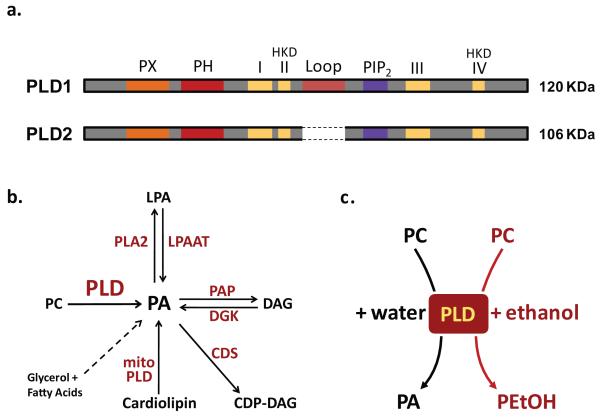
Alzheimer's disease is the most common neurodegenerative disorder. Although lipids are major constituents of brain, their role in Alzheimer's disease pathogenesis is poorly understood. Much attention has been given to cholesterol, but growing evidence suggests that other lipids, such as phospholipids, might play an important role in this disorder. In this review, we will summarize the evidence linking phospholipase D, a phosphatidic acid-synthesizing enzyme, to multiple aspects of normal brain function and to Alzheimer's disease. The role of phospholipase D in signaling mechanisms downstream of beta-amyloid as well as in the trafficking and processing of amyloid precursor protein will be emphasized.
Copyright 2010 Elsevier B.V. All rights reserved.
Figures
References
-
- Haass C, Selkoe DJ. Soluble protein oligomers in neurodegeneration: lessons from the Alzheimer’s amyloid beta-peptide. Nat Rev Mol Cell Biol. 2007;8:101–112. - PubMed
-
- Tanzi RE, Bertram L. Twenty years of the Alzheimer’s disease amyloid hypothesis: a genetic perspective. Cell. 2005;120:545–555. - PubMed
-
- Querfurth HW, LaFerla FM. Alzheimer’s disease. N Engl J Med. 2010;362:329–344. - PubMed
-
- Landman N, Kim TW. Got RIP? Presenilin-dependent intramembrane proteolysis in growth factor receptor signaling. Cytokine Growth Factor Rev. 2004;15:337–351. - PubMed
Publication types
MeSH terms
Substances
Grants and funding
LinkOut - more resources
Full Text Sources
Medical
