. 2009 Sep;4(3):180-190.
doi: 10.1007/s11483-009-9116-9. Epub 2009 Jun 23.

Modes of Disintegration of Solid Foods in Simulated Gastric Environment

Modes of Disintegration of Solid Foods in Simulated Gastric Environment

Fanbin Kong et al. Food Biophys. 2009 Sep.

Abstract

A model stomach system was used to investigate disintegration of various foods in simulated gastric environment. Food disintegration modes and typical disintegration profiles are summarized in this paper. Mechanisms contributing to the disintegration kinetics of different foods were investigated as related to acidity, temperature, and enzymatic effect on the texture and changes in microstructure. Food disintegration was dominated by either fragmentation or erosion, depending on the physical forces acting on food and the cohesive force within the food matrix. The internal cohesive forces changed during digestion as a result of water penetration and acidic and enzymatic hydrolysis. When erosion was dominant, the disintegration data (weight retention vs. disintegration time) may be expressed with exponential, sigmoidal, and delayed-sigmoidal profiles. The different profiles are the result of competition among the rates of water absorption, texture softening, and erosion. A linear-exponential equation was used to describe the different disintegration curves with good fit. Acidity and temperature of gastric juice showed a synergistic effect on carrot softening, while pepsin was the key factor in disintegrating high-protein foods. A study of the change of carrot microstructure during digestion indicated that degradation of the pectin and cell wall was responsible for texture softening that contributed to the sigmoidal profile of carrot disintegration.


Figures
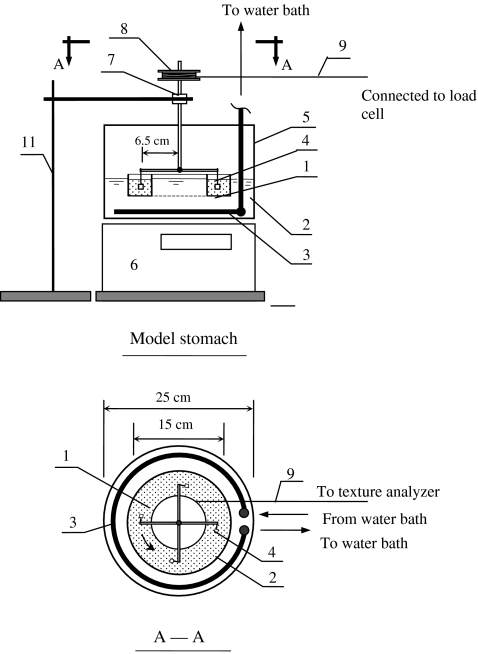
Fig. 1
Fig. 1
Diagram of modified model stomach system and force measurement apparatus: 1 simulated gastric juice (37 °C) and beads; 2 jacket filled with water; 3 copper coil; 4 food sample; 5 chamber; 6 turntable; 7 ball bearing; 8 wheel; 9 cotton wire; 10 pulley; 11 laboratory stand
Fig. 2
Fig. 2
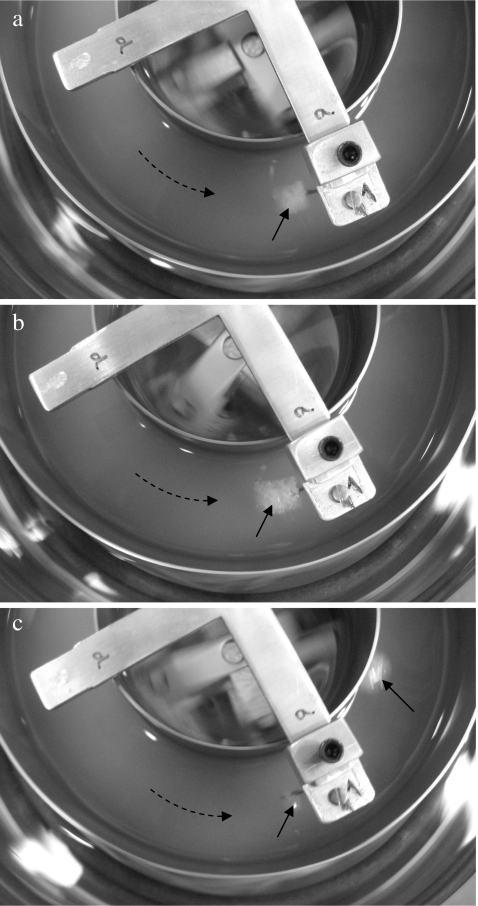
Disintegration of bread crouton in the model stomach system: a erosion was the dominant mechanism in the beginning; b swelling of the sample; c rupture of the bread crouton after half hour of running. Dashed arrow: fluid rotational direction; continuous arrow: sample
Fig. 3
Fig. 3
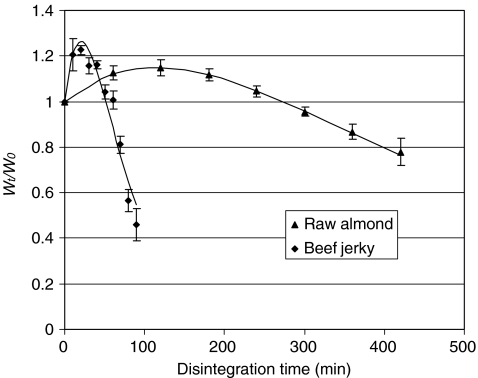
Typical delayed-sigmoidal disintegration curves (n = 4). Trial condition, 500 mL of simulated gastric content (gastric juice 176 mL, beads 324 g); turntable rotation speed, 30 rpm
Fig. 4
Fig. 4
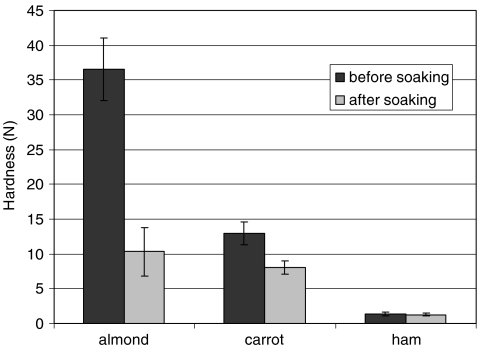
Comparison of hardness changes in almond, carrot, and ham during static soaking test (n = 8)
Fig. 5
Fig. 5
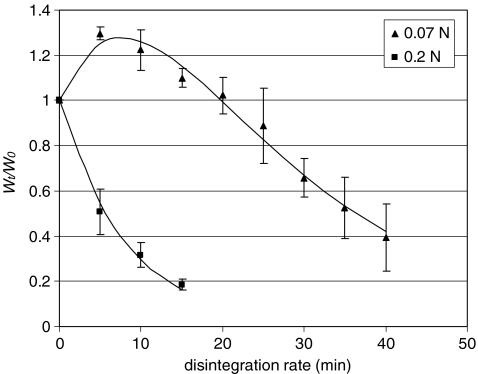
Changes in the disintegration profile of fried dough under different forces applied in the model stomach system (n = 4)
Fig. 6
Fig. 6
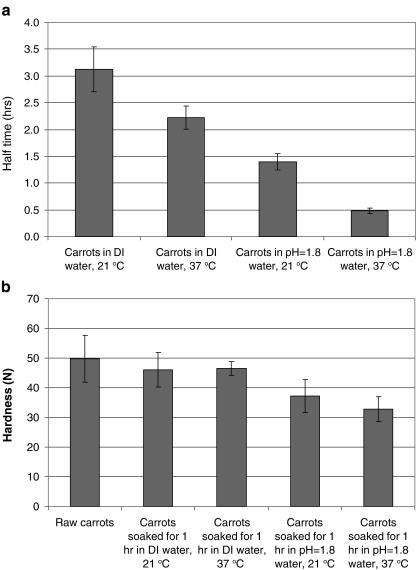
Changes in the disintegration rates (a) and hardness (b) of carrots in different liquid media (n = 8)
Fig. 7
Fig. 7
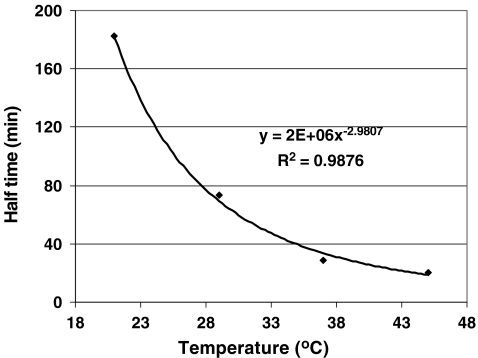
Disintegration rates of carrot (expressed as half time) at different temperatures
Fig. 8
Fig. 8
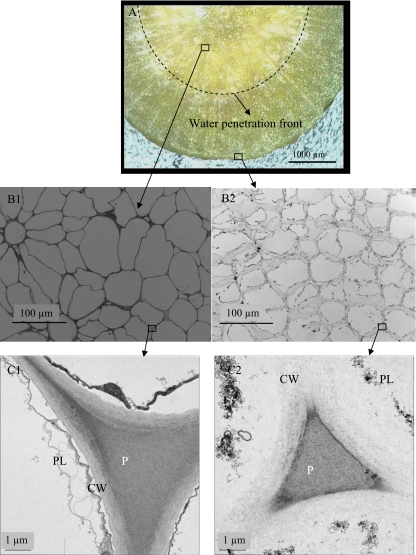
Changes in the microstructure of digested carrots. A Image showing cross-section of partially digested cylindrical carrot sample (diam 3 mm) and the front of water penetration indicated by dashed line (colored by methylene blue); B1, B2 Light microscopy images showing the undigested central region and the severely digested edge region; C1, C2 TEM images showing intact cell wall in the central region (C1) and damaged cell wall and dissolved pectin in the edge region (C2). CW cell wall, PL plasmalemma, P pectin

References

    1. Urbain JL, Siegel JA, Charkes ND, Maurer AH, Malmud LS, Fisher RS. The two-component stomach: effects of meal particle size on fundal and antral emptying. Eur J Nucl Med. 1989;15:254–259. doi: 10.1007/BF00257543. - DOI - PubMed
    1. Marciani L, Gowland PA, Fillery-Travis A, Manoj P, Wright J, Smith A, Young P, Moore RJ, Spiller RC. Assessment of antral grinding of a model solid meal with echo-planar imaging. Am J Physiol. 2001;280:G844–G849. - PubMed
    1. Pal A, Abrahamsson B, Schwizer W, Hebbard GS, Brasseur JG. Application of a virtual stomach to evaluate gastric mixing and breakdown of solid food. Gastroenterol. 2003;124:A673–A674. doi: 10.1016/S0016-5085(03)83412-1. - DOI
    1. Kong F, Singh RP. A model stomach system to investigate disintegration kinetics of solid foods during gastric digestion. J Food Sci. 2008;73(5):E202–E210. doi: 10.1111/j.1750-3841.2008.00745.x. - DOI - PubMed
    1. Charman WN, Porter CJ, Mithani S, Dressman JB. Physiochemical and physiological mechanisms for the effects of food on drug absorption: the role of lipids and pH. J Pharm Sci. 2000;86(3):269–282. doi: 10.1021/js960085v. - DOI - PubMed