


Characterization of the dopamine receptor system in adult rhesus monkeys exposed to cocaine throughout gestation
- PMID: 20401746
- PMCID: PMC2878372
- DOI: 10.1007/s00213-010-1847-2
Characterization of the dopamine receptor system in adult rhesus monkeys exposed to cocaine throughout gestation
Abstract
Rationale: Cocaine use during pregnancy is associated with alterations in the dopamine (DA) system in the fetal brain. However, little is known about the effects of prenatal cocaine exposure on the postnatal dopaminergic system.
Objectives: The objective of the study was to examine DA receptor function in adult monkeys that were prenatally exposed to cocaine.
Materials and methods: Male and female rhesus monkeys (approximately 13 years old) that had been prenatally exposed to cocaine (n = 10) and controls (n = 10) were used in all studies. First, DA D2-like receptor availability was assessed using positron emission tomography and the D2-like receptor radiotracer [(18)F]fluoroclebopride (FCP). Next, D(3) receptor function was assessed by measuring quinpirole-induced yawning (0.03-0.3 mg/kg). Finally, D1-like receptor function was examined by measuring eye blinking elicited by the high-efficacy D1-like receptor agonist SKF81297 (0.3-3.0 mg/kg).
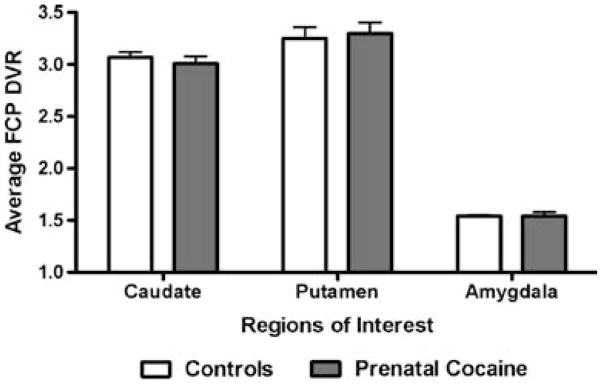
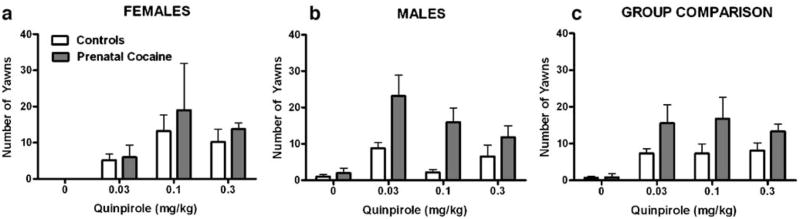
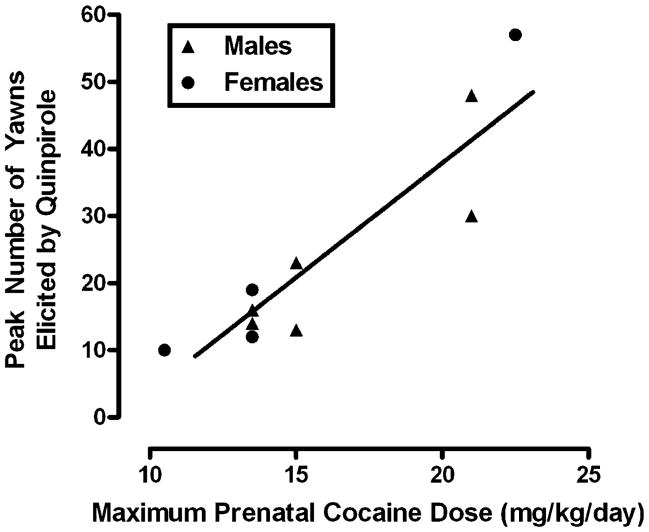
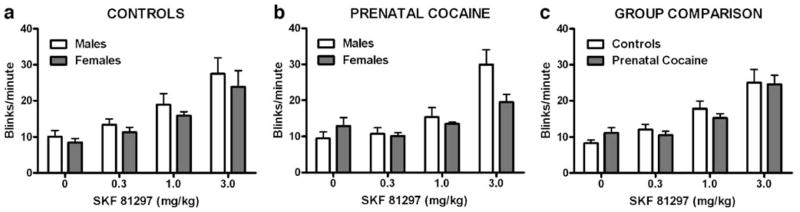
Results: There were no differences between groups or sexes in D2-like receptor availability in the caudate nucleus, putamen or amygdala. However, quinpirole elicited significantly more yawns in prenatally cocaine-exposed monkeys compared with control monkeys. A significant correlation between gestational dose of cocaine and peak effects of quinpirole was observed. In all monkeys, administration of SKF81297 elicited dose-dependent increases in eye blinks that did not differ between groups.
Conclusions: These findings suggest that prenatal cocaine exposure can have long-term effects on DA D(3) receptor function in adults.
Figures
References
-
- Bettinardi V, Pagani E, Gilardi MC, et al. An automatic classification technique for attenuation correction in positron emission tomography. Eur J Nucl Med. 1999;26:447–458. - PubMed
-
- Bhide PG. Dopamine, cocaine, and the development of cerebral cortical cytoarchitecture: a review of current concepts. Semin Cell Dev Biol. 2009;20:395–402. - PubMed
-
- Boulay D, Depoortere R, Perrault G, Borrelli E, Sanger DJ. Dopamine D2 receptor knock-out mice are insensitive to the hypolocomotor and hypothermic effects of dopamine D2/D3 receptor agonists. Neuropharmacology. 1999a;38:1389–1396. - PubMed
-
- Boulay D, Depoortere R, Rostene W, Perrault G, Sanger DJ. Dopamine D3 receptor agonists produce similar decreases in body temperature and locomotor activity in D3 knock-out and wild-type mice. Neuropharmacology. 1999b;38:555–565. - PubMed
Publication types
MeSH terms
Substances
Grants and funding
LinkOut - more resources
Full Text Sources
