


Are shorter article titles more attractive for citations? Cross-sectional study of 22 scientific journals
- PMID: 20401960
- PMCID: PMC2859422
- DOI: 10.3325/cmj.2010.51.165
Are shorter article titles more attractive for citations? Cross-sectional study of 22 scientific journals
Abstract
Aim: To investigate the correlation between the length of the title of a scientific article and the number of citations it receives, in view of the common editorial call for shorter titles.
Methods: Title and the number of citations to all articles published in 2005 in 22 arbitrarily chosen English-language journals (n=9031) were retrieved from citation database Scopus. The 2008 journal impact factors of these 22 journals were also retrieved from Thomson Reuters' Journal Citation Report (JCR). Assuming the article title length as the independent variable, and the number of citations to the article as the dependent variable, a linear regression model was applied.
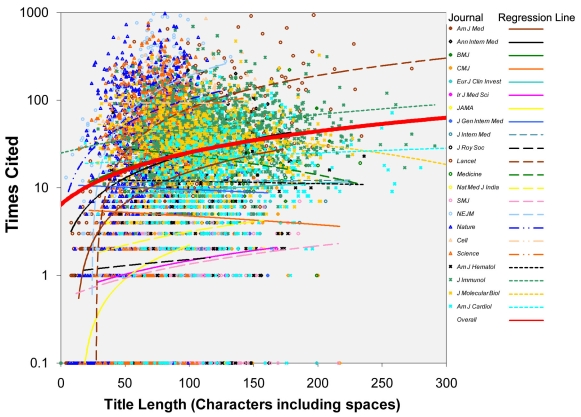
Results: The slope of the regression line for some journals (n=6, when titles were measured in characters but 7 when titles were measured in words) was negative - none was significantly different from 0. The overall slope for all journals was 0.140 (when titles were measured in characters) and 0.778 (when titles were measured in words), which is significantly different from 0 (P<0.001 , t test). Overall, articles with longer titles received more citations - Spearman rho=0.266 - when titles were measured in characters, and rho=0.244 when titles were measured in words (P<0.001). This association was found for 7 of 8 journals with impact factor >10 and for 2 out of 14 journals with impact factor <10 (P<0.001, Fisher exact test).
Conclusion: Longer titles seem to be associated with higher citation rates. This association is more pronounced for journals with high impact factors. Editors who insist on brief and concise titles should perhaps update the guidelines for authors of their journals and have more flexibility regarding the length of the title.
Figures
References
-
- Soler V. Writing titles in science: an exploratory study. Engl Specif Purposes. 2007;26:90–102. doi: 10.1016/j.esp.2006.08.001. - DOI
-
- Moss F. Titles, abstracts, and authors. In: Hall GM, editor. How to write a paper. 3rd ed. London: BMJ Publishing Group; 2003. p. 42-50.
-
- Finishing your paper. In: Peat J, Elliott E, Baur L, Keena V, editors. Scientific writing: Easy when you know how. London: BMJ Publishing Group; 2002. p. 93-119.
-
- Annals of Internal Medicine. Information for authors. Available from: http://www.annals.org/site/misc/ifora.xhtml Accessed: April 1, 2010.
-
- Journal of the German Society of Dermatology. Author guidelines. Available from: http://www.vet-report.de/journale/ddg/authors.htm Accessed: April 1, 2010.
MeSH terms
LinkOut - more resources
Full Text Sources
Miscellaneous
