


Prenatal exposure to methylmercury and PCBs affects distinct stages of information processing: an event-related potential study with Inuit children
- PMID: 20403381
- PMCID: PMC4852376
- DOI: 10.1016/j.neuro.2010.04.005
Prenatal exposure to methylmercury and PCBs affects distinct stages of information processing: an event-related potential study with Inuit children
Abstract
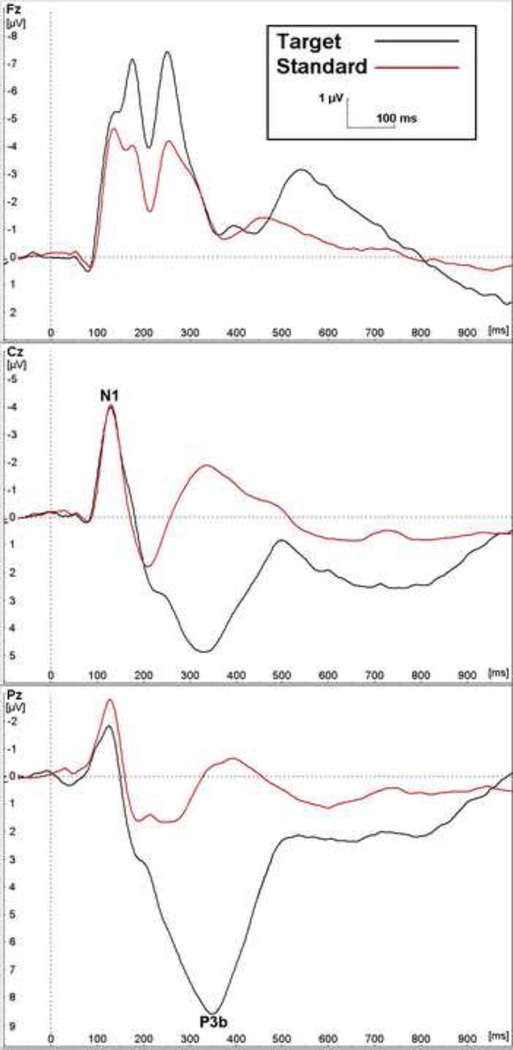
Methylmercury (MeHg) and polychlorinated biphenyls (PCBs) are seafood contaminants known for their adverse effects on neurodevelopment. This study examines the relation of developmental exposure to these contaminants to information processing assessed with event-related potentials (ERPs) in school-aged Inuit children from Nunavik (Arctic Québec). In a prospective longitudinal study on child development, exposure to contaminants was measured at birth and 11 years of age. An auditory oddball protocol was administered at 11 years to measure ERP components N1 and P3b. Multiple regression analyses were performed to examine the associations of levels of the contaminants to auditory oddball performance (mean reaction time, omission errors and false alarms) and ERP parameters (latency and amplitude) after control for potential confounding variables. A total of 118 children provided useable ERP data. Prenatal MeHg exposure was associated with slower reaction times and fewer false alarms during the oddball task. Analyses of the ERP parameters revealed that prenatal MeHg exposure was related to greater amplitude and delayed latency of the N1 wave in the target condition but not to the P3b component. MeHg effects on the N1 were stronger after control for seafood nutrients. Prenatal PCB exposure was not related to any endpoint for sample as a whole but was associated with a decrease in P3b amplitude in the subgroup of children who had been breast-fed for less than 3 months. Body burdens of MeHg and PCBs at 11 years were not related to any of the behavioural or ERP measures. These data suggest that prenatal MeHg exposure alters attentional mechanisms modulating early processing of sensory information. By contrast, prenatal PCB exposure appears to affect information processing at later stages, when the information is being consciously evaluated. These effects seem to be mitigated in children who are breast-fed for a more extended period.
(c) 2010 Elsevier Inc. All rights reserved.
Conflict of interest statement
Conflict of interest statement
The authors declare that there are no conflicts of interest.
Figures
References
-
- Grandjean P, Landrigan PJ. Developmental neurotoxicity of industrial chemicals. Lancet. 2006;368:2167–2178. - PubMed
-
- Tsubaki T, Irukayama K. Minamata disease: methylmercury poisoning in Minamata and Niigata. New York: Japan, Elsevier; 1977.
-
- Eto K. Minamata disease. Neuropathology. 2000;20:S14–S19. - PubMed
-
- Bakir F, Damluji SF, Amin-Zaki L, Murtadha M, Khalidi A, Al-Rawi NY, et al. Methylmercury poisoning in Iraq. Science. 1973;181:230–241. - PubMed
-
- Choi BH. The effects of methylmercury on the developing brain. Prog. Neurobiol. 1989;32:447–470. - PubMed
Publication types
MeSH terms
Substances
Grants and funding
LinkOut - more resources
Full Text Sources
