


MLCK-dependent exchange and actin binding region-dependent anchoring of ZO-1 regulate tight junction barrier function
- PMID: 20404178
- PMCID: PMC2889526
- DOI: 10.1073/pnas.0908869107
MLCK-dependent exchange and actin binding region-dependent anchoring of ZO-1 regulate tight junction barrier function
Abstract
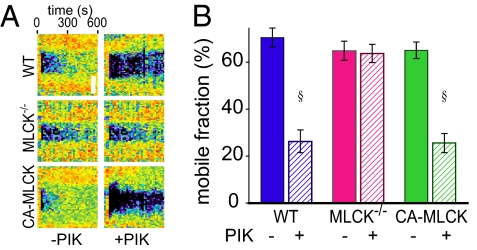
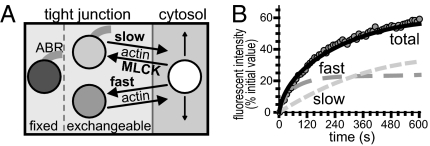
The perijunctional actomyosin ring contributes to myosin light chain kinase (MLCK)-dependent tight junction regulation. However, the specific protein interactions involved in this process are unknown. To test the hypothesis that molecular remodeling contributes to barrier regulation, tight junction protein dynamic behavior was assessed by fluorescence recovery after photobleaching (FRAP). MLCK inhibition increased barrier function and stabilized ZO-1 at the tight junction but did not affect claudin-1, occludin, or actin exchange in vitro. Pharmacologic MLCK inhibition also blocked in vivo ZO-1 exchange in wild-type, but not long MLCK(-/-), mice. Conversely, ZO-1 exchange was accelerated in transgenic mice expressing constitutively active MLCK. In vitro, ZO-1 lacking the actin binding region (ABR) was not stabilized by MLCK inhibition, either in the presence or absence of endogenous ZO-1. Moreover, the free ABR interfered with full-length ZO-1 exchange and reduced basal barrier function. The free ABR also prevented increases in barrier function following MLCK inhibition in a manner that required endogenous ZO-1 expression. In silico modeling of the FRAP data suggests that tight junction-associated ZO-1 exists in three pools, two of which exchange with cytosolic ZO-1. Transport of the ABR-anchored exchangeable pool is regulated by MLCK. These data demonstrate a critical role for the ZO-1 ABR in barrier function and suggest that MLCK-dependent ZO-1 exchange is essential to this mechanism of barrier regulation.
Conflict of interest statement
The authors declare no conflict of interest.
Figures



References
-
- Madara JL, Pappenheimer JR. Structural basis for physiological regulation of paracellular pathways in intestinal epithelia. J Membr Biol. 1987;100:149–164. - PubMed
Publication types
MeSH terms
Substances
Grants and funding
- P01 DK067887/DK/NIDDK NIH HHS/United States
- P30CA14599/CA/NCI NIH HHS/United States
- UL1 RR024999/RR/NCRR NIH HHS/United States
- P30 CA014599/CA/NCI NIH HHS/United States
- P41RR013186/RR/NCRR NIH HHS/United States
- T32 HL007237/HL/NHLBI NIH HHS/United States
- R01 DK061931/DK/NIDDK NIH HHS/United States
- P41 RR013186/RR/NCRR NIH HHS/United States
- R01 DK068271/DK/NIDDK NIH HHS/United States
- F32 DK082134/DK/NIDDK NIH HHS/United States
- R01DK61931/DK/NIDDK NIH HHS/United States
- UL1RR024999/RR/NCRR NIH HHS/United States
- T32HL007237/HL/NHLBI NIH HHS/United States
- F32DK082134/DK/NIDDK NIH HHS/United States
- P01DK67887/DK/NIDDK NIH HHS/United States
- R01DK68271/DK/NIDDK NIH HHS/United States
LinkOut - more resources
Full Text Sources
Other Literature Sources
Molecular Biology Databases
Miscellaneous
